
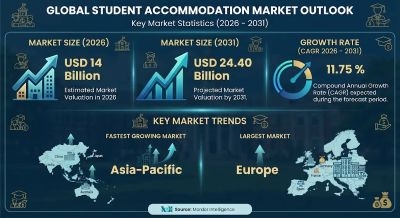
Hyderabad, India, November 19, 2026: According to Mordor Intelligence: the Student Accommodation Market Size is expected to grow from USD 12.40 billion in 2025 to USD 14 billion in 2026 and reach USD 24.40 billion by 2031, registering a CAGR of 11.75% during 2026-2031. The market is gaining momentum as international student mobility increases, purpose-built student accommodation expands, higher education hubs become more urbanized, and students place greater emphasis on safe, secure, and well-managed housing.
The Student Accommodation Industry is being shaped by persistent shortages of purpose-built beds in major university cities, rising cross-border enrollment, increasing institutional investment, and demand for professionally managed accommodation. Construction cost pressure, labor shortages, regulatory complexity, and longer planning timelines are limiting new supply in several markets, supporting occupancy and pricing for existing assets. Europe remained the largest regional market, while Asia-Pacific is expected to be the fastest-growing region during the forecast period.
Student Accommodation Market Growth Drivers
Rising international student mobility increases accommodation demand
International student mobility remains a major demand driver for the student accommodation market across leading education destinations. Students continue to seek universities in countries with established academic ecosystems, accessible visa pathways, strong institutional reputations, and reliable accommodation options.
Although visa policy changes in some destinations are creating short-term uncertainty, demand is increasingly shifting between countries rather than disappearing. Destination markets with limited student housing supply can therefore benefit as international students redirect their study plans.
Operators located near highly ranked universities are well positioned to capture this demand because international students often prioritize housing certainty, safety, accessibility, and professionally managed accommodation when selecting a residence. This is supporting demand for purpose-built student accommodation in major education hubs.
Purpose-built student accommodation expands market supply and investment
The growth of purpose-built student accommodation is attracting institutional capital because professionally managed properties can provide operational scale, income visibility, and stronger control over the resident experience.
Investment activity across established and emerging student housing markets is supporting the development and acquisition of larger accommodation portfolios. Institutional investors and specialist operators are increasingly targeting underpenetrated university cities where organized supply remains limited.
Purpose-built student accommodation also provides an opportunity to combine accommodation with amenities, security, technology-enabled services, and convenient access to universities. As a result, the student accommodation market is moving toward larger operating platforms and professionally managed properties.
Urbanization of higher education hubs supports student housing demand
The concentration of students in large urban education corridors is increasing demand for student accommodation, particularly where land availability is limited and new construction takes longer.
Universities and other education institutions are increasingly considering acquisitions, conversions, and redevelopment strategies to add housing capacity in dense cities. These approaches can help address shortages without relying entirely on new ground-up developments.
For private operators, this creates opportunities to enter fast-growing education hubs through adaptive reuse and off-campus accommodation. The growing concentration of students around major urban universities is therefore strengthening demand for housing located close to campuses and transport networks.
Preference for safe and secure living supports premium accommodation
Student preferences are increasingly influencing the design and positioning of accommodation properties. Reliable WiFi, private bedrooms, physical security, practical study environments, and professionally managed facilities are among the factors shaping housing decisions.
These requirements are supporting demand for purpose-built student accommodation because professionally operated properties can provide greater consistency than fragmented private rental options. International students and first-year students can place particular value on secure and reliable accommodation when entering a new city.
As operators invest in secure access systems, connectivity, study spaces, and resident services, the student accommodation market is creating opportunities for properties that combine functional quality with affordable pricing.
Expansion of private higher education providers boosts student enrollment
The expansion of private higher education providers is broadening the student base and supporting accommodation demand across a wider range of education markets. Increasing enrollment can create additional demand for housing close to universities, colleges, training centers, and other education facilities.
The growing student population is also creating opportunities beyond traditional university accommodation. Vocational training, professional education, researchers, interns, and other education-linked groups can contribute to demand in markets where conventional university housing supply remains constrained.
Rising demand for value-added amenities enhances premium accommodation uptake
Students are increasingly looking beyond basic accommodation when selecting housing. Amenities, connectivity, security, study facilities, and professionally managed services can influence accommodation decisions, particularly in competitive university cities.
Operators are therefore adding value-added features that can improve resident experience and differentiate properties. These services can support premium positioning while helping accommodation providers respond to changing expectations among domestic and international students.
Access This Report in Japanese: https://www.mordorintelligence.com/ja/industry-reports/student-accommodation-market?utm_source=abnewswire
Student Accommodation Market Segmentation
By room type
The Student Accommodation Market is segmented by room type into entire place / studio, private room, and shared room.
Entire place / studio accommodation provides students with independent living arrangements, while private rooms offer individual bedrooms within professionally managed properties. Shared rooms provide a more affordable accommodation option and are particularly relevant in markets where students face high rental costs.
By type of institution
By type of institution, the market is segmented into K-12, higher education, and others.
Higher education represents the core demand base for student accommodation, supported by university enrollment and international student mobility. K-12 accommodation serves younger students requiring residential arrangements, while the others segment includes additional education-related groups that contribute to accommodation demand.
By type of accommodation
By type of accommodation, the market is segmented into on-campus / university-owned accommodation and off-campus / purpose-built student accommodation (PBSA).
On-campus accommodation provides students with housing located within or directly connected to university facilities. Off-campus / purpose-built student accommodation provides professionally managed housing outside university-owned facilities and can serve students from multiple educational institutions.
By student
By student, the market is segmented into domestic and international students.
Domestic students form an important demand base for accommodation near universities and other educational institutions. International students are increasingly seeking professionally managed housing that provides convenient locations, secure living environments, and predictable rental arrangements.
By region
By geography, the Student Accommodation Market is segmented into North America, Europe, Asia-Pacific, South America, and the Middle East and Africa.
Europe benefits from established higher education systems and strong demand for purpose-built student accommodation across major university cities. Asia-Pacific is supported by rising student enrollment, international student mobility, urbanization, and increasing investment in organized student housing.
North America continues to offer opportunities through large student populations and established student accommodation operators. South America is supported by expanding higher education participation, while the Middle East and Africa present opportunities as organized student housing develops across emerging education markets.
Explore Our Full Library of Hospitality and Tourism Research Reports: https://www.mordorintelligence.com/market-analysis/hospitality-and-tourism?utm_source=abnewswire
Student Accommodation Market Key Players
The Student Accommodation Market includes Greystar Real Estate Partners, Unite Students, Scape, GSA Group, The Social Hub, American Campus Communities, Campus Living Villages, Host Students, Nido Living, Yugo, Aparto Living, iQ Student Accommodation, Vita Group, Urbanest, Chapter Living, Scion Group, AvalonBay Communities, Dwell Student Living, Cardinal Group Management, and Stanza Living.
These companies are focusing on portfolio expansion, purpose-built student accommodation development, university partnerships, acquisitions, professional property management, and value-added resident services. Operators are also targeting underpenetrated university cities where limited organized supply creates opportunities for new developments and portfolio expansion.
Student Accommodation Market Forecast
The Student Accommodation Market Forecast remains positive as international student mobility, higher education enrollment, purpose-built student accommodation investment, urbanization, and demand for safe and professionally managed housing continue to support market expansion.
Persistent shortages of student beds in major university cities are expected to maintain demand for existing accommodation assets. Institutional capital is also moving toward scaled platforms, supporting consolidation, portfolio expansion, and operating efficiency across the industry.
At the same time, high upfront development costs, long payback periods, regulatory and zoning complexity, affordability pressures, and seasonal occupancy patterns remain important challenges. Construction cost inflation and labor shortages can further delay new supply, particularly for smaller developers with limited access to financing.
Operators are responding through off-campus development, adaptive reuse, university partnerships, portfolio acquisitions, professionally managed accommodation, and differentiated room and amenity offerings. These strategies are expected to support the continued expansion of the student accommodation industry through 2031.
For more insights on this market, please visit the Mordor Intelligence page: https://www.mordorintelligence.com/industry-reports/student-accommodation-market?utm_source=abnewswire
About Mordor Intelligence
Mordor Intelligence is a global market intelligence firm, founded in 2014, helping businesses make informed decisions through data-driven insights, industry expertise, and advanced analytics. With 550+ domain experts and on-ground specialists across 180+ countries, the company delivers comprehensive intelligence across aerospace & defense, agriculture, automation, automotive, chemicals & materials, consumer goods & services, electronics, energy & power, financial services, food & beverages, healthcare, hospitality & tourism, information & communications technology, and logistics.
Its offerings include syndicated industry reports, custom research and advisory, and subscription platforms such as Synapse, Data Center Intelligence, and Robotics Intelligence. Mordor Intelligence is ISO 9001:2015 and ISO/IEC 27001:2022 certified, a member of ESOMAR and the Market Research Society of India, and a four-time Great Place to Work® honoree. Learn more at mordorintelligence.com.
For any inquiries or to access the full report:
media@mordorintelligence.com
https://www.mordorintelligence.com
Media Contact
Company Name: Mordor Intelligence
Contact Person: Jignesh Thakkar
Email: Send Email
Phone: +1 617-765-2493
Address:11th Floor, Rajapushpa Summit, Nanakramguda Rd, Financial District, Gachibowli media@mordorintelligence.com
City: Hyderabad
State: Telangana 500008
Country: India
Website: https://www.mordorintelligence.com/