
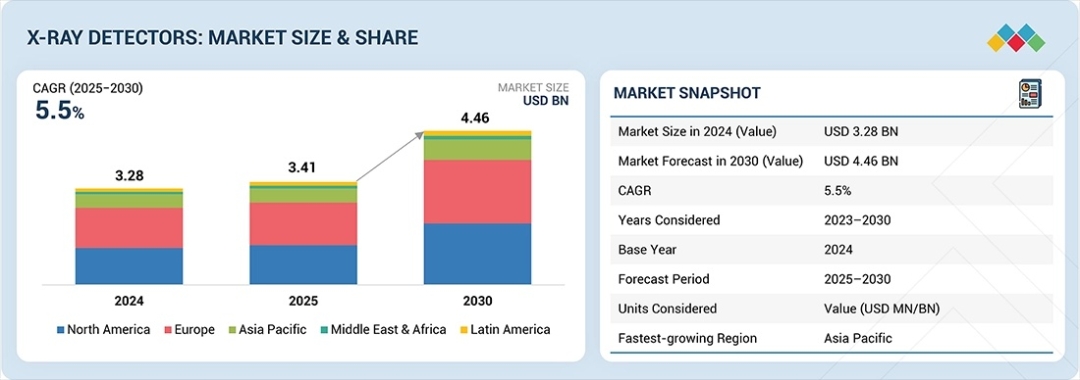
The global X-ray detectors market, valued at USD 3.28 billion in 2024, reached USD 3.41 billion in 2025 and is projected to grow at a steady CAGR of 5.5% from 2025 to 2030, culminating in a market size of USD 4.46 billion by the end of the forecast period. This growth is primarily driven by the increasing adoption of advanced medical imaging technologies across global healthcare systems. X-ray detectors, which convert radiation into digital signals for imaging, play a crucial role in diagnostic procedures such as radiography, fluoroscopy, mammography, and dental imaging. The ongoing transition from computed radiography (CR) to flat-panel detectors (FPDs), coupled with advancements in detector materials and imaging precision, is further fueling demand. Additionally, the rising prevalence of chronic diseases and growing investments in healthcare infrastructure are creating a favorable environment for market expansion across both developed and emerging regions.
Download PDF Brochure-https://www.marketsandmarkets.com/pdfdownloadNew.asp?id=7004984
Growing Disease Burden and Technological Advancements Driving Market Expansion
One of the primary drivers of the X-ray detectors market is the increasing global burden of chronic diseases, including cardiovascular conditions, cancer, and orthopedic disorders, all of which require frequent and accurate diagnostic imaging. Governments and healthcare organizations worldwide are emphasizing early disease detection, leading to higher demand for reliable and efficient imaging solutions. Public health initiatives and screening programs have further amplified the need for advanced imaging technologies, positioning X-ray detectors as a critical component of modern diagnostics.
Technological advancements are also playing a significant role in accelerating market growth. Innovations such as flat-panel detectors offer superior image quality, faster processing times, and reduced radiation exposure compared to traditional systems. Indirect conversion detectors, including amorphous silicon (a-Si) and CMOS-based technologies, are gaining traction due to their high spatial resolution and cost-effectiveness. Manufacturers are increasingly focusing on developing wireless and portable detectors, enabling their use in mobile healthcare settings and emergency care. Furthermore, integration with artificial intelligence (AI) and cloud-based Picture Archiving and Communication Systems (PACS) is enhancing diagnostic accuracy and workflow efficiency, making X-ray detectors more valuable in clinical environments.
Cost Constraints and Workforce Challenges Impact Market Adoption
Despite strong growth prospects, the X-ray detectors market faces several challenges that may hinder widespread adoption. One of the key restraints is the high initial cost associated with flat-panel detector systems. These advanced systems require significant capital investment, which can be prohibitive for small and mid-sized healthcare facilities, particularly in low- and middle-income countries. In addition to acquisition costs, ongoing maintenance expenses and limited reimbursement policies for digital imaging upgrades in certain regions further restrict adoption.
Another critical challenge is the shortage of skilled radiologists and technicians, particularly in developing markets. The effective use of X-ray detectors requires specialized training to ensure optimal image quality and patient safety. A lack of trained professionals can result in diagnostic errors, increased radiation exposure, and inefficiencies in healthcare delivery. Rising vacancy rates for radiologic technologists have further strained healthcare systems, leading to delays in diagnostic procedures and increased patient burden. While initiatives such as training programs and AI-assisted imaging tools are helping to address this gap, the shortage of skilled personnel remains a significant concern for the industry.
Request Sample Pages-https://www.marketsandmarkets.com/requestsampleNew.asp?id=7004984
Emerging Opportunities in Portable Imaging and Regional Growth Dynamics
The growing demand for portable and mobile X-ray systems presents a significant opportunity for market players. These systems are increasingly being used in home healthcare, military applications, and remote diagnostic settings, where accessibility and convenience are critical. Portable detectors with wireless capabilities are enabling healthcare providers to deliver imaging services in non-traditional environments, expanding the reach of diagnostic care.
From a technological perspective, flat-panel detectors dominate the market and represent the fastest-growing segment. Their advantages, including enhanced image quality, lower radiation exposure, and rapid image acquisition, make them the preferred choice across medical applications. Within this segment, indirect conversion detectors are particularly popular due to their balance of performance and cost efficiency. Continuous improvements in durability and design are further supporting their adoption in mobile and high-demand clinical settings.
In terms of application, medical imaging remains the largest segment, driven by widespread use in general radiography, mammography, and dental imaging. General radiography, in particular, accounts for a significant share due to its essential role in routine diagnostics, emergency care, and skeletal and chest examinations. The increasing number of diagnostic centers and ongoing upgrades in hospital imaging infrastructure are further contributing to segment growth.
Regionally, North America continues to dominate the global X-ray detectors market, supported by a well-established healthcare system and early adoption of advanced imaging technologies. The United States leads the region, benefiting from favorable reimbursement policies, high replacement rates of outdated systems, and rapid adoption of AI-enabled imaging solutions. Regulatory initiatives promoting low-dose radiology standards and the strong presence of key market players such as Varex Imaging, Carestream Health, Canon Inc., and Agfa-Gevaert Group further strengthen the region’s position. Meanwhile, Canada is advancing through government-led digital health initiatives and investments in radiology modernization.
Overall, the X-ray detectors market is poised for sustained growth, driven by technological innovation, expanding healthcare access, and increasing demand for accurate and efficient diagnostic imaging solutions. Key players, including Varex Imaging (US), Thales (France), Canon Inc. (Japan), Konica Minolta, Inc. (Japan), and Agfa-Gevaert Group (Belgium), are expected to play a crucial role in shaping the competitive landscape through continuous innovation and strategic collaborations.
Media Contact
Company Name: MarketsandMarkets™ Research Private Ltd.
Contact Person: Mr. Rohan Salgarkar
Email: Send Email
Phone: 18886006441
Address:1615 South Congress Ave. Suite 103, Delray Beach, FL 33445
City: Florida
State: Florida
Country: United States
Website: https://www.marketsandmarkets.com/Market-Reports/x-ray-detectors-market-7004984.html