
In a faster, noisier market, sellers are shifting from trend-chasing to margin-first validation before spending on ads.
The phrase “winning product” has become one of ecommerce’s most overused labels. In 2026, almost anything can look like a winner for 48 hours-until ad costs rise, shipping issues appear, competitors copy the creative, and refunds arrive a week later.
That’s why more dropshippers are redefining what “winning” actually means. A winning product isn’t the one that gets views. It’s the one that can keep profit when reality shows up: fluctuating acquisition costs, fulfillment variability, fee creep, and customer expectations that are higher than they were just a few years ago.
This shift is changing how sellers research products, how they validate demand, and-most importantly-how they decide whether a product deserves a serious budget. Instead of starting with “what’s trending,” many are starting with a stricter question: can this product realistically support a strong gross margin before I spend on ads?
What “Winning” Means in 2026 (A Definition Sellers Can Actually Use)
Ask ten sellers what a “winning product” is and you’ll get ten different answers. But in practice, most successful operators converge on the same three requirements:
1) Demand that’s easy to explain
If a product needs a long pitch to make sense, acquisition costs usually rise. Clear, simple value propositions tend to convert better and require less persuasion.
2) Operational stability
Products that trigger customer support, reships, damage claims, or “not as described” refunds can quietly erase profit. In 2026, shipping clarity and expectation management have become part of the product itself.
3) Profit buffer at the product level (gross margin)
This is the part many sellers still skip. The market moves too fast to scale products with thin margins. A product can sell well and still be a bad business if there’s no cushion for marketing costs and inevitable friction.
As a practical screening benchmark, TrueProfit’s internal analysis suggests that products capable of reaching a gross profit margin of 65–70% (under normal pricing and cost assumptions) tend to be stronger candidates for “winning” status-because they have more room to absorb marketing costs, refunds, and operational variability. 11 The point is not that every product must sit at that exact number; it’s that thin gross margin products are fragile in a competitive environment.
Why “Trending” Still Matters – But Only as a Starting Signal
Trends aren’t useless. They’re just incomplete.
Trend discovery is still one of the fastest ways to generate product candidates, especially for sellers who want to move quickly. The trap is treating a trending item as a strategy instead of an input. Trend exposure brings competition. Competition compresses pricing power. And compressed pricing power puts pressure on gross margin.
A healthier approach is to use trend lists to create a shortlist, then immediately zoom out to the niche and offer:
-
What niche does this product belong to?
-
Who is the buyer and what do they care about?
-
Can I bundle it with adjacent products to increase perceived value?
-
Can I position it in a way that avoids pure commodity pricing?
For sellers who want a quick pool of ideas, one reference point is trending dropshipping products-used as a discovery feed rather than a final answer.
The Practical Workflow Sellers Use to Find Product Candidates
In 2026, the sellers who consistently find “winners” typically follow a repeatable workflow instead of relying on instinct.
They start by generating candidates from trends, marketplaces, and niche communities. Then they filter ruthlessly before investing time into store builds or ad creatives.
Common filters include:
-
Pricing power: Can you price it high enough without customers feeling it’s overpriced?
-
Shipping and fulfillment risk: Will shipping costs, damage, and reships kill the margin?
-
Return profile: Is this category naturally high-refund (fit/sizing/expectations), or relatively stable?
-
Demonstrability: Can the value be shown quickly in content?
-
Differentiation: Can you offer something real-bundles, positioning, trust signals-beyond “same product, different store”?
These filters aren’t glamorous, but they do one thing extremely well: they remove products that are likely to become unprofitable as soon as you scale.
Validation Isn’t “Getting Clicks” – It’s Proving You Can Keep Profit
A common failure pattern is confusing attention for demand.
In practice, validation means three things: customers buy at a price that supports margin, operational issues stay manageable, and acquisition costs don’t destroy profitability.
To avoid scaling fragile products, many sellers now run a profit reality check before they scale spend. The idea is simple: estimate whether a product can hit a strong gross margin under realistic assumptions, not just optimistic ones.
This is where free estimation tools can help compress the learning curve.
Quick Profit Validation (Gross Margin Screening Before Ads)
TrueProfit provides a free product-level calculator designed for margin estimation: TrueProfit’s dropshipping profit calculator.
Used correctly, this isn’t a “nice-to-have.” It’s a guardrail. Sellers can run a realistic scenario and a stress scenario (where marketing costs rise) and see whether the product still looks viable.
TrueProfit’s benchmark framing is clear: if a product can realistically reach ~65–70% gross margin, it often has enough buffer to be tested more confidently. 11 If the product looks thin even before marketing volatility, it may still sell-but scaling becomes more sensitive and less predictable.
Cost Reality: The Budget to “Start” Isn’t the Budget to “Test”
Another reason products fail is not the product-it’s the testing plan.
Many sellers underestimate the cost of a proper test window. They run a small campaign, get mixed signals, and make a decision too early. Or they scale too early based on a narrow slice of performance.
The 2026 market punishes both mistakes.
A more realistic way to plan is to align product testing with your true startup budget, including tooling, creative production, and early operational costs. For a grounded overview of those startup considerations, see how much does it cost to start dropshipping.
After a Product “Wins,” the Real Job Starts: Profit Tracking at Scale
A product becomes “winning” in two phases.
Phase one is selection and validation. Phase two is keeping it profitable while volume increases.
This is where many sellers run into trouble. They track revenue and basic product cost, but miss the expense categories that quietly erode net profit: payment processing fees, international and currency conversion fees, Shopify app fees, premium theme costs, shipping and fulfillment changes, refunds, taxes, custom costs, and ad spend.
At that stage, sellers often need a profit-first system, not more spreadsheets.
Where TrueProfit Fits (Naturally, in the Scaling Phase)
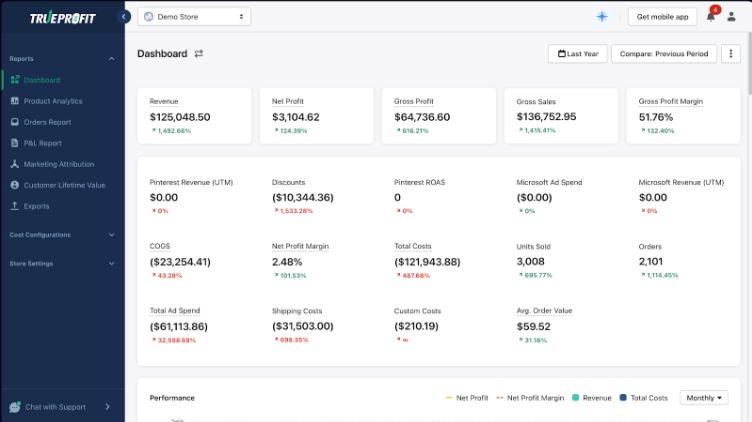
TrueProfit is positioned as a Net Profit Analytics platform built for Shopify and ecommerce merchants (including dropshippers and POD sellers) who want to see profit clearly across the store as they scale-especially when costs and marketing spend live across multiple systems.
In practice, TrueProfit centers around six core capabilities:
-
Real-time profit dashboard (product, ad channel, store level): Helps merchants see which products and channels actually keep margin, then drill down into what to scale and what to stop.
-
Accurate cost tracking: Helps capture the costs sellers often overlook-COGS, payment processing fees, international and currency conversion fees, Shopify app fees, premium theme costs, shipping and fulfillment, refunds, taxes, and custom costs.
-
Ad spend sync: Helps bring ad spend into the same view as profit so performance is judged by profitability, not vanity ROAS.
-
P&L reporting: Helps review weekly and monthly performance in a clean structure, making profit leaks easier to spot.
-
Customer value insights: Helps merchants understand customer value so acquisition and retention decisions are made with long-term profit in mind.
-
Mobile monitoring and all-store view: Helps owners monitor profit across stores quickly without living inside spreadsheets.
The New “Winning Product” Playbook (2026 Summary)
In 2026, winning products are increasingly the result of a system:
Start with trend signals, then filter by operational risk and pricing power. Validate with a margin-first reality check. Prioritize products that can realistically sustain strong gross margin. Then track profit tightly as volume grows so “winning” doesn’t turn into “busy but broke.
Media Contact
Company Name: TrueProfit
Contact Person: TrueProfit’s Partnership Manager
Email: Send Email
Country: Vietnam
Website: https://trueprofit.io