
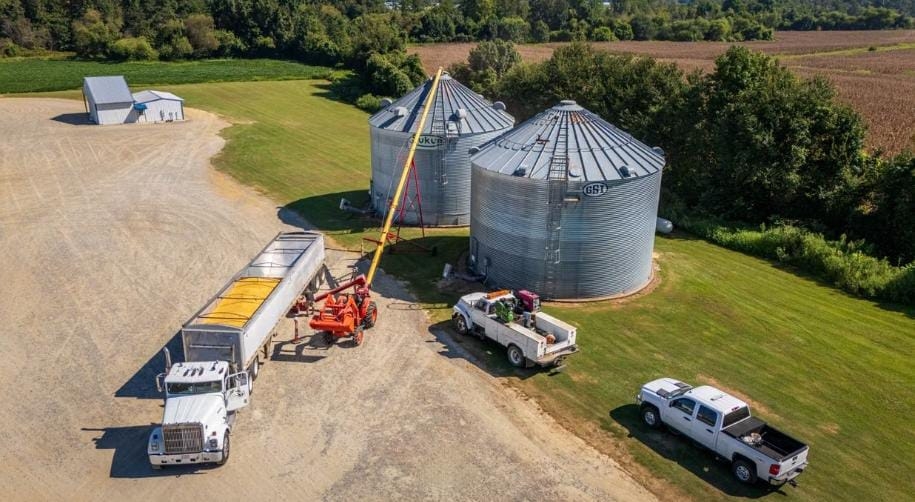
New York-United States – October 26, 2026 – A strong harvest does not guarantee a good return. Grain must reach buyers in acceptable condition, sometimes months later. In 2026, storage matters: USDA counted 2.10 billion bushels of old-crop corn still in U.S. storage on September 1, 35% more than a year earlier. That grain occupied space ahead of the fall harvest.
Cash bids change during harvest. When local elevators are busy, or bin space runs short, a farm has fewer delivery options. Properly equipped grain storage tanks protect grain quality and offer more flexibility in delivery scheduling.
What Grain Can Lose After Harvest
Grain remains biologically active in storage. Moisture and temperature affect how quickly molds and insects develop, while broken kernels and fines restrict airflow. Trouble often starts in one pocket of a bin rather than across the entire load.
A bin cannot correct high moisture on its own. Aeration mainly manages temperature; drying needs sufficient airflow and suitable conditions. Safe moisture targets vary by crop and expected storage period.
There are direct financial consequences. Grain sold at a lower grade receives a discount, if it is accepted at all. Cleaning and handling add labor, and farmers may need to remove or dispose of spoiled grain. Once mold has damaged a load, turning on a fan cannot restore its original quality.
Storage Gives Farmers a Choice About When to Sell
Harvest-time sales are sometimes unavoidable. Bills are due, space is full, and trucks need somewhere to unload. But selling everything as soon as it is harvested means accepting whatever local cash bid is available that week.
Sound storage creates an alternative. A farmer can deliver part of the crop at harvest and retain another portion for a later contract or a buyer with a different delivery schedule. Grain merchants and processors benefit from receiving consistent quality after the main harvest rush, rather than taking every shipment at once.
Holding grain is not automatically profitable. The cash price might improve, stay flat, or decline. A decision to store should account for:
-
The likely selling price: Compare cash bids and delivery terms, including any change in the local basis.
-
The cost of waiting: Include drying, electricity, handling, storage fees or ownership costs, and interest tied up in unsold grain.
-
Quality risk: Allow for shrinkage, monitoring, and possible discounts if the stored crop deteriorates.
Suppose a later offer is 15 cents per bushel higher than the harvest bid, but carrying costs total 20 cents. The apparent price gain would leave the producer five cents behind. Cost records expose that trade-off.
What Modern Storage Equipment Should Actually Do
Silo capacity matters, but it says little about whether grain will leave in the same condition it arrived in. Cooling, monitoring, filling, and unloading all affect the result.
Temperature Control Is Not the Same as Drying
Aeration fans cool stored grain and help keep temperatures more uniform. Temperature cables make it easier to detect a developing hot spot without relying on a single surface reading. Remote monitoring can alert staff when temperatures drift, but it does not eliminate the need for grain sampling or equipment inspections.
Drying remains a separate decision. Grain that enters storage above a safe moisture level needs an appropriate drying plan. Fan capacity and airflow paths must match the task; a system designed mainly for cooling should not be assumed to dry a wet harvest.
Filling and Unloading Matter Too
Large operations need reliable handling without excessive kernel damage. Level sensors, conveyors and automated controls can coordinate incoming loads and track inventory. Cleanable surfaces and dust-control equipment are important for product quality and safe handling.
Modern bulk storage silos can be specified with different discharge arrangements. Flat-bottom designs commonly use mechanical reclaim equipment for larger volumes; hopper-bottom silos support gravity-assisted unloading. The right choice depends on grain type, daily throughput, available space, and the handling equipment already on site. Monitoring and aeration must be designed into the overall system rather than assumed to come with every silo.
Why Dependable Storage Matters Beyond One Farm
Weather complicates storage. A wet harvest can increase drying demand just as receiving points fill up. A warm fall can delay cooling. When transport routes or elevators are disrupted, farms with limited storage have fewer options for keeping harvested grain in good condition.
Storage cannot prevent price swings or weather losses. It can, however, reduce avoidable spoilage and let grain move to mills, feed producers, and exporters over a longer period. That matters for a food system that depends on usable inventory between harvests, not merely on what was produced in the field.
Before expanding a facility, operators should examine seasonal peak intake, expected holding time, required drying and airflow, and the speed at which grain must be unloaded. The return on storage investment ultimately depends on how much remains marketable and the opportunities it gives the business to deliver grain when needed.
About Us
Tarsco Bolted Tank specializes in engineering, manufacturing, and installing bolted steel storage tanks for water, chemical, and industrial applications. As part of the TF Warren Group, the company provides customized storage solutions, tank maintenance, coatings, and inspection services. With decades of industry experience, Tarsco Bolted Tank serves municipal, commercial, and industrial clients worldwide.
Media Contact
Company Name: Tarsco Bolted Tank
Contact Person: Media Relations
Email: Send Email
Country: United States
Website: https://tarscoboltedtank.com/