
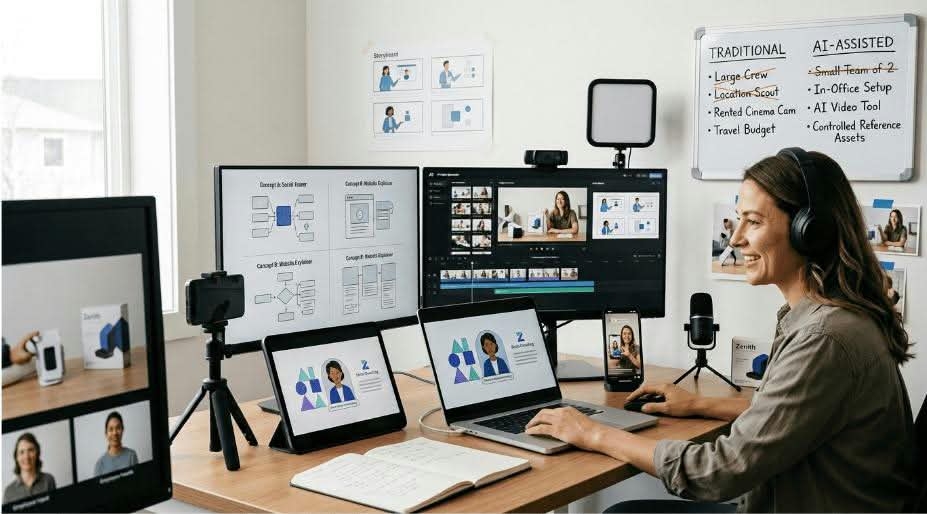
Punjab, Pakistan – November 23, 2026 – For most of the past two decades, video has been the marketing format small businesses talked about and did not make. The reasoning was straightforward. A professionally produced piece required a crew, a location, equipment, a day of somebody’s time and an edit afterwards. For a company with fewer than twenty employees, that cost was comparable to a month of advertising spend for an asset that might run for a year and might not work at all.
So small firms published photographs and written content, and the video category belonged to organisations large enough to absorb the risk.
That arrangement has been shifting, and the real change is not simply that the technology has become better. It is that video production is becoming accessible to businesses that once could not justify the cost of a shoot. An AI Video Generator through Higgsfield can turn an idea, product, or existing material into video content without requiring the same production setup, giving smaller businesses a more realistic way to compete visually.
Why was video out of reach for small firms?
Because the cost structure penalised low volume.
A video shoot carries a largely fixed setup regardless of what is being filmed. Crew, equipment, location, lighting and scheduling cost broadly the same whether the output runs for thirty seconds or three minutes.
That economics works for an organisation producing many assets or one asset with a very large audience. It works poorly for a business producing one piece a year for a local market.
Scheduling compounded the problem. Coordinating a shoot requires the people involved to be available simultaneously, which in a small firm means closing part of the operation for a day.
The result was a category split along company size. Businesses with marketing departments made video. Businesses without them did not, and the gap widened as audiences moved toward video-first platforms.
What changed in the production economics?
The marginal cost of an additional piece fell substantially.
An AI Video Generator produces material without a shoot, which removes the fixed setup that made low-volume production uneconomic. A business producing four pieces a year now faces roughly the same per-asset cost as one producing forty.
That is a structural change rather than an incremental saving. The previous constraint was not that video was expensive in absolute terms, but that it could not be justified at small volumes.
The second AI Video Generator change is revision cost. Filmed material strands when the thing it documents changes, and reshooting is a fresh production. Generated material can be revised, which makes it viable to put changeable information on video at all.
Several categories of content that were never filmed for those reasons have become practical. Procedural explanations, seasonal updates, product-specific material and content in additional languages all sat below the threshold where a shoot could be justified.
Which parts still require filming?
A clear set, and the distinction matters commercially as well as ethically.
Anything representing a real product must be filmed. A customer making a purchasing decision from footage is relying on it, and generated product imagery in a commercial context constitutes a misdescription.
Premises and facilities must be filmed. A business showing a workshop, a restaurant or a clinic is making a claim about where a customer will be going.
People appearing as staff or customers must be real, with appropriate agreement. Generated likenesses presented as employees or clients misrepresent the business.
And anything demonstrating a process or result must show that process or result as it actually occurs.
What an AI Video Generator covers is the surrounding layer. Openings, context, transitions, settings and the framing around genuine footage, none of which makes a claim about the business.
What does an AI Video Generator actually produce?
Short continuous passages, generated from a text description and reference material.
An AI Video Generator produces output measured in seconds rather than minutes, with audio generated alongside the picture in many cases. The material is typically used as components within a larger piece rather than as a finished video in itself.
AI Video Generator reference inputs allow output to be anchored to specific material, such as photographs of an actual location or product, which distinguishes it from generic stock footage.
Multiple language versions can be produced from the same AI Video Generator pass, with the spoken layer differing while the visual material stays constant. For businesses serving multilingual markets this removes a cost that previously multiplied with each language.
Higgsfield, which operates as an AI creative suite, is one of several platforms providing access to these models with an editing environment around them, which is the arrangement most non-specialist users encounter rather than the models directly.
Where are businesses using it first?
In categories where the same information is communicated repeatedly.
Customer-facing explanations are the most common entry point. The description a business gives repeatedly about what happens next, what is needed, or how a process works. Recording it once replaces a task that otherwise consumes staff time continuously.
Product and listing content follows, particularly for businesses with large catalogues where per-item production was never feasible.
Internal training and onboarding appears frequently, especially in sectors with high staff turnover where induction never stops.
And marketing content for businesses that previously had none, which is the category this article opened with.
What appears less often is brand and campaign work, where the production values and the creative judgement remain worth paying for.
What does the adoption pattern look like by sector?
Uneven and the differences are instructive.
Service businesses with repeated customer explanations have moved fastest. Trades, clinics, letting agents, logistics operators and professional services all have procedural content that was never worth filming and is now worth recording once.
Retail and hospitality have followed, driven by staff turnover rather than by marketing. Induction content that previously required a supervisor’s time now exists as a library, which matters most in sectors where hiring never stops.
Businesses with large product catalogues have adopted where per-item production was the constraint. The economics there were never marginal, they were prohibitive and removing the per-asset cost changes what is possible rather than what is affordable.
Slower adoption appears in sectors where regulation governs who may communicate what and in businesses whose output is itself creative, where commissioning a production is part of the proposition rather than a cost to minimise.
What the faster adopters have in common is not sophistication. It is that they already knew which content they wanted and had been refusing it on cost, which meant the decision required no strategy work once the cost changed.
An AI Video Generator is therefore most useful to organisations that had already identified the gap, which is a less exciting observation than most coverage of this technology offers and a more reliable predictor of whether adoption succeeds.
What does the disclosure position look like?
Developing, and currently varying by jurisdiction and platform.
Several major platforms now require or encourage labelling of synthetic media, with implementation differing between them. Some detect provenance metadata automatically and apply labels without the uploader choosing to.
Content provenance standards have gained adoption and Higgsfield is among the platforms attaching them, embedding a signed record of how an asset was produced. Several generation platforms attach these by default.
For businesses, the practical position is that labelling may occur regardless of preference, which makes voluntary disclosure the stronger stance. Audiences respond better to a stated position than to a label that arrives unbidden.
Advertising standards bodies in several markets have also published guidance on synthetic media in commercial communications and businesses in regulated sectors should establish their position before producing rather than after.
How are regulators approaching this?
Unevenly, and with the direction of travel toward more disclosure rather than less.
Several jurisdictions have introduced or proposed transparency requirements covering synthetic media, with the focus generally on content depicting real people and on political advertising rather than on commercial material broadly.
Consumer protection law already applies regardless of how content is produced. Misleading a consumer about a product, a service or a business is an existing offence in most markets and the production method does not alter that.
Sector regulators in financial services, healthcare and legal services have their own requirements about who may communicate what, which apply to generated content exactly as they apply to filmed content.
Businesses also need to consider how generated material is presented to audiences. Clear disclosures can become particularly important when viewers could reasonably believe that a person, statement, product demonstration or event shown in the content is genuine rather than digitally created or altered.
The practical summary for a business is that existing law covers the substance and emerging rules cover the labelling.
What are the common mistakes?
Three, consistently reported by businesses that have adopted these tools.
Producing AI Video Generator volume rather than capability. Output rising without a corresponding increase in what the content is for produces material nobody watches and a library nobody maintains.
Underestimating review. The production cost falls and the approval cost does not, which means organisations producing substantially more content face substantially more checking and that work is human.
And neglecting maintenance. A library that grows quickly starts producing outdated information and in customer-facing or training content, outdated information is worse than none.
Businesses that have adopted Higgsfield and comparable platforms successfully generally treat the saving as capacity for content that previously did not exist, rather than as licence to produce more of what they already had.
Does this displace production work?
Partially, and not in the category most discussed.
The work an AI Video Generator displaces is largely work that was not being commissioned. A business that could not afford video previously was not a customer of production companies and content it now produces does not come out of anybody’s revenue.
Where displacement does occur is at the lower end of commercial production, in straightforward corporate and explanatory work with limited creative requirement.
Higher-value production has been less affected, because the commissioning rationale there is creative judgement and production values rather than the existence of footage.
The pattern resembles previous shifts in creative tooling, where accessible tools expanded the total volume of work produced while concentrating professional practice at the higher end.
How would a business assess it?
By testing against a specific existing cost rather than in the abstract.
The useful starting point, before opening Higgsfield or any comparable platform, is a list of content that has been requested internally and declined. That list was assembled by actual demand and indicates where the constraint has been binding.
Producing a small number of AI Video Generator pieces from that list, through a normal approval process, establishes both whether the output is adequate and whether the organisation can handle the review load at volume.
Measurement of Higgsfield output should focus on the operational outcome the content was intended to affect rather than on views. Enquiry volume on a specific topic, time taken in onboarding, or the frequency of a particular customer question are all more informative.
Most platforms offer a free tier sufficient for this assessment. Higgsfield operates one, which allows an organisation to test against its own material before committing.
About us:
Video was not out of reach for small businesses because it was technically difficult. It was out of reach because the cost structure required volume that small firms did not have.
An AI Video Generator alters that structure rather than making video better, which is a less interesting claim and a more consequential one. Higgsfield and comparable platforms provide the production environment that makes the models usable by organisations without specialist staff.
What has not changed is that the product must be the product, the premises must be the premises and the people must be real. Those requirements predate the technology and are unaffected by it.
Media Contact
Company Name: Growithm
Contact Person: Media Relations
Email: Send Email
Phone: 9203002937119
Country: Pakistan
Website: https://growithm.com/