
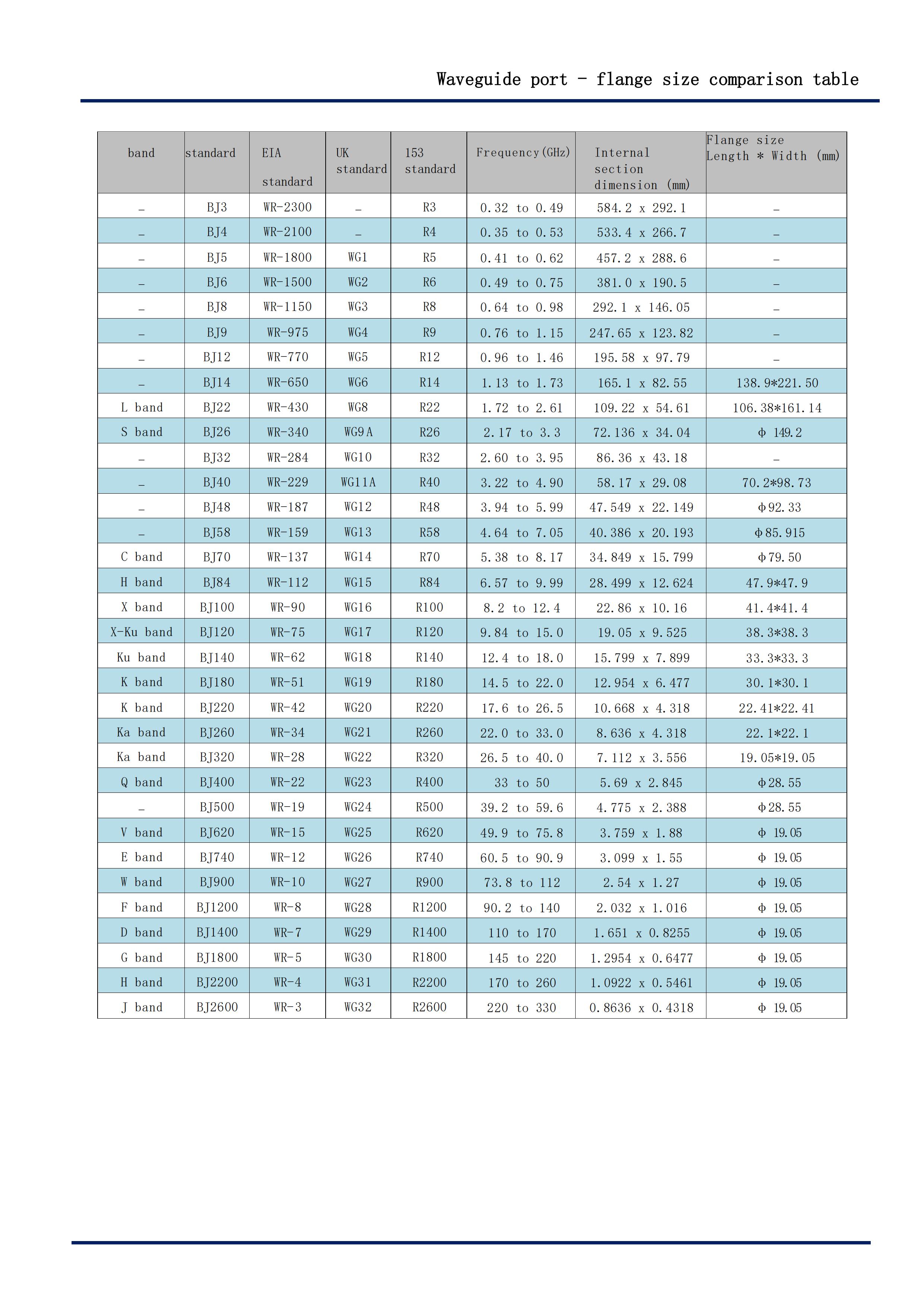
The relationship between waveguide port dimensions, flange sizes, and frequency bands is standardized to ensure mechanical compatibility and optimal RF performance. Below is a simplified comparison table and key principles for common rectangular waveguides and their associated flanges.
Key Concepts
1. Waveguide Designation: Waveguides are labeled with “WR” (Waveguide Rectangular) followed by a number (e.g., WR-90). The number approximates the inner broad-wall dimension in hundredths of an inch (e.g., WR-90 ≈ 0.90″ inner width).- Example: WR-90 = 0.9″ (22.86 mm) inner width.
2. Flange Types: Flanges standardize the connection between waveguides. Common types include: – UG/UPC (MIL-STD): Standardized military flange (e.g., UG-387/UPC). – CPR (Commercial): European standards (e.g., CPR-137). – Choke Flanges: For low-leakage, high-power applications. – Cover Flanges: Simpler, used for vacuum sealing.
3. Frequency Bands: Each waveguide supports a specific frequency range based on its dimensions.
Waveguide-to-Flange Comparison Table Waveguide Frequency Range Flange Type Flange Dimensions (Typical) Applications WR-90 8.2–12.4 GHz (X-band) UG-387/UPC (MIL) Bolt Circle: 1.872″ (47.5 mm) Radar, satellite comms. WR-112 7.05–10 GHz (C-band) UG-595/UPC Bolt Circle: 2.400″ (61.0 mm) Radar, telecom WR-62 12.4–18 GHz (Ku-band) UG-385/UPC Bolt Circle: 1.250″ (31.75 mm) Satellite, military systems WR-42 18–26.5 GHz (K-band) UG-383/UPC Bolt Circle: 0.800″ (20.3 mm) High-frequency radar WR-28 26.5–40 GHz (Ka-band) UG-599/UPC Bolt Circle: 0.600″ (15.2 mm) 5G, automotive radar WR-15 50–75 GHz (V-band) UG-387Mini/UPC Bolt Circle: 0.400″ (10.2 mm) mmWave, research
Flange Dimensions (Typical) 1. Bolt Circle Diameter (BCD): Diameter of the circle formed by the centers of the mounting bolts. 2. Hole Spacing: Distance between bolt holes (e.g., 4-hole or 8-hole patterns). 3. Waveguide Aperture: Matches the waveguide’s inner dimensions.
Key Relationships
1. Waveguide Size ↔ Flange Size:- Larger waveguides (lower frequencies) use larger flanges (e.g., WR-112 flange > WR-90 flange).- Smaller waveguides (higher frequencies) use compact flanges (e.g., WR-28, WR-15).
2. Flange Compatibility:- Flanges must match mechanically (hole alignment, BCD) and electrically (impedance continuity).- Mixing flange types (e.g., UG-387 with CPR-137) requires adapters.
3. Standards by Region:- MIL-STD (UG/UPC): Common in U.S. defense systems.- IEC/CPR: Common in European commercial systems.
Example Flange Standards Flange Type Waveguide Compatibility Key Features UG-387/UPC WR-90, WR-62, WR-42 4-hole, MIL-STD-392, widely used. UG-599/UPC WR-28, WR-15 Compact, for mmWave systems. CPR-137 WR-112, WR-90 European standard, 8-hole pattern. Choke Flange All Grooved design for reduced leakage.
Notes- Always verify mechanical drawings from manufacturers for exact dimensions. – Mismatched flanges cause impedance discontinuities, leading to VSWR degradation. – For vacuum systems, use O-ring sealed cover flanges.
Let me know if you need a specific waveguide-flange combination!
Media Contact
Company Name: Chengdu Leader Microwave Technology Co., Ltd
Email: Send Email
Country: China
Website: https://www.leader-mw.com/