
For buyers evaluating a Veterinary Syringe manufacturer in China, the key question is not only price but also how production capability, quality control, and OEM flexibility affect long-term supply. This guide uses the OEM WJ201 as a practical reference to explain what distinguishes a reliable manufacturer, from material sourcing and assembly precision to compliance, customization, and order support. By the end, readers will have a clearer framework for comparing suppliers, identifying operational risks, and deciding whether a Chinese manufacturing partner fits their veterinary product strategy.
Why Choosing a Veterinary Syringes Manufacturer in China Matters
The global veterinary equipment market relies heavily on established production infrastructure in China. For importers and veterinary pharmaceutical distributors, partnering with a specialized veterinary syringes manufacturer in China offers access to a mature ecosystem of raw material suppliers, automated assembly lines, and high-volume output capabilities. This ecosystem is particularly advantageous for sourcing specialized delivery systems, such as the OEM WJ201 continuous syringe, which requires precise engineering to handle repeated dosing in demanding livestock management environments. Industrial hubs in provinces like Zhejiang and Jiangsu have developed concentrated supply chains that streamline the procurement of medical-grade polymers and brass alloys, enabling rapid production cycles.
Commercial Benefits for Buyers
Sourcing veterinary syringes from Chinese manufacturers provides measurable commercial advantages, primarily driven by economies of scale and localized supply chain integration. Buyers typically observe a 20% to 35% reduction in overall unit costs compared to domestic production in North American or European markets. This cost efficiency spans raw material procurement, injection molding processes, and final assembly. Furthermore, leading Chinese factories offer scalable Minimum Order Quantities (MOQs). They can often accommodate initial trial runs of 5,000 units while maintaining the operational bandwidth to fulfill high-volume container orders exceeding 500,000 units per month. This flexibility allows global distributors to manage inventory risk efficiently, balancing Less than Container Load (LCL) shipments for niche products with Full Container Load (FCL) strategies for fast-moving consumables.
Product Types and Common Use Cases
The manufacturing landscape covers a broad spectrum of delivery devices tailored for different livestock and companion animal applications. Key product categories include disposable plastic syringes for single-use vaccination, specialized drenches for oral medication, and heavy-duty metal or polymer Continuous Syringes designed for mass immunization.Continuous models, such as the WJ201, typically feature adjustable dosage settings ranging from 0.5 ml to 5.0 ml, enabling precise administration for swine, poultry, and cattle without requiring manual reloading. Consistent dosing is critical to preventing vaccine wastage and ensuring herd immunity. By leveraging OEM services, buyers can customize barrel capacities—commonly 10ml, 20ml, or 50ml—and select specific Luer lock or Luer slip tip configurations. Advanced OEM customizations also allow for ergonomic handle modifications and reinforced O-rings to extend the operational lifespan of the device under harsh agricultural conditions.
What Buyers Should Compare When Evaluating Manufacturers
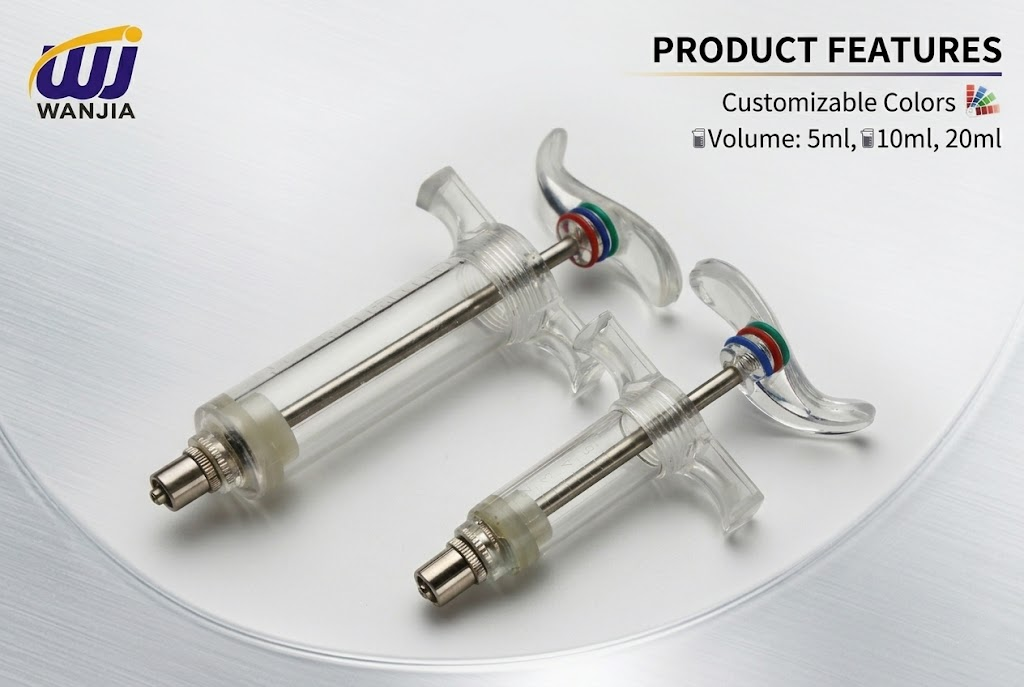
Identifying a capable supplier requires a rigorous evaluation of technical competencies and quality assurance protocols. Importers must look beyond baseline pricing to assess the structural integrity, material safety, and operational longevity of the syringes produced. Substandard manufacturing can lead to critical failures in the field, such as medication leakage, inaccurate dosing, or barrel fracturing under pressure. A facility’s ability to consistently output precision-molded components directly impacts the efficacy of veterinary treatments and the overall safety of the animals.
Specifications, Materials, and Sterility Options
Material selection dictates both the physical durability and the sterilization compatibility of veterinary syringes. High-quality continuous syringes utilize food-grade or medical-grade polymers alongside corrosion-resistant metals to withstand the rigors of field use and repeated sanitization. Buyers must specify the required sterilization method—such as ethylene oxide (EO) gas, gamma irradiation, or high-pressure autoclaving—as this dictates the appropriate barrel and gasket materials. UV resistance is also a critical specification for devices frequently used in outdoor agricultural settings.
| Material | Typical Application | Sterilization Compatibility | Cost Impact |
|---|---|---|---|
| Polypropylene (PP) | Disposable Syringes | EO Gas, Gamma | Low |
| Polycarbonate (PC) | Reusable Barrels | Autoclave (up to 121°C) | Moderate |
| TPX (Polymethylpentene) | Premium Reusable | Autoclave, Chemical | High |
| Brass / Stainless Steel | Continuous Syringe Frames | Autoclave, Dry Heat | High |
Quality, Compliance, and Pricing Factors
Regulatory compliance serves as a non-negotiable baseline for international procurement. Reputable manufacturers should hold active ISO 13485 certifications for medical device quality management, ensuring strict traceability and comprehensive batch records. Quality control metrics should be scrutinized; buyers should target suppliers demonstrating a critical defect rate of less than 0.5% across mass production batches. Pricing structures correlate directly with these quality tiers and material choices. For instance, a standard disposable 20ml veterinary syringe may cost between $0.03 and $0.08 per unit depending on needle inclusion and blister packaging. In contrast, a highly engineered OEM continuous syringe like the WJ201 can range from $8.00 to $15.00 per unit. This higher price band accounts for premium surface treatments, such as chrome plating on brass components, and laser-etched dosage markings that resist fading over time.
How Importers Should Select the Right Manufacturer
Establishing a resilient supply chain demands a systematic approach to vendor qualification. Importers must implement structured screening frameworks to separate general trading companies from genuine manufacturers. Working directly with the factory eliminates margin stacking by intermediaries and ensures transparent oversight of the production lifecycle, which is essential for complex OEM projects.
Supplier Screening and Sourcing Steps
The sourcing process should commence with a comprehensive desktop audit, verifying the supplier’s business licenses, export records, and core manufacturing competencies. Following initial verification, importers must request physical samples of the target product, such as the WJ201 syringe, to conduct independent functional testing. This testing should evaluate dosage accuracy using viscous veterinary medications or suitable substitutes, assess plunger seal integrity under pressure, and measure spring tension over repeated actuation cycles. Once samples are approved, buyers should conduct a facility audit—either in-person or via a certified third-party inspection agency—to confirm automated assembly capabilities, cleanroom standards, and the presence of raw material certificates. Standard lead times for custom OEM orders typically range from 30 to 45 days. Verifying the factory’s production scheduling is critical to ensure on-time delivery during peak seasonal agricultural demands.
Final Selection Criteria and Trade-Offs
The final selection often requires navigating strategic trade-offs between unit cost, customization flexibility, and intellectual property protection.
Key Takeaways
The most important conclusions and rationale for Veterinary Syringes Manufacturer
Specs, compliance, and risk checks worth validating before you commit
Practical next steps and caveats readers can apply immediately
Frequently Asked Questions
Why source veterinary syringes from a China manufacturer like Wanjia Vet?
Chinese suppliers like Wanjia Vet offer lower unit costs, flexible OEM options, and scalable output, making trial orders and bulk monthly supply easier for distributors.
What is the WJ201 continuous syringe used for?
The WJ201 is designed for repeated livestock dosing, especially vaccination or medication in swine, poultry, and cattle, with adjustable doses for efficient mass treatment.
Which specifications should buyers confirm before ordering?
Check dosage range, barrel size, tip type, material grade, sterilization compatibility, and O-ring durability to match your veterinary application and cleaning method.
Can Wanjia Vet provide OEM customization for veterinary syringes?
Yes, buyers can typically request custom barrel capacities, Luer lock or slip tips, handle design changes, and reinforced components for tougher farm use.
How can importers evaluate a reliable veterinary syringe manufacturer?
Review material quality, dosing accuracy, production capacity, compliance documents, and sample performance to reduce risks like leakage, breakage, or inconsistent dosing.
Media Contact
Company Name: Shaoxing wanjia appliance co. ltd.
Email: Send Email
Country: China
Website: https://www.wanjiavet.com/