
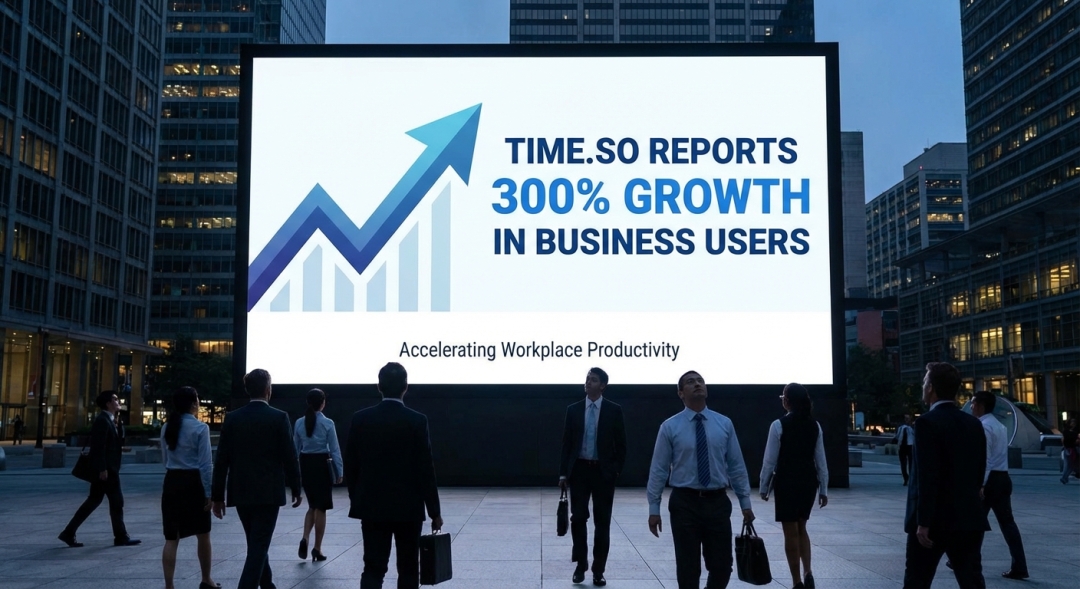
Jan 31, 2026 – Time.so today announced a 300% increase in business users, reflecting rising demand for dependable time data across distributed teams, global customer support, and cross border operations.
The surge follows a clear shift in how companies schedule work. Meetings span continents. Deadlines move with daylight saving changes. Customer expectations do not pause for weekends or time differences. In that environment, precise time becomes operational infrastructure, not a convenience.
Time.so has grown by staying simple. It loads fast. It answers the first question people ask, what time is it there, and then keeps going. Teams use the site to settle scheduling disputes, confirm offsets, and reduce last minute confusion that can derail calls, launches, and handoffs.
Growth driven by practical, repeat use
Business adoption has been strongest among roles where timing errors cost money or trust. Operations teams. Sales and customer success. Logistics and travel coordinators. Remote first managers who run recurring meetings across multiple time zones.
Many new users arrive through everyday workflow moments. A calendar invite that looks wrong. A client who says, “That is not my time.” A flight, a delivery window, a maintenance window, a live stream. One quick check turns into a habit.
Time.so’s homepage, now widely shared inside workplaces, acts as a clean baseline for time verification. Users can validate the current time via Time.so and then drill down to more specific views without switching tools.
A global index built for teams
Time.so organizes time in ways businesses already think about it. By geography. By city. By time zone. That structure has made it easier for teams to standardize how they reference time across documents, messages, and customer communications.
Users can confirm national time differences and regional offsets through the countries list. For city level planning, teams lean on the city time directory to coordinate site visits, local staffing, and partner calls.
For companies that operate by offsets rather than locations, the time zones page provides a direct view of common zones and their current times, helping teams avoid errors during seasonal clock changes.
Weather becomes part of the timing decision
Time and weather are often linked in planning. Delays. Commutes. Outdoor events. Field service. Time.so has seen growing use of its weather view as businesses try to reduce risk around real world conditions.
Planners and coordinators can check conditions quickly using the weather forecast, then make a call on whether to move a start time, extend a buffer, or shift a meeting to a safer window.
What the 300% figure signals
The 300% growth in business users signals a broader pattern: teams want a neutral, single source for time. They want fewer tools, not more. They want answers that do not require training.
Time.so expects continued adoption as more organizations formalize remote operations, expand internationally, and standardize how they communicate timing across systems and people.
About Time.so
Time.so is a web based time utility that provides current time across cities, countries, and time zones, along with planning tools designed for everyday scheduling needs. It helps individuals and teams verify time quickly and reduce coordination errors.
Contact
Email: support@time.so
Media Contact
Company Name: Time.so Limited
Contact Person: Time.so PR
Email: Send Email
Country: United States
Website: https://time.so