
Is a Dihydroxyacetone Free Self Tanner Really Better?
Is “DHA-Free” Really Better? Currently, discussions regarding “self-tanners without Dihydroxyacetone” have emerged in the market, prompting many consumers and manufacturers of tanning products to question whether DHA remains the optimal choice for self-tanning formulations.
For the average consumer, the primary concerns regarding traditional self-tanning products typically center on three issues: unpleasant odors, uneven skin tone, and unsuitability for sensitive skin. As a manufacturer of dihydroxyacetone powder, Kintainutri® offers the following clarification: currently, DHA remains the most technologically mature and highest-selling ingredient in the self-tanning sector, maintaining an absolutely dominant position within the industry.
What is dihydroxyacetone?
DHA-based self-tanning is a safe, convenient method of achieving a tanned look without the need for sun exposure. Its primary active ingredient, dihydroxyacetone (DHA), acts exclusively upon the stratum corneum (the outermost layer of the skin) and does not enter the bloodstream; it is characterized as non-toxic and carries no carcinogenic risks.
Dihydroxyacetone powder reacts with amino acids present in the stratum corneum to produce a natural, uniform bronze skin tone. The resulting effect closely mimics a genuine sun tan, avoiding the tell-tale “fake white” look or artificial coloration often associated with inferior products.
Furthermore, since color development occurs without the need for UV radiation, this method helps mitigate the risks of sunburn, photoaging, and skin cancer. Commonly found in products such as lotions and sprays, dihydroxyacetone powderis easy to use and can be formulated in combination with moisturizing and Antioxidant ingredients to enhance skin feel and ensure uniform color application.
DHA reacts with amino groups to form melanoidin pigments
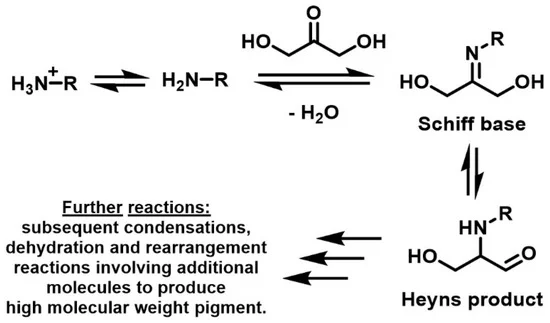
Dihydroxyacetone (DHA) and Erythrulose
It is generally recommended that brands adopt a blended formulation strategy utilizing both DHA powder and Erythrulose. Erythrulose is a naturally occurring ketose sugar; rather than serving as a direct substitute for DHA, it functions as a crucial auxiliary ingredient that enhances the overall self-tanning result. This combination leverages dihydroxyacetone powder’s ability to produce rapid initial coloration while utilizing the complementary ingredient to slow down the fading process, thereby achieving the most perfect and enduring self-tanning effect.
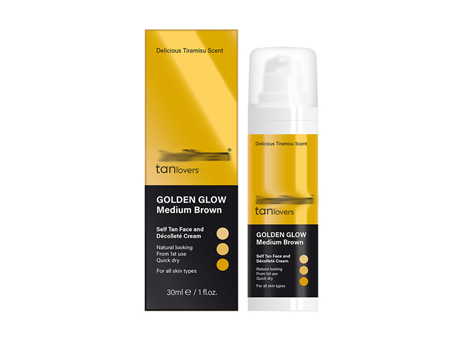
The blend of 1,3-Dihydroxyacetoneand Erythrulose represents the prevailing technological trend in the current self-tanning market; compared to traditional Pure-DHA formulas, this combination significantly improves the natural appearance and uniformity of the resulting skin tone. WhileDHA powder rapidly establishes a base color, Erythrulose optimizes the final shade through a slower color-development process, effectively minimizing issues such as orange undertones, redness, and patchiness, resulting in a skin tone that more closely resembles a natural sun tan.
Moreover, the synergistic combination of these two ingredients extends the longevity of the tan, reduces instances of uneven fading, and enhances the overall user experience. Thanks to their ability to deliver a more natural, long-lasting, and consistent finish, these types of formulations have been widely adopted in mainstream self-tanning products, such as mousses and lotions.
The Truth Behind the Dihydroxyacetone Free Self Tanner Trend
Types of DHA-free self tanners
In addition to products containing DHA-based self-tanning agents, the self-tanning market encompasses two other major categories: instant-tinting products and UV-activated products. Instant-tinting products primarily utilize coloring agents such as caramel to provide immediate color. Akin to body foundation, they deliver visible results immediately upon application. However, they do not alter the skin’s natural pigmentation and can be easily washed off, making them ideal for users seeking temporary cosmetic effects.
UV-activated products, conversely, do not provide direct coloration; instead, they typically contain ingredients such as tyrosine that work in conjunction with sunlight or tanning beds to stimulate melanin production, thereby achieving a deeper, more natural-looking tan. These types of products are most commonly utilized in professional tanning salons or as complementary aids in sun-tanning regimens.
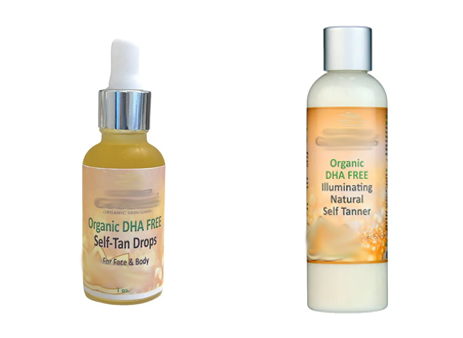
DHA vs DHA-Free
Instant-tinting products differ significantly from their DHA-based counterparts in terms of both underlying mechanism and user experience.
1,3-Dihydroxyacetone products work by reacting with the keratin layer of the skin to gradually develop color; it typically takes anywhere from a few hours to a full day for the tan to fully manifest, and the results can last for 5 to 7 days. However, this process may be accompanied by a characteristic odor (though Kintainutri®’s high-quality, low-impurity cosmetic-grade DHA powder significantly mitigates formulation-related odors at the source) and can sometimes result in uneven coloration, particularly around joints.Nevertheless, advanced “DHA + Erythrulose” combination technologies have proven effective in minimizing patchiness and preventing the unsightly uneven fading often associated with traditional DHA products.
In contrast, Glycerone-free products employ an instant-tinting mechanism that delivers immediate color upon application. This approach offers greater control over color intensity, allows for easy removal or adjustment at any time, and is typically free of any noticeable odor.Consequently, these products are particularly well-suited for individuals with sensitive skin, as well as for specific scenarios such as special events or photoshoots, where only a short-term cosmetic effect is desired.
DHA vs UV Tanning
The primary advantage of dihydroxyacetone powder-based self-tanning lies in its safety profile. Excessive exposure to ultraviolet (UV) radiation is a known cause of skin cancer, photoaging, and ocular damage, and has been identified by the World Health Organization as a significant contributor to the global burden of disease. Conversely, the European Union’s Scientific Committee on Consumer Safety (SCCS) has concluded that DHA concentrations of up to 10% in cosmetic products do not pose a risk to human health.
In terms of aesthetic results, Glycerone-induced tans tend to have a yellowish undertone, though modern formulation technologies have made significant strides in improving the naturalness of the resulting color. It is important to note, however, that the skin coloration produced by DHA offers virtually no protection against UV radiation; therefore, users must still apply sunscreen to ensure adequate sun protection. This safety feature makes DHA an ideal alternative to UV-induced tanning.
Why the Market Doesn’t Need a Dihydroxyacetone Free Self Tanner
The Safety Profile of DHA
DHA has been approved for use in cosmetics by the European Union’s Scientific Committee on Consumer Safety (SCCS); when applied topically at concentrations not exceeding 10%, it poses no risk to human health. However, it should be noted that in vitro studies suggest that high concentrations of Glycerone may induce increased mitochondrial reactive oxygen species (ROS), disrupt cellular energy metabolism, and cause dihydroxyacetone powder replication stress. In human applications, DHA boasts an excellent safety record, with only isolated, rare cases of contact allergy reported. Overall, as a topical ingredient, DHA demonstrates a high safety profile with an extremely low incidence of adverse reactions.
DHA, at concentrations ranging from 1% to 15%, is widely utilized as the active ingredient in sunless tanning products; it is commonly found in low-concentration lotions intended for daily use and in high-concentration sprays intended for weekly application. The FDA permits its topical use but advises consumers to avoid inhalation, ingestion, or contact with the mucous membranes of the eyes and lips. Existing human clinical data indicate that the topical application of dihydroxyacetone possesses an acceptable safety profile, although a small minority of users may experience irritant or allergic contact dermatitis. Clinicians should advise patients to exercise caution when using commercially available products with higher concentrations (>10%), for instance, by avoiding multiple applications per week.
Why Choose Dihydroxyacetone Powder By Kintainutri®?
Kintainutri® acknowledges the existence of the “sunless tanner without dihydroxyacetone” concept; however, DHA remains an irreplaceable ingredient. What the current market truly requires is not “DHA-Free” alternatives, but rather high-purity, low-odor, premium-quality DHA powder. We offer Dihydroxyacetone powder with a purity level reaching 98–99%. This product is designed to empower cosmetic formulators and brand procurement teams in meeting their requirements for both new product R&D and mass production, providing you with high-specification raw material support. Please contact us to request a free sample of our high-purity powder.
Media Contact
Company Name: KINTAI Biotech Inc.
Email: Send Email
Country: China
Website: https://www.kintainutri.com/