
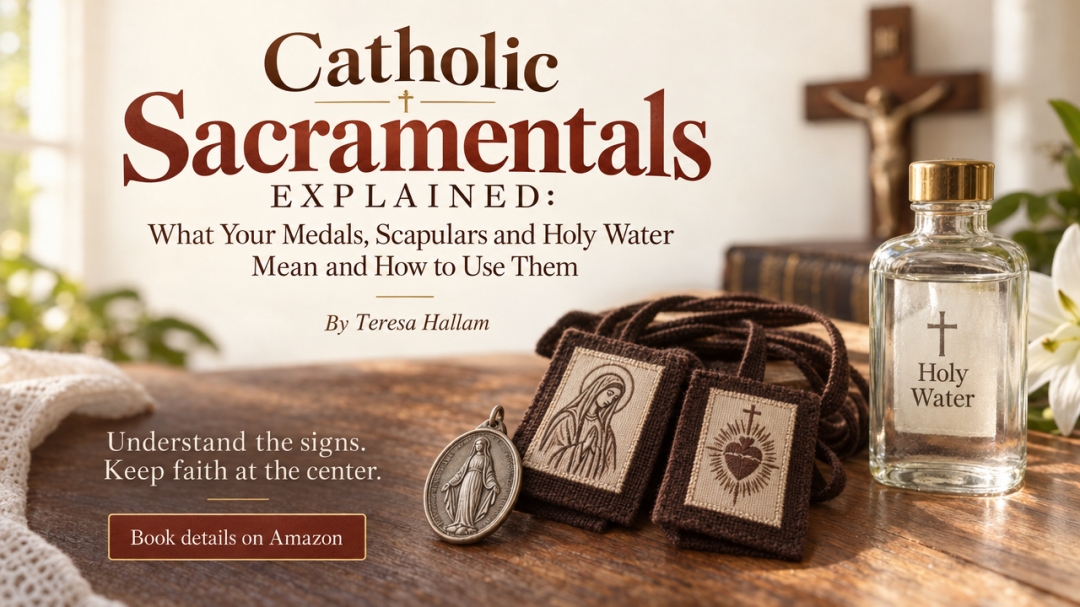
HOUSTON, TX – November 12, 2026 – Teresa Hallam’s Catholic Sacramentals Explained: What Your Medals, Scapulars and Holy Water Mean and How to Use Them, published November 10, 2026, offers readers a practical handbook for questions that arise around household devotion. For those asking how to use holy water at home, what a religious gift communicates, or whether wearing a scapular guarantees salvation, the book connects familiar objects with prayer and responsible choices. Its relevance rests in situations where readers want to honor Catholic traditions while understanding what those traditions do—and do not—ask of them.
A medal received as a gift, a scapular worn beneath clothing, or a bottle of holy water kept near the door can raise questions beyond an object’s name. Readers may want to know how to explain its purpose to a child, how to share a practice with someone who does not share their faith, or what to do when an item becomes damaged. Hallam’s handbook addresses that intersection of belief and daily life, presenting sacramentals as aids to faith rather than objects with independent power.
For readers wondering how to use holy water at home, the book joins devotional meaning with ordinary household care. It presents holy water as a reminder of Baptism and an aid to prayer, while explaining the importance of a clean, closed container, clear labeling when confusion is possible, and storage away from cleaning supplies. Its guidance also addresses contamination: a blessing does not remove the need to stop using water that has become cloudy, unpleasant-smelling, or otherwise spoiled. Reverence and cleanliness are treated as compatible responsibilities.
That attention to practical circumstances extends to relationships. The book cautions against sprinkling someone without consent or using holy water secretly in an effort to control another person’s behavior. For households whose members have different beliefs or levels of religious participation, this is a meaningful distinction. A devotional practice can be offered as an invitation to prayer without becoming a demand. In the handbook’s treatment, respect for another person’s freedom is not separate from devotion; it belongs within the charity that devotion is meant to encourage.
Religious gifts present a related concern. Someone choosing a medal or scapular may wish to offer reassurance, affection, or spiritual support, yet the accompanying explanation matters. The handbook discusses gifts and thoughtful buying within its broader account of what sacramentals mean. Its emphasis gives readers a way to distinguish a reminder of prayer from a promise of protection. An object given with care can point toward faith and companionship without suggesting that the recipient will be spared illness, accidents, or hardship.
Does a Brown Scapular guarantee salvation? The book’s answer is no: wearing the cloth does not automatically secure heaven. Hallam places the devotion within faith, repentance, perseverance, and a continuing Christian life. The scapular is presented as a reminder to follow Christ, not permission to disregard moral responsibility or a replacement for confession. For readers troubled by absolute claims about devotional objects, that distinction directs attention away from merely possessing or wearing an item and toward the life the sign is intended to support.
The same concern becomes especially important when someone is sick. In its discussion of the Green Scapular, the handbook emphasizes asking before placing an object near another person, touching them with it, or praying aloud at the bedside. It recognizes that illness can make people sensitive to noise, touch, and unwanted attention. Elsewhere, its treatment of the Saint Benedict Medal makes clear that devotion cannot replace medical treatment, professional care, or pastoral support. Prayer accompanies care rather than excusing its absence.
For families establishing a prayer space, the book moves from individual objects to shared habits. Its coverage includes prayer corners, crucifixes, holy cards, icons, statues, and house blessings. A household practice before a crucifix brings together thanksgiving, petitions, forgiveness, and the Lord’s Prayer, with an emphasis on reconciliation and charity afterward. This gives the objects a place within relationships: the purpose of gathering is not simply to arrange a devotional display, but to let prayer shape how household members respond to one another.
Seasonal customs offer another point of connection for readers. The handbook covers the Advent wreath and Nativity scene alongside Epiphany chalk, Candlemas, ashes, palms, and Easter water. These practices allow familiar household objects to carry meaning through the Church year. The book also makes room for sensible adaptation. Its discussion of Advent greenery and blessed candles pairs prayer with fire precautions and flameless alternatives where necessary, making clear that preserving a custom does not require accepting an avoidable danger.
Travel provides a similarly concrete example. A Saint Christopher medal or car blessing may express a desire for protection, but the handbook links that desire with attentive driving, seat belts, maintenance, and safely secured devotional reminders. A blessed vehicle is not beyond the possibility of an accident. For readers giving a medal to a driver or requesting a vehicle blessing, the emphasis keeps the gesture connected to patience and care for everyone on the road rather than a sense of invulnerability.
Across these situations, Catholic Sacramentals Explained addresses readers who want to choose, explain, use, and eventually retire devotional objects thoughtfully. It can be read from beginning to end or consulted when a particular question arises. Its central theme gives household prayer, religious gifts, and seasonal customs a common direction: the object should draw attention toward God and encourage responsible action, not become the source of a guaranteed outcome. Readers can find the book and further details at https://www.amazon.com/dp/B0HR4L24HM. Additional book information is available through Book website.
Readers can explore related background through Sacramentals in everyday life..
About Teresa Hallam
Teresa Hallam is the author of Catholic Sacramentals Explained: What Your Medals, Scapulars and Holy Water Mean and How to Use Them. The handbook explores Catholic devotional objects, blessings, household prayer, and practices associated with the Church year. Its approach connects religious meaning with responsible conduct, respect for conscience, and practical care, distinguishing aids to faith from claims of automatic protection or guaranteed outcomes.
Video Link: https://www.youtube.com/embed/MxQOnkVbD90
Media Contact
Company Name: Catholic Sacramentals Explained
Contact Person: Teresa Hallam
Email: Send Email
Phone: 713-392-6222
Address:450 N Sam Houston Prky E Ste 103
City: Houston
State: TX
Country: United States
Website: https://y9rgibrniw2mq8jrirc4y6es.macaly.app