
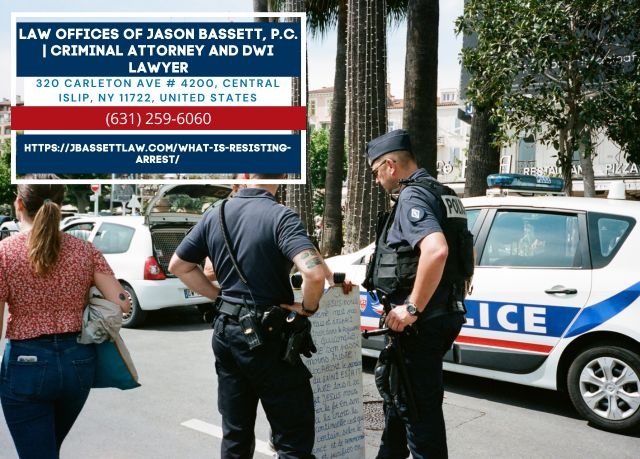
New York law makes it a crime to physically interfere with a lawful arrest, regardless of whether it is believed the arrest is justified. Suffolk County criminal defense attorney Jason Bassett of the Law Offices of Jason Bassett, P.C. (https://jbassettlaw.com/what-is-resisting-arrest/), is providing clarity on what qualifies as resisting arrest, what penalties individuals face, and how someone accused of this offense can protect their rights.
Resisting arrest is charged under NY Penal Law § 205.30 and applies when a person intentionally attempts to prevent a police officer from carrying out an arrest. Suffolk County criminal defense attorney Jason Bassett explains that the law focuses on intent: “Accidental movements or reflexive actions typically do not meet this standard.” Despite this, many everyday reactions to police contact, like pulling away or going limp, are often used as grounds for resisting arrest charges.
Suffolk County criminal defense attorney Jason Bassett emphasizes that resisting arrest charges often accompany other offenses, but they can also be brought independently. Even if the initial reason for contact with police doesn’t result in formal charges, the act of resistance alone can lead to criminal prosecution. This highlights the broad discretion law enforcement officers have when interpreting actions as resistance, such as tensing up during handcuffing or failing to exit a hiding place when ordered.
“Almost any physical action can be interpreted as resistance,” says Jason Bassett. He notes that people may not even realize their behavior could lead to criminal charges. Running from the police, locking arms behind the back, or even protesting while making physical movements may lead to accusations of resisting arrest.
A conviction for resisting arrest in New York is categorized as a Class A misdemeanor. This is the most serious misdemeanor level in the state and can carry a sentence of up to one year in jail, probation for up to three years, and fines as high as $1,000. Beyond these legal penalties, Jason Bassett explains that a conviction creates a permanent criminal record, which can harm employment opportunities, housing applications, and immigration status. “Even if a person is not convicted of the crime they were arrested for, a resisting arrest conviction remains on their record,” he adds.
There are several situations where a defense to resisting arrest may be available. Jason Bassett outlines three primary defenses: lack of intent, use of excessive force by police, and unlawful arrest. For example, if the officer misinterpreted a person’s actions, such as pulling away out of surprise or reacting reflexively, then the necessary intent to resist may not exist under the law. Additionally, if an officer used force beyond what was reasonable under the circumstances, a person may be able to claim they were defending themselves rather than resisting.
Unlawful arrests present another area where charges can be challenged. According to Jason Bassett, an arrest must be based on reasonable cause, which requires more than mere suspicion. If this standard isn’t met, any resulting resisting arrest charge may be invalid. However, even in such cases, New York law does not allow people to use physical force to resist arrest in the moment. Instead, individuals are expected to comply and later challenge the arrest in court.
The impact of a resisting arrest charge extends beyond the courtroom. Suffolk County prosecutors often use these charges to strengthen otherwise weak cases, and judges may interpret resistance as a sign of guilt, potentially influencing bail and pretrial release conditions. As Jason Bassett notes, “Prosecutors and judges view resistance as evidence of guilt on underlying charges.”
Importantly, resisting arrest is not a felony in New York. It remains a misdemeanor, but Jason Bassett warns that any additional actions, like assaulting an officer during the arrest, can result in more serious felony charges with harsher consequences, including years in state prison.
The message from Jason Bassett is clear: do not physically resist an arrest, even if a person believes it is unjust. Instead, comply with law enforcement, calmly state no consent, and request legal representation as soon as possible. Physical resistance only escalates the situation and provides law enforcement with a separate, prosecutable offense.
Those facing resisting arrest charges or who believe their rights were violated during an arrest are encouraged to seek legal guidance immediately. Jason Bassett and the Law Offices of Jason Bassett, P.C. offer detailed reviews of arrest procedures, evaluate evidence, and develop a strong defense strategy tailored to each case.
If charged with resisting arrest in Suffolk County or elsewhere in New York, the next steps matter. An experienced criminal defense attorney like Jason Bassett can help ensure that rights are protected and that any misconduct or procedural errors are fully addressed.
About Law Offices of Jason Bassett, P.C.:
The Law Offices of Jason Bassett, P.C. represents individuals facing criminal charges throughout Long Island and New York. Led by Suffolk County criminal defense attorney Jason Bassett, the firm is committed to safeguarding clients’ rights and providing legal support for those navigating the criminal justice system.
Embeds:
Youtube Video: https://www.youtube.com/watch?v=Img1Khpkcbs
GMB: https://www.google.com/maps?cid=695024758410642184
Email and website
Email: bassettlaw@live.com
Website: https://jbassettlaw.com/
Media Contact
Company Name: Law Offices of Jason Bassett, P.C.
Contact Person: Jason Bassett
Email: Send Email
Phone: (631) 259-6060
Address:320 Carleton Ave # 4200
City: Central Islip
State: New York 11722
Country: United States
Website: https://jbassettlaw.com/