
Software Composition Analysis Market Overview
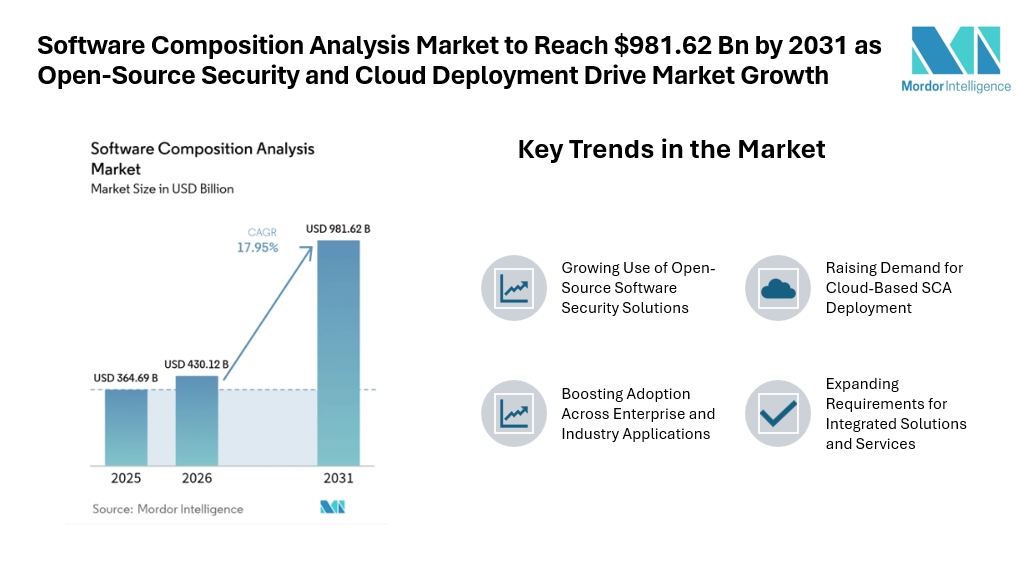
The Software Composition Analysis market size is estimated to grow from USD 430.12 billion in 2026 to USD 981.62 billion by 2031, registering a CAGR of 17.95% during the forecast period. Software Composition Analysis solutions help organizations identify and manage open source software components used within applications. The market is supported by the increasing use of open source components across software development and the need to maintain visibility into software dependencies, vulnerabilities, and licensing requirements.
The Software Composition Analysis industry serves organizations across IT and telecom, BFSI, retail and e-commerce, government, healthcare and life sciences, manufacturing, automotive, energy and utilities, and other sectors. Solutions and services are available through cloud, on-premises, and hybrid deployment models, supporting the requirements of both large enterprises and small and medium enterprises.
Software Composition Analysis Market Trends
Growing Use of Open Source Software Security Solutions
Organizations increasingly rely on open source software components as part of application development, creating a need for visibility and control over software dependencies. Software Composition Analysis tools help development and security teams identify components within applications and assess associated security and licensing requirements. This is supporting demand for SCA solutions across organizations with large software portfolios and complex development environments. The Software Composition Analysis market trends are closely connected with the growing need to manage software components throughout development and application maintenance.
Raising Demand for Cloud-Based SCA Deployment
Cloud deployment is an important area of the Software Composition Analysis market as organizations adopt cloud-based development environments and software delivery processes. Cloud-based SCA solutions can support distributed development teams and provide access to software component analysis across application environments. Hybrid and on-premises deployments also remain relevant for organizations with specific infrastructure, security, or operational requirements. The Software Composition Analysis market growth therefore includes demand across different deployment models as businesses select approaches suited to their software development environments.
Boosting Adoption Across Enterprise and Industry Applications
Large enterprises represent an important customer group because of their extensive application portfolios and use of third-party and open source components. Small and medium enterprises also require tools that help manage software dependencies and security requirements as application development expands. Demand extends across IT and telecom, BFSI, retail and e-commerce, government, healthcare and life sciences, manufacturing, automotive, and energy and utilities. The Software Composition Analysis market share across these sectors reflects the broad use of software applications and the need for organizations to understand the components within their software environments.
Expanding Requirements for Integrated Solutions and Services
The Software Composition Analysis market includes both solutions and services, allowing organizations to address software component management through different approaches. Services can support implementation, integration, and ongoing requirements, while solutions provide capabilities for identifying and managing software components. Organizations are evaluating SCA offerings based on deployment requirements, company size, industry needs, and software development practices. The Software Composition Analysis market forecast reflects continued demand for solutions and services that help organizations maintain better visibility into software composition.
Check out more details and stay updated with the latest industry trends, including the Japanese version for localized insights: https://www.mordorintelligence.com/ja/industry-reports/software-composition-analysis-market?utm_source=abnewswire
Software Composition Analysis Market Segmentation
-
By Component
-
Solutions
-
Services
-
By Deployment Mode
-
Cloud
-
On-premises
-
Hybrid
-
By Organisation Size
-
Large Enterprises
-
Small and Medium Enterprises
-
By Industry Vertical
-
IT and Telecom
-
BFSI
-
Retail and E-commerce
-
Government
-
Healthcare and Life Sciences
-
Manufacturing
-
Automotive
-
Energy and Utilities
-
Other Verticals
-
By Geography
-
North America
-
United States
-
Canada
-
Mexico
-
South America
-
Brazil
-
Argentina
-
Rest of South America
-
Europe
-
Germany
-
United Kingdom
-
France
-
Italy
-
Spain
-
Rest of Europe
-
Asia-Pacific
-
China
-
Japan
-
India
-
South Korea
-
Southeast Asia
-
Rest of Asia-Pacific
-
Middle East and Africa
-
Middle East
-
Saudi Arabia
-
United Arab Emirates
-
Turkey
-
Rest of Middle East
-
Africa
-
South Africa
-
Nigeria
-
Egypt
-
Rest of Africa
Explore Our Full Library of Technology Media and Telecom Research: https://www.mordorintelligence.com/market-analysis/technology-media-and-telecom?utm_source=abnewswire
Software Composition Analysis Market Key Players
The Software Composition Analysis industry includes companies providing solutions and services for analyzing software components, managing dependencies, and addressing software security and licensing requirements. Key players covered in the market include Synopsys, Inc., Sonatype Inc., Snyk Limited, Veracode Inc., and Mend.io (White Source Ltd.). These companies serve organizations across different industries and deployment environments, offering software composition analysis capabilities for enterprise and development requirements.
The competitive landscape includes providers with offerings across cloud, on-premises, and hybrid environments. Companies are evaluated based on their solutions and services and their ability to address the requirements of organizations across different sizes and industry verticals.
Explore more insights on the software composition analysis competitive landscape: https://www.mordorintelligence.com/industry-reports/software-composition-analysis-market/companies?utm_source=abnewswire
Conclusion
The Software Composition Analysis market continues to support organizations seeking greater visibility into software components used within applications. Demand spans solutions and services, with cloud, on-premises, and hybrid deployment models addressing different organizational requirements. Large enterprises and small and medium enterprises across technology, financial services, retail, healthcare, government, manufacturing, automotive, energy, and other sectors contribute to market demand.
The Software Composition Analysis market forecast indicates continued opportunities as organizations manage increasingly diverse software environments and open source dependencies. Understanding Software Composition Analysis market share, Software Composition Analysis market trends, deployment preferences, industry requirements, and regional activity can help businesses evaluate opportunities within the Software Composition Analysis market.
Industry Related Reports:
Media Planning Market
The media planning market is estimated at USD 6.64 billion in 2026 and is projected to reach USD 11.35 billion by 2031, registering an 11.32% CAGR during 2026–2031. Growth is driven by increasing digital advertising spending, data-driven audience targeting, and the adoption of programmatic advertising. The growing demand for omnichannel campaigns and measurable advertising outcomes is further supporting market expansion.
https://www.mordorintelligence.com/industry-reports/media-planning-market?utm_source=abnewswire
Reverse Extract Transform Load Software Market
The reverse extract transform load software market is projected to expand from USD 1.31 billion in 2026 to USD 3.14 billion by 2031, registering a 19.11% CAGR during 2026–2031. Growth is fueled by rising adoption of cloud data platforms, increasing demand for automated data integration, and the need to make operational data accessible for analytics. Growing investments in modern data stacks and real-time data workflows are further driving market adoption.
Rich Communication Services Market
The rich communication services market is estimated at USD 3.59 billion in 2026 and is projected to reach USD 10.93 billion by 2031, registering a 24.95% CAGR during 2026–2031. Market growth is driven by increasing demand for interactive mobile messaging, enhanced customer engagement, and personalized business communications. Rising smartphone usage, enterprise messaging adoption, and the integration of multimedia features into messaging platforms are further accelerating market expansion.
https://www.mordorintelligence.com/industry-reports/rich-communications-service-market?utm_source=abnewswire
About Mordor Intelligence:Mordor Intelligence is a trusted partner for businesses seeking comprehensive and actionable market intelligence. Our global reach, expert team, and tailored solutions empower organizations and individuals to make informed decisions, navigate complex markets, and achieve their strategic goals.
With a team of over 550 domain experts and on-ground specialists spanning 150+ countries, Mordor Intelligence possesses a unique understanding of the global business landscape. This expertise translates into comprehensive syndicated and custom research reports covering a wide spectrum of industries, including aerospace & defense, agriculture, animal nutrition and wellness, automation, automotive, chemicals & materials, consumer goods & services, electronics, energy & power, financial services, food & beverages, healthcare, hospitality & tourism, information & communications technology, investment opportunities, and logistics.
Media Contact
Company Name: Mordor Intelligence Private Limited
Contact Person: Jignesh Thakkar
Email: Send Email
Phone: +1 617-765-2493
Address:11th Floor, Rajapushpa Summit, Nanakramguda Rd, Financial District, Gachibowli
City: Hyderabad
State: Telangana 500008
Country: India
Website: https://www.mordorintelligence.com/