
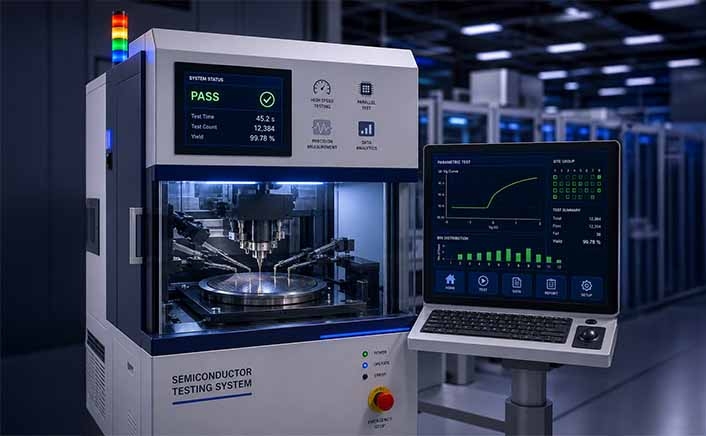
May 28, 2026 — The Singapore semiconductor testing equipment market was valued at USD 170 million in 2025 and is projected to reach USD 310 million by 2033, expanding at a compound annual growth rate of 7.8% over the forecast period. As chip complexity accelerates across the AI, automotive, and advanced packaging categories, Singapore’s role as a high-value semiconductor backend hub continues to attract sustained capital investment in precision testing infrastructure.
A Hub Built for High-Value Semiconductor Work
Singapore’s semiconductor industry is not centered on high-volume commodity chip production. Instead, the country has carved out a distinct position in advanced packaging, specialty semiconductors, power electronics, and backend manufacturing. Major players, including Micron, GlobalFoundries, Infineon Technologies, and United Microelectronics Corporation (UMC), operate manufacturing and testing facilities in the country. According to the Singapore Economic Development Board, semiconductors account for more than 20% of Singapore’s total manufacturing output, with electronics remaining the nation’s largest manufacturing sector.
This structural positioning creates a consistent baseline demand for automated test equipment, wafer-probing systems, burn-in systems, handlers, and inspection platforms — all of which are essential for validating chip performance, reliability, and functionality before integration into end-use devices.
Access the Full Report Here: https://marksparksolutions.com/reports/singapore-semiconductor-testing-equipment-market
AI and Automotive Complexity Driving Testing Intensity
The most consequential demand driver in Singapore’s testing equipment landscape is the growing complexity of AI accelerators and automotive semiconductors. AI processors and high-bandwidth memory chips require longer test times, higher pin counts, and faster signal validation than conventional consumer semiconductors. A single defect in an AI accelerator or automotive control chip carries far greater downstream cost than in standard consumer electronics applications, making thorough pre-deployment validation non-negotiable.
Automotive semiconductors face an additional layer of requirements. Electric vehicles, advanced driver-assistance systems, and industrial automation electronics must comply with strict safety and operational reliability standards, necessitating extended burn-in testing and thermal-stress validation. This is accelerating the procurement of thermal-reliability platforms and long-duration screening systems across semiconductor facilities in Singapore.
Advanced Packaging Shifts Testing Earlier in the Production Cycle
One of the more significant structural shifts underway is the move toward 2.5D and 3D semiconductor packaging technologies. As chiplet integration and heterogeneous packaging become more prevalent, manufacturers are testing earlier in the production cycle at the wafer level to detect defects before costly packaging steps are completed. This shift is accelerating the adoption of wafer probing systems and high-precision inspection platforms.
Singapore’s established, advanced packaging ecosystem makes it particularly well-positioned to capitalize on this transition. Wafer-level testing reduces downstream yield losses and limits financial exposure from defective high-performance chips, both of which are critical given the high unit costs of AI and automotive semiconductor production.
AI-enabled testing platforms are also gaining traction. Companies such as Advantest and Teradyne are integrating machine learning algorithms and real-time data analytics into their automated test equipment to enable predictive maintenance and faster defect identification. In a market with elevated labor costs and high export volumes, these capabilities align directly with Singapore’s operational priorities.
Download Free Sample Report @ https://marksparksolutions.com/sample-reports?846&Download_Free_Sample
Supply Chain Diversification Adding Structural Tailwind
Beyond domestic manufacturing dynamics, Singapore is benefiting from a broader strategic realignment of global semiconductor supply chains. Multinational semiconductor companies are diversifying production and backend operations across Southeast Asia to reduce reliance on concentrated manufacturing hubs. Singapore’s intellectual property protection framework, geopolitical stability, logistics infrastructure, and established semiconductor talent base continue to position it as a preferred destination for such investment.
Electronics exports from Singapore have exceeded SGD 100 billion in recent years, with semiconductors the largest category. This export dependence underscores the strategic importance of testing efficiency and investment in automation across local semiconductor operations.
Government agencies, including the Singapore Economic Development Board and A*STAR, continue to support research collaboration in advanced packaging, photonics, and compound semiconductors, where demand for specialized testing and inspection systems is expected to grow through 2033.
Capital Intensity and Talent Constraints Remain Factors to Watch
High-performance automated test equipment systems carry multi-million-dollar per-unit price tags, and procurement decisions are sensitive to semiconductor industry cycles. During periods of lower fab utilization, replacement cycles can extend, and equipment spending can soften. Manufacturers also incur ongoing costs for software upgrades, calibration systems, and engineering support, in addition to hardware acquisition.
Talent availability is another constraint. Semiconductor testing operations require specialized engineering expertise, and Singapore competes with larger semiconductor economies in Asia and North America for skilled professionals. Maintaining a capable engineering workforce will be important for sustaining the country’s testing infrastructure over the forecast period.
Inquire Before Buying @ https://marksparksolutions.com/reports/singapore-semiconductor-testing-equipment-market.
Competitive Landscape
The Singapore semiconductor testing equipment market is moderately consolidated, with a small group of global specialists dominating the deployment of high-end infrastructure. Advantest and Teradyne lead in high-performance ATE systems for AI processors, memory, and high-speed computing applications. Cohu holds a strong position in handlers, inspection platforms, and thermal testing solutions, particularly for automotive semiconductors. Chroma ATE is broadening its footprint in power semiconductor and industrial electronics testing. ASMPT leverages Singapore’s packaging ecosystem through integrated assembly and testing capabilities. Through 2033, competitive differentiation will increasingly center on software-driven test optimization, predictive maintenance, and architectural compatibility with heterogeneous chip designs.
Media Contact
Company Name: Mark & Spark Solutions
Contact Person: Sushil
Email: Send Email
Phone: 08605772696
Address:2nd Floor, Panchsheel Park, Aundh
City: Pune
State: Not Applicable
Country: India
Website: https://marksparksolutions.com/reports/singapore-semiconductor-testing-equipment-market