
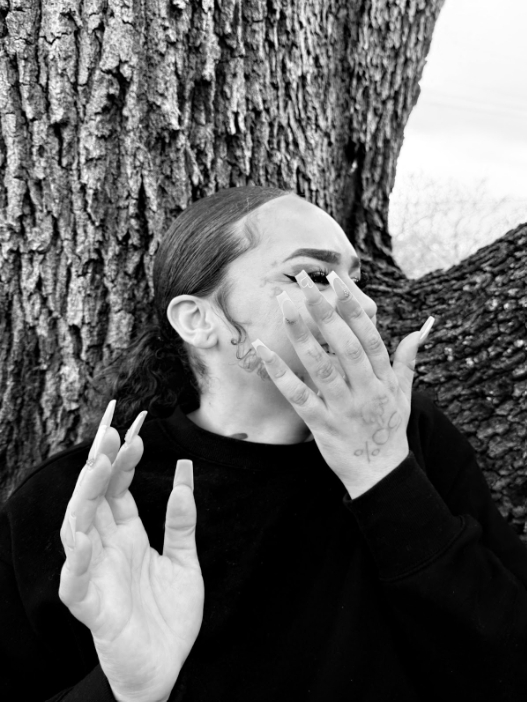
Delicia “Lici” Carmichael is the first featured voice in Incomplete Sentences, a year-long initiative that challenges us to see beyond the verdict.
Delicia Carmichael was fifteen years old when her trafficker coerced her into an act that would come to define her in the eyes of the law. But it did not define who she was, who she would become, or what she had already survived. Sentenced to decades in a Texas prison as a child, Lici has spent her incarceration refusing to be reduced to a case number or a conviction. She has become an advocate, a storyteller, and a voice for those whose circumstances are deliberately excluded from courtroom narratives.
Her journey from trafficking victim to imprisoned minor to self-determined activist reveals not just one person’s resilience, but the systemic failures that make stories like hers possible—and the urgent need to listen when those directly impacted finally get the chance to speak for themselves.
Before the Verdict
Long before the courtroom, there was a child trying to survive. Lici describes a childhood shaped by instability, abuse, and a mother whose promises were written, as she puts it, in red—the color of broken commitments and danger. She was arrested six times before she turned fourteen. Six times handcuffed, booked, processed, and labeled. But not once, she says, did anyone ask the right question.
“They asked me what I did. They never asked me who was doing something to me. Nobody asked what pushed a 14-year-old girl to that point.” — Lici Carmichael
By fifteen, Lici was deep in a trafficking situation she did not have the language or the power to escape. The adults around her—the ones tasked with her care and her correction—saw behavior. They saw attitude. They saw a case. What they did not see, Lici says, was a little girl in pain.
The System’s Blind Spot
When Lici was sentenced, she received twenty years. That number was larger than the total number of years she had been alive. The system processed her as a perpetrator. The context of her trafficking, her age, her developmental vulnerability—these were not factors the courtroom was equipped or inclined to weigh.
Lici’s case sits at a painful intersection that the criminal justice system has only recently begun to acknowledge: the place where juvenile sentencing meets human trafficking, where the line between offender and victim is not a line at all, but a tangled web of exploitation, poverty, and institutional failure.
“I was not a problem to manage. I was a child in pain.” — Lici Carmichael
Research in developmental neuroscience has established that adolescents process risk, consequence, and decision-making differently than adults. The same neuroplasticity that makes young people vulnerable to coercion also gives them a remarkable capacity for growth, change, and rehabilitation—if they are given the opportunity.
Finding the Words
Inside prison, Lici discovered something no one could take from her: her voice. She did not find it in a classroom. She found it in the silence, in the space where everything else had been stripped away—her freedom, her childhood, the ability to control what happened to her body. What remained were her thoughts and her words.
“I didn’t have control over my body or my sentence, but I had control over what I thought and what I wrote. Once I realized my voice could move people, I understood something powerful.” — Lici Carmichael
Lici began writing poetry, essays, and spoken word pieces. She earned the nickname “the little reporter” for her relentless curiosity and her commitment to telling stories—her own and others’. She turned what she describes as wounds into words, silence into speaking, and shame into protection for someone else.
Her writing does not shy away from the weight of what she has lived. But it refuses to stay there. Her poems move—from red to gold, from chaos to hope, from Point A to Point B along a path that was never a straight line.
Gold Is Forged in Fire
When asked what color she would use to write the promises she is making to herself, Lici chose gold. Not soft yellow, not pale gold. Gold—because gold is forged in fire. Gold survives heat. Gold is refined under pressure. Gold does not disappear when it is burned. It becomes purer.
“If I can introduce myself without the weight of what happened, I would simply say: I am becoming. And that is powerful enough.” — Lici Carmichael
Lici describes herself with three words: unfinished, because she is still growing, still healing, still becoming; resilient, because she has survived what was designed to break her; and purposeful, because she has found a reason to keep fighting.
Standing in the Gap
Today, Lici’s advocacy extends beyond her own story. She writes and speaks on behalf of young people who are trapped in the same systems that failed her—children who are labeled before they are understood, sentenced before they are heard, and discarded before they are given a chance to grow.
“If nobody cares about kids like me, I will. If nobody stands in the gap, I will. I refuse to let another child think they’re disposable just because the world treated them that way.” — Lici Carmichael
Her participation in Incomplete Sentences is an extension of that commitment. It is not about relitigating her case or excusing harm. It is about ensuring that when the public encounters a story like hers, they see the full picture—the developmental context, the systemic failures, the exploitation that preceded the conviction, and the transformation that followed it.
An Incomplete Sentence
Lici’s story is, by design, unfinished. The legal system rendered a verdict, but it could not foreclose the chapters that would come after. Her writing, her advocacy, her refusal to be defined by a single moment—these are the evidence that a sentence, no matter how long, cannot contain the whole of a person.
This is what Incomplete Sentences asks us to consider: that behind every case number is a human being with a history, a capacity for growth, and a future still being written. The question is whether we are willing to listen.
“My writing is my voice. When I speak I’m not heard. To read this is your choice. It’s nothing forced. I’ve been shut down and silenced my whole life. Now I will use my voice to fight.” — Lici Carmichael, from her original poem “My Writing Is My Voice”
Media Contact
Company Name: Incomplete Sentences
Email: Send Email
Country: United States
Website: https://incompletesentences.org