
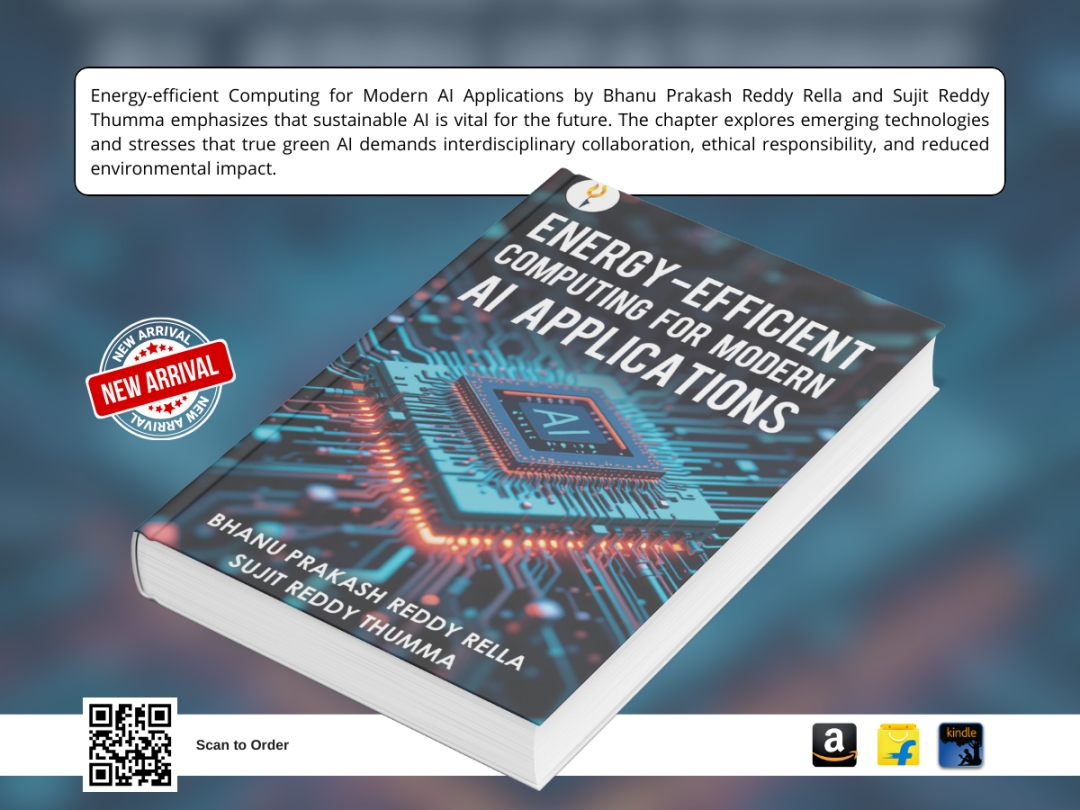
Charting a Sustainable Future for AI: A Deep Dive into Energy-efficient Computing for Modern AI Applications
The current landscape of technological advancement is profoundly shaped by the rapid adoption and sophistication of artificial intelligence. AI, in its various forms—from large language models to complex deep learning networks—is undoubtedly the engine of innovation across virtually every industry. However, this transformative power comes with a mounting, often overlooked, cost: ever-increasing energy consumption. This critical, emerging challenge threatens the long-term sustainability and scalability of modern AI systems.
It is against this backdrop of urgent environmental and economic concern that the seminal work, Energy-efficient Computing for Modern AI Applications, emerges as a vital, groundbreaking resource. Authored by the distinguished experts Bhanu Prakash Reddy Rella and Sujit Reddy Thumma, the book provides not merely a diagnosis of the problem, but a comprehensive, actionable roadmap for building a truly sustainable AI ecosystem.The Problem: A Conundrum of Scale
The authors begin by providing an in-depth exploration of the environmental and economic impact of contemporary AI technologies. As AI models continue their trajectory toward increased complexity—characterized by billions of parameters and vast training datasets—their energy requirements have surged exponentially. This phenomenon is generating significant concerns:
-
Environmental Strain: The carbon footprint associated with training a single, massive AI model can be comparable to the lifetime emissions of multiple cars, directly contradicting global efforts toward net-zero emissions.
-
Economic Viability: The enormous operational expenditures (OpEx) for power-hungry data centers risk making advanced AI inaccessible or economically unviable for smaller organizations and research institutions.
-
Scalability Limit: The relentless pursuit of scale, often termed the “bigger is better” paradigm, is fundamentally unsustainable, pointing to a looming wall that limits future innovation.
The Solution: A Framework for Sustainable AI
Energy-efficient Computing for Modern AI Applications serves as a timely and essential solution, moving beyond general discussions to offer concrete, practical strategies designed to drastically reduce energy consumption without any compromise on computational performance or model accuracy. The book systematically covers a wide spectrum of interconnected domains crucial for achieving energy efficiency:
-
Energy-Efficient Hardware and Microarchitectures: This includes exploring innovations in specialized AI accelerators (like custom ASICs and FPGAs), low-power processors, and advanced techniques such as approximate computing and heterogeneous computing platforms designed to maximize performance per watt.
-
Advanced Memory Architectures: Recognizing that data movement (memory access) is often more energy-intensive than computation itself, the book delves into technologies like In-Memory Computing (IMC) and Near-Memory Computing (NMC) to minimize the energy cost of data retrieval and processing.
-
Optimized Algorithms and Software: The focus shifts to the software layer with detailed coverage of techniques such as model compression (pruning, quantization, and knowledge distillation), efficient network architectures (e.g., lightweight convolutional networks), and sparse matrix operations that reduce the overall computational load.
-
Sustainable Data Center Practices: Beyond the chip level, the authors address the infrastructure, advocating for advanced cooling technologies (like liquid immersion cooling), efficient power management systems, and the strategic use of renewable energy sources to power the underlying compute infrastructure.
The Vision: Championing “Green AI”
A core philosophical contribution of the book is its emphasis on “Green AI.” This concept challenges the traditional, resource-extravagant methodology of endless model scaling and instead advocates for efficiency as a primary metric, equal in importance to innovation and performance. Green AI promotes smarter, more resource-conscious solutions, shifting the conversation from how big a model is to how efficient it is. This paradigm demands that researchers and practitioners prioritize the environmental and resource cost of their AI systems from the initial design phase.Real-World Impact and Future Trajectories
Crucially, the book grounds its technical discussion in practical reality, thoroughly examining real-world applications and demonstrating the tangible benefits of implementing energy-efficient AI across diverse high-impact sectors:
-
Healthcare: Deploying low-power AI for on-device medical imaging analysis and remote patient monitoring.
-
Finance: Using optimized models for high-frequency trading and fraud detection with reduced latency and energy overhead.
-
Robotics and Autonomous Systems: Essential for maintaining battery life and operational longevity in mobile platforms.
-
Natural Language Processing (NLP): Developing smaller, yet highly effective, models for deployment on edge devices and for real-time inference.
With the acceleration of AI adoption globally, the imperative for sustainable solutions has reached an all-time high. Energy-efficient Computing for Modern AI Applications provides not just a comprehensive technical guide for researchers, developers, and engineers, but a definitive roadmap for organizations seeking to build AI systems that are not only powerful, intelligent, and scalable but also profoundly environmentally responsible. It offers a transformative vision for the future of AI, one where technological innovation and global sustainability are inextricably and productively aligned.
Media Contact
Company Name: Hemant Bansal
Contact Person: Hemant Bansal
Email: Send Email
Phone: 8895095404
Country: India
Website: verseskindlerpublication.com