
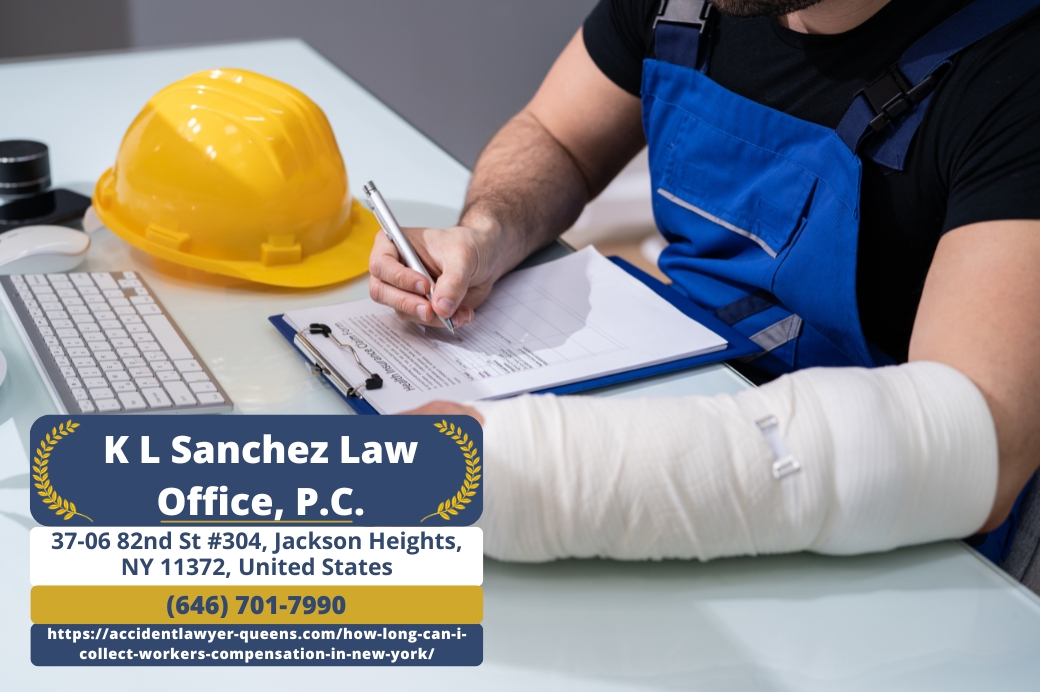
QUEENS, NY – One of the most pressing questions injured workers face after a workplace accident is how long they can expect to receive financial support—and the answer depends on whether the disability is classified as temporary or permanent, total or partial, and on what the medical evidence shows about the worker’s capacity to return to work. Queens workers’ compensation attorney Keetick L. Sanchez of K L Sanchez Law Office, P.C. (https://accidentlawyer-queens.com/how-long-can-i-collect-workers-compensation-in-new-york/) explains how New York’s workers’ compensation system determines the type and duration of benefits for each category of disability.
According to Queens workers’ compensation attorney Keetick L. Sanchez, New York’s workers’ compensation system provides two categories of benefits: medical coverage for all necessary treatment related to the workplace injury, which continues for the lifetime of the injured worker with no time limit, and wage replacement benefits, which are calculated at two-thirds of the worker’s average weekly wage multiplied by the percentage of disability, subject to an annual state-set maximum. Temporary disability benefits continue until a treating physician determines the worker has reached Maximum Medical Improvement, the point at which the condition has stabilized and is unlikely to improve further with additional treatment, after which the case is evaluated for permanent disability classification. “Understanding where you are in the process and what your classification means for your benefits is something many workers don’t fully grasp until a claim is in jeopardy,” Sanchez notes.
Queens workers’ compensation attorney Keetick L. Sanchez emphasizes that Permanent Total Disability benefits in New York are designed to provide lifetime financial support for workers who are permanently and entirely unable to engage in any gainful employment due to a work-related injury or illness. There is no statutory limit on the number of weeks payable for a Permanent Total Disability classification. By contrast, Permanent Partial Disability benefits are tied to the worker’s Loss of Wage-Earning Capacity percentage, with benefit duration ranging from 225 weeks for a 1–15% capacity loss up to 525 weeks for a 96–99% capacity loss. Schedule Loss of Use awards provide a separate, one-time payment for permanent functional impairment to specific body parts such as arms, legs, hands, feet, and hearing, calculated by multiplying the degree of impairment by the statutory number of weeks assigned to that body part.
Workers who return to employment in a limited capacity or modified role may continue receiving partial wage replacement benefits adjusted to reflect the difference between their pre-injury average weekly wage and their current reduced earnings. The firm advises that returning to work does not automatically end benefit eligibility, but it does reduce the weekly amount proportionally. An injured worker earning $500 per week in a modified role after previously earning $900 per week would receive approximately two-thirds of the $400 wage difference as a continuing benefit, subject to the state maximum.
“Insurance carriers sometimes push for a settlement or closure of a claim before a worker fully understands the long-term value of their benefits,” advises Sanchez. “A lump-sum settlement may sound appealing but could be worth less than continued weekly payments over time, particularly for workers with permanent conditions.” When significant discrepancies arise between a treating physician’s assessment and an Independent Medical Examination conducted by a physician selected by the insurance carrier, the Workers’ Compensation Board may schedule a hearing where both medical opinions are presented and a Workers’ Compensation Law Judge evaluates the evidence.
Injured workers must file Form C-3 with the Workers’ Compensation Board within two years of the injury date and notify their employer in writing within 30 days of the accident. Medical benefits remain available even after wage replacement benefits end, ensuring that workers continue to receive necessary treatment regardless of changes in their disability classification or employment status.
For Queens workers navigating a complex workers’ compensation claim or facing challenges with an insurance carrier, consulting with an experienced attorney can help ensure the full scope of available benefits is pursued.
About K L Sanchez Law Office, P.C.:
K L Sanchez Law Office, P.C. is a Queens-based personal injury and workers’ compensation law firm serving injured workers throughout New York City. Led by attorney Keetick L. Sanchez, the firm represents clients from its Jackson Heights office at 37-06 82nd Street, Suite 304, across Queens, Brooklyn, the Bronx, Manhattan, and Staten Island. Services are available in English and Spanish. For consultations, call (646) 701-7990.
Embeds:
Youtube Video: https://www.youtube.com/watch?v=siFdmJv-RPs
GMB: https://www.google.com/maps?cid=2729652254808699760
Email and website
Email: accidentlawny1@gmail.com
Website: https://accidentlawyer-queens.com/
Media Contact
Company Name: K L Sanchez Law Office, P.C.
Contact Person: Keetick Sanchez
Email: Send Email
Phone: (646) 701-7990
Address:37-06 82nd St #304
City: Jackson Heights
State: New York 11372
Country: United States
Website: https://accidentlawyer-queens.com/