
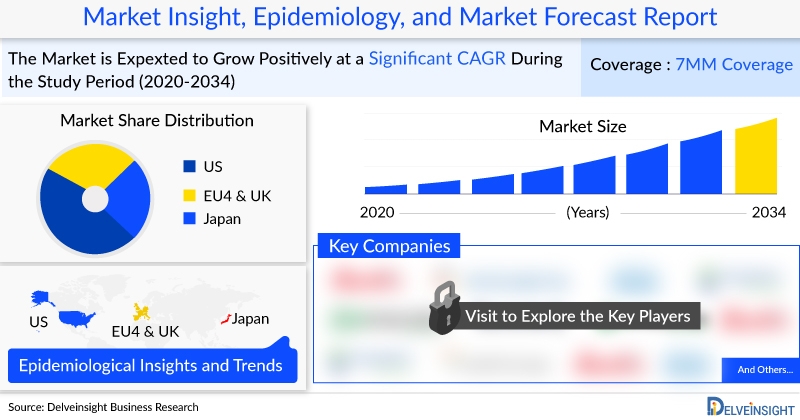
DelveInsight’s Platinum-Resistant Ovarian Cancer Market Insights report delivers an in-depth evaluation of existing treatment paradigms, investigational drugs in development for platinum-resistant ovarian cancer, the market share held by individual therapies, and both historical and projected market size spanning 2020 to 2034 across the major markets (the US, EU4, the UK, and Japan).
The anticipated introduction of emerging candidates such as Corcept Therapeutics (relacorilant), Advenchen Laboratories (catequentinib), Regeneron Pharmaceuticals (ubamatamab), and others is expected to further accelerate market expansion.
Platinum-Resistant Ovarian Cancer Market Overview
- The platinum-resistant ovarian cancer market across key regions is projected to experience robust growth by 2034.
- In 2024, the United States represented the largest share of the platinum-resistant ovarian cancer treatment market within the 7MM, surpassing other significant regions such as the EU4 nations, the United Kingdom, and Japan.
- Across the 7MM, the US recorded the highest number of ovarian cancer cases, totaling approximately 20,000.
- Prominent companies advancing therapies for platinum-resistant ovarian cancer—including Corcept Therapeutics, Advenchen Laboratories, Regeneron Pharmaceuticals, Laekna Therapeutics, and others—are actively developing innovative treatments anticipated to enter the platinum-resistant ovarian cancer market in the forthcoming years.
- Encouraging therapeutic candidates currently under clinical investigation for platinum-resistant ovarian cancer include Relacorilant (CORT125134), Catequentinib (Anlotinib), Ubamatamab (REGN4018) ± Cemiplimab, Afuresertib (LAE002) combined with Paclitaxel, among others.
Explore more about novel platinum-resistant ovarian cancer therapies @ New Treatments for Platinum-Resistant Ovarian Cancer
Primary Drivers Stimulating Growth in the Platinum-Resistant Ovarian Cancer Market
Increasing Incidence of Ovarian Cancer
In 2024, the 7MM reported approximately 61,000 newly diagnosed ovarian cancer cases. With ovarian cancer incidence continuing to rise and long-term forecasts indicating meaningful increases in both incidence and mortality, the expanding patient population is driving demand for additional second- and later-line therapies, including treatments specifically targeting platinum-resistant disease.
Clinical Validation of FRα
The recognition of FRα as a predictive biomarker for ELAHERE (mirvetuximab soravtansine) signifies a transition toward precision medicine and biomarker-focused therapeutic strategies. As the sole antibody-drug conjugate (ADC) assessed in a pivotal PROC trial, mirvetuximab capitalizes on FRα overexpression in ovarian tumors to deliver cytotoxic agents selectively, presenting a compelling therapeutic option characterized by enhanced specificity and minimized off-target toxicity.
Advancement of Innovative PROC Therapies
The therapeutic pipeline for PROC continues to expand, with companies such as Corcept Therapeutics (relacorilant), Advenchen Laboratories (catequentinib), Regeneron Pharmaceuticals (ubamatamab), Laekna Therapeutics (afuresertib), and others progressing candidates through various stages of clinical development.
Platinum-Resistant Ovarian Cancer Market Insights
The therapeutic landscape for platinum-resistant ovarian cancer remains complex and challenging, as conventional single-agent chemotherapy has demonstrated limited efficacy, prompting intensified focus on targeted agents and combination regimens. While established treatment modalities such as PARP inhibitors and anti-angiogenic agents remain integral components of care, the field is increasingly shifting toward biomarker-guided interventions and novel mechanisms of action.
A landmark achievement occurred in 2024 with the full FDA approval of ELAHERE for patients with folate receptor alpha (FRα)-positive PROC, demonstrating improvements in both progression-free survival and overall survival relative to chemotherapy, and reinforcing the significance of molecular diagnostics in treatment selection. Concurrently, investigational agents such as relacorilant (CORT125134) in combination with nab-paclitaxel have exhibited promising clinical activity, while catequentinib (anlotinib), a multi-targeted tyrosine kinase inhibitor, is under evaluation for resistant disease management.
Furthermore, immunotherapeutic strategies, including ubamatamab (REGN4018), a MUC16-targeting bispecific T-cell engager administered with or without cemiplimab, and the AKT inhibitor afuresertib (LAE002) in combination with paclitaxel, underscore the ongoing transition toward multi-pathway, biomarker-driven therapeutic frameworks.
For further insights into platinum-resistant ovarian cancer treatment options, visit @ Approved Platinum-Resistant Ovarian Cancer Drugs
Platinum-Resistant Ovarian Cancer Competitive Landscape
The PROC development pipeline is steadily expanding, with Corcept Therapeutics (relacorilant), Advenchen Laboratories (catequentinib), Regeneron Pharmaceuticals (ubamatamab), Laekna Therapeutics (afuresertib), and other companies advancing candidates at different phases of clinical evaluation.
Corcept Therapeutics’ relacorilant functions as a selective cortisol modulator, specifically targeting the glucocorticoid receptor (GR) without interacting with other hormonal receptors. The company is exploring its application across multiple serious conditions, including ovarian, adrenal, and prostate cancers, as well as Cushing’s syndrome.
Advenchen Laboratories’ anlotinib is an innovative oral receptor tyrosine kinase (RTK) inhibitor that targets VEGFR-2 and -3, FGFR1-4, PDGFR-α/β, c-Kit, and Ret. By exerting multi-target inhibition, it suppresses both tumor growth and angiogenesis. The therapy is presently undergoing Phase III clinical trials for patients with platinum-sensitive or platinum-resistant recurrent or metastatic ovarian cancer.
In February 2024, Advenchen Laboratories announced that the Japan run-in cohort comprising three patients in the AL3818-US-002 global Phase III PROC study successfully completed dose-limiting toxicity (DLT) evaluation within six months, and the study has subsequently progressed into its close-out phase.
The expected commercialization of these investigational therapies is anticipated to significantly redefine the platinum-resistant ovarian cancer market environment in the years ahead. As these next-generation treatments advance toward regulatory clearance, they are projected to establish new therapeutic standards and create avenues for continued medical advancement and economic development.
Learn more about platinum-resistant ovarian cancer therapies @ Platinum-Resistant Ovarian Cancer Clinical Trials
Recent Updates in the Platinum-Resistant Ovarian Cancer Market
- In July 2025, Corcept Therapeutics disclosed the submission of a new drug application (NDA) to the US FDA for relacorilant, its proprietary selective cortisol modulator, intended for the treatment of patients with PROC.
- In April 2025, Mural Oncology revealed that after reviewing findings from its Phase II ARTISTRY-6 melanoma trial and previously disclosed outcomes from the Phase III ARTISTRY-7 PROC trial, it has decided to discontinue all clinical development of nemvaleukin alfa and initiate an immediate evaluation of strategic alternatives aimed at maximizing shareholder value.
- In March 2025, Sutro announced the conclusion of a strategic portfolio reassessment, leading to prioritization of its wholly owned next-generation ADC programs. Although Sutro will not independently continue development of luveltamab tazevibulin (luvelta), being explored for PROC, it remains receptive to potential partnership opportunities.
Understanding Platinum-Resistant Ovarian Cancer
Ovarian cancer constitutes approximately 3% of all cancers diagnosed in women but ranks as the fifth leading cause of cancer-related mortality, following lung, breast, colorectal, and pancreatic cancers. It may originate from diverse ovarian cell types, including epithelial cells lining the ovary, germ cells responsible for egg formation, and stromal cells that support hormone production and structural integrity.
Despite being less prevalent than certain other malignancies, ovarian cancer exhibits the highest mortality rate among gynecologic cancers and is frequently referred to as a “silent killer” due to its typically asymptomatic progression and the absence of effective screening methods. Consequently, nearly 75% of patients receive diagnosis at advanced stages. While less common than breast cancer, ovarian cancer is nearly three times more fatal.
Although platinum-based chemotherapy continues to serve as the primary treatment modality, recurrence rates remain high. Platinum-resistant ovarian cancer (PROC) is defined by disease relapse within six months after completion of platinum-based therapy and represents a significant therapeutic challenge due to resistance mechanisms.
Platinum-Resistant Ovarian Cancer Epidemiology Segmentation
The epidemiology section of the platinum-resistant ovarian cancer report provides detailed insights into historical and present patient populations, along with projected trends across leading markets. Among histological subtypes, serous ovarian cancer accounted for the highest proportion of cases throughout the 7MM. Approximately 80% of patients with advanced-stage ovarian cancer and 20% with early-stage disease experience recurrence following first-line therapy.
The report offers epidemiological analysis for 2020–2034 in the 7MM, categorized into:
- Total Incident Cases of Ovarian Cancer
- Site-specific Incident Cases of Ovarian Cancer
- Stage-specific Incident Cases of Ovarian Cancer
- Mutation-specific Incident Cases of Ovarian Cancer
- Line-wise Treated Cases of Ovarian Cancer
- Total Incident Cases of Platinum-Resistant Ovarian Cancer
Platinum-Resistant Ovarian Cancer Market Report Specifications
- Study Duration: 2020 – 2034
- Market Coverage: 7MM [The United States, the EU4 (Germany, France, Italy, and Spain), the United Kingdom, and Japan].
- Major Companies: Corcept Therapeutics, Advenchen Laboratories, Regeneron Pharmaceuticals, Laekna Therapeutics, and others
- Key Therapies: Relacorilant (CORT125134), Catequentinib (Anlotinib), Ubamatamab (REGN4018) ± Cemiplimab, Afuresertib (LAE002) + Paclitaxel, and others
- Therapeutic Assessment: Currently marketed and pipeline therapies
- Market Dynamics: Core forecast assumptions and future outlook
- Competitive Intelligence: SWOT evaluation and entry strategies
- Unmet Needs, KOL perspectives, analyst insights, market access and reimbursement analysis
Download the report to explore the drivers shaping platinum-resistant ovarian cancer therapeutic market trends @ Platinum-Resistant Ovarian Cancer Market Trends
Table of Contents
- Platinum-Resistant Ovarian Cancer Market Highlights
- Introduction to the Platinum-Resistant Ovarian Cancer Market Report
- Executive Overview of Platinum-Resistant Ovarian Cancer (PROC)
- Major Events
- Epidemiology and Market Research Methodology
- Market Overview Snapshot
- Disease Background and Overview
- Treatment Landscape and Guidelines
- Epidemiology and Patient Demographic
- Patient Journey
- Marketed Therapies
- Emerging Therapies
- 7MM Market Analysis
- Unmet Needs
- SWOT Analysis
- KOL Perspectives
- Market Access and Reimbursement
- References
- Research Methodology
About DelveInsight
DelveInsight is a leading Life Science market research and business consulting company recognized for its off-the-shelf syndicated market research reports and customized solutions to firms in the healthcare sector.
Media Contact
Company Name: DelveInsight Business Research LLP
Contact Person: Ankit Nigam
Email: Send Email
Phone: +14699457679
Address:304 S. Jones Blvd #2432
City: Albany
State: New York
Country: United States
Website: https://www.delveinsight.com/consulting