
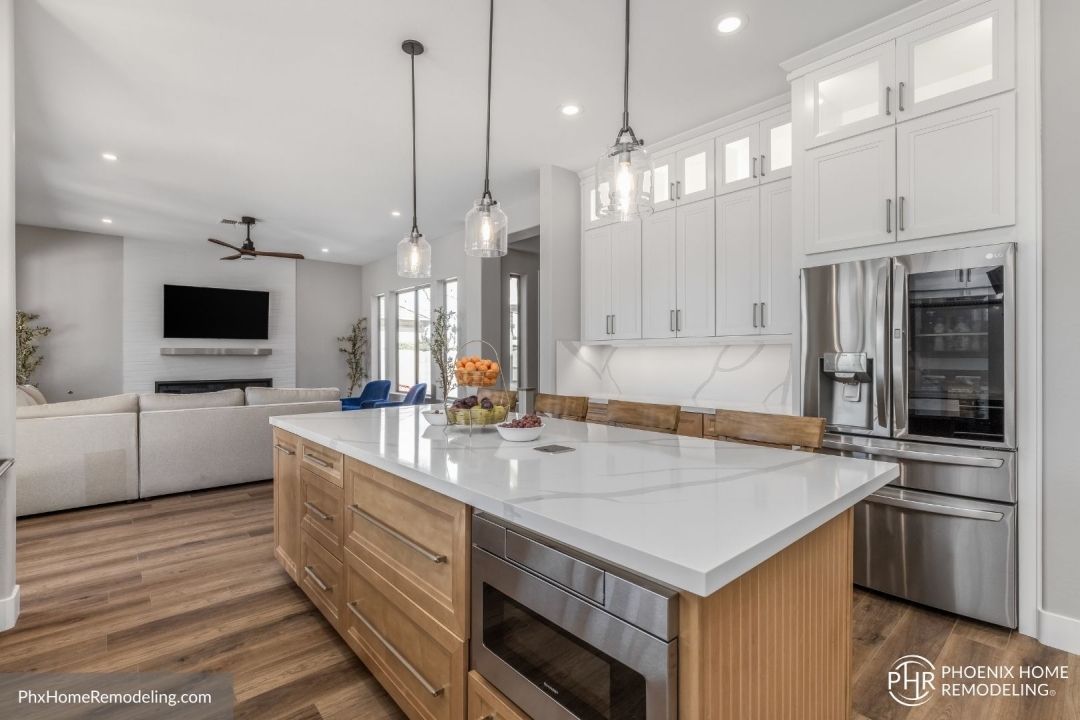
May 23, 2026 – Kitchen remodeling in Phoenix often begins with a clear visual goal, but the success of the project usually depends on decisions that happen long before demolition. Layout planning, appliance placement, cabinet measurements, lighting design, plumbing locations, countertop fabrication, and material ordering must work together. When those details are handled separately, homeowners can face mid-project revisions that affect cost, sequencing, and schedule.
Many Phoenix homes were built with kitchen layouts that no longer match how families use the space today. Common concerns include narrow walkways, limited prep areas, disconnected dining spaces, aging cabinetry, poor lighting, and appliance locations that interrupt daily routines. As homeowners choose to stay in place rather than relocate, kitchen remodeling has become a way to improve function while updating one of the most frequently used areas of the home.
Phoenix Home Remodeling, a Phoenix-based design-build remodeling company, is emphasizing the importance of early coordination for homeowners planning kitchen remodeling in Phoenix. The company’s planning-first approach focuses on completing feasibility, 3D design, scope alignment, and material selections before construction begins.
Kitchen Layout Decisions Affect More Than Appearance
One of the most important parts of kitchen remodel planning is determining whether the existing layout still supports the homeowner’s daily routine. In many Phoenix homes, kitchens were originally designed around smaller appliances, limited storage expectations, and more closed-off floor plans.
When homeowners request a more open kitchen, larger island, expanded pantry, or improved cooking zone, each layout change can affect several parts of the project. Moving a sink may require plumbing adjustments. Expanding an island may affect electrical placement. Replacing upper cabinets with open visual space may require new storage strategies elsewhere. Changing appliance locations may affect cabinetry dimensions and ventilation planning.
These decisions are easier to manage when design and construction teams coordinate before work begins. Instead of designing a kitchen based only on appearance, the process should account for how every selection affects buildability, sequencing, and installation.
For homeowners researching kitchen remodeling in Phoenix, Phoenix Home Remodeling provides additional project planning information at:https://phxhomeremodeling.com/services/kitchen-remodeling/phoenix-az/
Design-Build Coordination Helps Reduce Mid-Project Revisions
Kitchen remodels involve multiple trades working in a specific order. Cabinetry, electrical, plumbing, drywall, flooring, countertops, backsplash, and finish carpentry all depend on accurate measurements and clear design decisions.
When design and construction are managed separately, homeowners may receive drawings that look complete but still require field adjustments once construction begins. Those adjustments can lead to revised cabinet orders, delayed countertop templates, relocated fixtures, or finish changes that were not anticipated during planning.
A design-build process reduces this risk by connecting design intent with construction execution from the beginning. Before construction starts, the team can confirm:
-
Appliance specifications and exact dimensions
-
Cabinet layout and storage requirements
-
Island size, seating clearance, and circulation space
-
Lighting zones and switch placement
-
Countertop material and edge details
-
Sink, faucet, and fixture locations
-
Flooring transitions and finish coordination
When these items are coordinated early, homeowners gain a clearer understanding of what will be built and how the work will be sequenced.
Phoenix Homes Often Require Careful Space Planning
Kitchen remodeling in Phoenix often involves homes built during different development periods, each with its own layout challenges. Some older homes have compact kitchens with limited storage and segmented rooms. Homes from later development periods may have larger footprints but still include angled islands, oversized soffits, desk niches, or pantry locations that no longer serve the homeowner well.
Planning should begin by identifying how the homeowner uses the kitchen throughout the day. A household that cooks frequently may need more prep space, deeper drawers, and improved task lighting. A homeowner who entertains may prioritize island seating, beverage storage, and better flow between the kitchen and living area. A family with several people using the kitchen at once may need wider walkways and separated work zones.
These lifestyle details influence more than style. They affect cabinetry design, outlet placement, appliance selection, storage planning, and lighting. A remodel that starts with these decisions is more likely to support daily use once construction is complete.
Cabinetry and Appliance Planning Must Be Aligned Early
Cabinetry is one of the most schedule-sensitive parts of a kitchen remodel. Cabinet dimensions affect appliance openings, countertop measurements, sink placement, backsplash layout, and finished walkways. If cabinet plans are changed after construction begins, several other parts of the project may also need to shift.
Appliance planning is equally important. Refrigerators, ranges, wall ovens, dishwashers, microwaves, and beverage centers each have clearance requirements and utility needs. Even small differences in appliance depth can affect aisle width, cabinet alignment, and panel placement.
During early planning, homeowners should confirm whether they want to keep appliances in their current locations or adjust the layout. They should also decide whether the kitchen needs specialty storage such as tray dividers, pull-out shelves, spice storage, utensil drawers, appliance garages, or larger pantry zones.
A coordinated design-build process allows these details to be reviewed together rather than treated as isolated decisions.
Lighting and Electrical Planning Should Not Be Delayed
Lighting has a major effect on how a finished kitchen feels and functions. Many older Phoenix kitchens rely on limited overhead lighting that does not provide enough illumination for cooking, cleaning, or entertaining.
Modern kitchen remodel planning often includes layered lighting. This may involve recessed ceiling lights, pendant lights over an island, under-cabinet lighting, task lighting near prep areas, and accent lighting where appropriate. Electrical planning also includes outlet placement, appliance circuits, charging areas, and switch locations.
If lighting is not planned early, homeowners may discover during construction that fixtures conflict with ceiling framing, cabinets, or ventilation pathways. By coordinating lighting during the design phase, the construction team can plan placement with greater accuracy and reduce the likelihood of layout changes once work is underway.
Countertop, Backsplash, and Finish Selections Affect Sequencing
Finish selections are often viewed as design choices, but they also affect project sequencing. Countertop slabs must be selected, measured, fabricated, and installed in coordination with cabinet installation. Backsplash tile layout depends on cabinet height, outlet placement, range location, and countertop thickness. Flooring transitions must be planned around adjacent rooms and existing surfaces.
When homeowners wait too long to finalize materials, the project can become more vulnerable to delays. A planning-first process encourages selections to be completed before construction starts so products can be ordered, reviewed, and coordinated with the project schedule.
This does not mean every kitchen needs the same design. It means each selection should be made with an understanding of how it affects the rest of the remodel.
Common Kitchen Remodel Planning Ranges in Phoenix
Final kitchen remodel pricing depends on kitchen size, layout changes, cabinet selections, countertop material, appliance coordination, electrical needs, plumbing adjustments, flooring, and finish details. However, homeowners planning a full kitchen remodel in Phoenix often benefit from understanding common planning ranges before design begins.
A full kitchen remodel can vary significantly based on scope. Projects that keep the general footprint may require less structural and utility coordination than projects involving layout reconfiguration, wall changes, larger islands, or expanded storage. Cabinetry, countertops, and appliances can also create a wide range of final investment levels.
Rather than relying on early guesses, Phoenix Home Remodeling provides fixed construction pricing only after planning, design, feasibility review, and material selections are completed. This approach is intended to reduce uncertainty and help homeowners make decisions with a more complete project scope.
Planning Before Construction Creates a More Predictable Experience
Kitchen remodels can become stressful when too many decisions are left unresolved. Homeowners may feel pressured to make fast choices during construction, especially when cabinet dimensions, fixture locations, or material selections were not finalized ahead of time.
A planning-first approach helps reduce that pressure by organizing the project before construction begins. Homeowners can review 3D designs, understand layout options, make finish selections, and confirm scope details before the remodel moves forward.
This type of preparation is especially important in kitchens because so many details are connected. A change to an island may affect lighting. A change to a sink may affect plumbing and countertops. A change to cabinet height may affect backsplash tile. A change to flooring may affect transitions into adjacent spaces.
By coordinating these decisions early, homeowners can enter construction with fewer unknowns and a clearer understanding of the finished plan.
About Phoenix Home Remodeling:
Phoenix Home Remodeling is a Phoenix-based design-build remodeling company specializing in whole home, kitchen, bathroom, shower, and interior renovations.
The company uses a planning-first process that completes feasibility, material selections, and 3D design before construction begins. Fixed construction pricing is provided only after full planning and design are finalized to reduce surprises and change orders.
Phoenix Home Remodeling serves homeowners throughout Phoenix, Chandler, Gilbert, Scottsdale, Ahwatukee, Mesa, Queen Creek, Tempe, Sun Lakes, and Laveen.
Home Remodeling is licensed in Arizona under ROC #313636 (B-3 General Remodeling and Repair Contractor).
Third-Party Validation and Recognition for Phoenix Home Remodeling:
-
Rated Best Phoenix Kitchen Remodeler by Trust Analytica
-
Houzz Best of Service 2020–2026
-
BBB Accredited Business with an A+ rating
-
4.9 rating with 200+ public reviews
-
Member of National Association of Remodeling Industry (NARI)
-
Nextdoor Neighborhood Favorite
-
Recognized as Best Kitchen Phoenix by Phoenix Review
Phoenix Home Remodeling’s Google business listing: https://goo.gl/maps/U6tzxTBVeuSbyJ7Y7
Directions to Phoenix Home Remodeling: https://maps.app.goo.gl/VviHdJx6iSoMZALp9
Phoenix Home Remodeling on Facebook: https://www.facebook.com/PhoenixHomeRemodelingCompany/posts/pfbid02dX1xkaUTsfSknx7qgaNzFw8MNdkY16paYnwpT1BizQTytcA1UHaZxGKmcpYP4DEhl
Phoenix Home Remodeling on X: https://x.com/PhxHmRemodeling/status/2051358699734888763?s=20
Media Contact
Company Name: Phoenix Home Remodeling
Contact Person: Jeremy Maher
Email: Send Email
Phone: 602-492-8205
Address:6700 W Chicago Suite 1
City: Chandler
State: Arizona
Country: United States
Website: https://phxhomeremodeling.com/services/kitchen-remodeling/phoenix-az/