
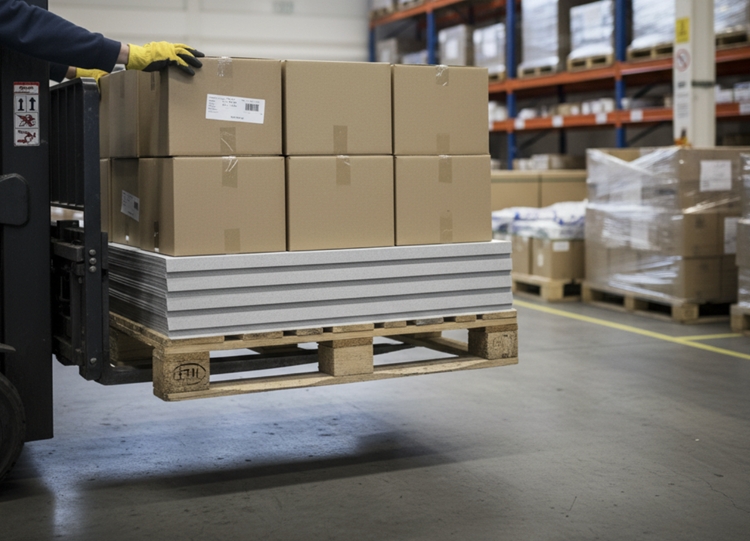
In a logistics landscape defined by container backlogs, driver shortages and volatile fuel prices, the most decisive innovations are often the least flashy. While headlines focus on autonomous trucks and AI-driven routing, the quiet revolution happens in the small details that keep pallets stable, products protected and shipments on schedule. Among those understated tools, grip sheets have emerged as one of the most effective ways to secure loads and cut waste without expensive technology upgrades.
At first glance, a grip sheet looks like an ordinary piece of paper. In reality, it is a high-friction layer placed between products on a pallet, designed to stop boxes, bags or trays from sliding during transport and handling. As logistics networks become more complex and just-in-time deliveries more critical, these sheets play a surprisingly central role in keeping goods upright and damage-free from factory floor to store shelf.
Why pallet stability suddenly matters more
Retailers and manufacturers push for higher stacking, faster loading and fewer stretch-wrap layers to save time and money. At the same time, trucks and containers travel longer distances, often across borders and through multiple terminals. Every sharp turn, sudden brake or uneven ramp introduces a risk that stacked goods tilt, shift or collapse.
When a pallet fails, the impact goes far beyond a few dented boxes. Damaged products trigger insurance claims, customer complaints, urgent replacement shipments and extra manual handling. In food, pharma and cosmetics, even minor damage often means full disposal due to safety and quality rules. In a climate where margins are under pressure and sustainability targets tighten, avoidable waste on the road becomes increasingly unacceptable.
Grip sheets respond to this pressure with a straightforward mechanical solution. By increasing the friction between layers, they reduce the need to overwrap pallets or rely on heavy corner protection. The result is a more stable load that withstands both forklift maneuvers in the warehouse and hard braking on the highway.
The overlooked cost of damaged goods
Supply chain managers often track fuel, labor and packaging material closely but underestimate the hidden cost of in-transit damage. A single collapsed pallet in a regional distribution center might require:
- Repacking or disposing of dozens of products
- Extra labor to clean up and restack
- Administrative time for reporting and insurance
- Emergency shipments to keep shelves full
- Potential penalties from retailers for late or incomplete deliveries
When these incidents repeat across a year, the financial drain becomes substantial. For consumer brands, the reputational impact also matters: a crumpled display or leaking container in a store aisle sends a poor signal to shoppers, even if the product itself remains usable.
By adding a thin stabilizing layer under each stack, companies reduce the frequency of such incidents dramatically. This is particularly important for high-value goods like electronics, spirits, specialty foods or pharmaceutical products, where even a small number of damaged units represents a serious loss.
Sustainability pressure reshapes packaging choices
Corporate sustainability commitments push companies to cut plastic use, lower CO₂ emissions and reduce waste along the entire supply chain. Traditional load securing often relies heavily on stretch film and shrink wrap, which are difficult to recycle and highly visible in waste streams.
Grip sheets support a shift away from plastic-heavy solutions. Because they create friction between layers, warehouses typically use fewer wraps per pallet or lighter film grades without compromising stability. Many sheets are made from recyclable paper and fit seamlessly into existing paper and cardboard recycling flows at distribution centers and retail backrooms.
This change matters as regulators tighten rules on single-use plastics and large retailers demand greener packaging from suppliers. Reducing plastic film use by even a small percentage per pallet adds up quickly across thousands of shipments each week. The combination of better stability and lower material consumption aligns operational efficiency with environmental responsibility rather than putting them in conflict.
Automation and the rise of smart warehouses
The rapid expansion of automated warehouses introduces new demands on pallet quality. Robotics, high-bay storage and automated guided vehicles depend on predictable, uniform loads. A slightly leaning stack or a shifting layer that a human forklift driver might correct on the fly becomes a serious problem for automated systems.
In these environments, grip sheets function as a quiet enabler of automation. They help ensure that cartons do not move when conveyors accelerate, when shuttles change direction or when pallets are lifted to extreme heights in narrow aisles. Consistent friction between layers means fewer jams, fewer system stops and less unplanned manual intervention.
For companies investing millions in warehouse robotics, these relatively low-cost sheets act as a form of insurance. They protect not just the goods but also the performance of the automation itself, keeping throughput high and downtime low.
Human safety on the warehouse floor
Beyond product protection and efficiency, there is a human dimension. Warehouse workers rank among those with the highest rates of workplace injuries, often related to handling unstable loads. A tilting pallet, a sliding stack of boxes or an unexpected collapse can cause serious accidents, especially when employees rush to meet tight loading slots.
By securing each layer, grip sheets reduce the likelihood that a stack shifts when a pallet is nudged, lifted or turned. Forklift drivers handle more predictable loads, and manual pickers face fewer surprises when they remove boxes from higher levels. In busy cross-dock terminals and peak season operations, this added stability supports a safer working environment.
Safety officers and operations managers increasingly look for such passive, design-based protections that do not rely solely on training or constant vigilance. A more stable pallet is, by definition, a safer pallet.
From niche accessory to strategic tool
What began as a niche packaging accessory now shapes broader decisions about how companies move goods. As transport networks grow more fragile and customer expectations for on-time, damage-free delivery rise, simple physical solutions gain strategic importance.
Grip sheets will not grab headlines like self-driving trucks or drone deliveries, yet they solve a daily, concrete problem: how to keep products intact through every bump and corner between origin and destination. In a supply chain where small disruptions ripple quickly, that reliability matters.
For logistics planners, packaging engineers and sustainability leads, these sheets offer a rare combination of benefits: lower damage rates, reduced plastic use, smoother automation and better worker safety. In an era obsessed with digital transformation, they serve as a reminder that sometimes the smartest upgrade is a thin layer of friction placed in exactly the right spot.
Media Contact
Company Name: Palcut LLC
Contact Person: Henrik Thulesen
Email: Send Email
Country: Denmark
Website: https://palcut.com/