
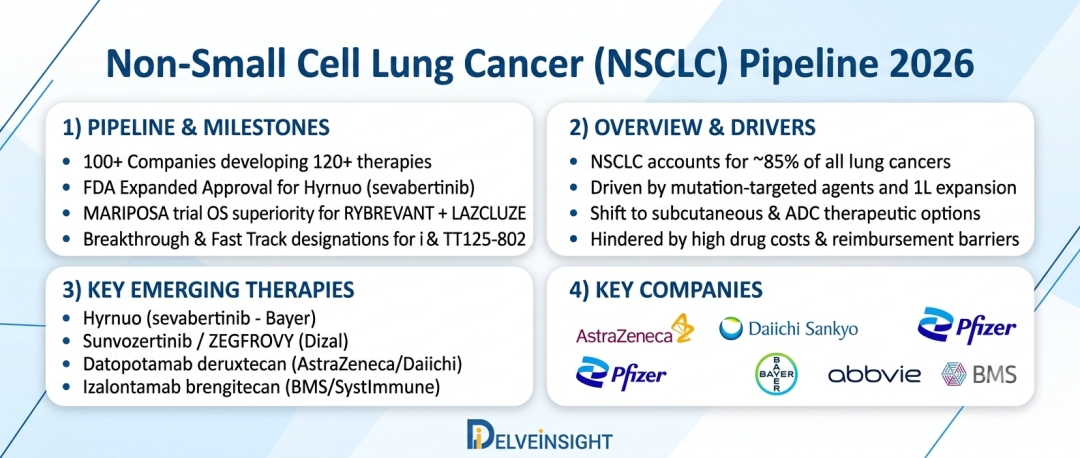
“Non-Small Cell Lung Cancer Pipeline Insight, 2026″ report by DelveInsight outlines comprehensive insights into the present clinical development scenario and growth prospects across the Non-Small Cell Lung Cancer Market.
The Non-Small Cell Lung Cancer Pipeline report embraces in-depth commercial and clinical assessment of the pipeline products from the pre-clinical developmental phase to the marketed phase. The report also covers a detailed description of the drug, including the mechanism of action of the drug, clinical studies, NDA approvals (if any), and product development activities comprising the technology, collaborations, mergers acquisition, funding, designations, and other product-related details.
Get a Free Sample PDF Report to know more about Non-Small Cell Lung Cancer Pipeline Therapeutic Assessment-
https://www.delveinsight.com/report-store/non-small-cell-lung-cancer-pipeline-insight
Some of the key takeaways from the Non-Small Cell Lung Cancer Pipeline Report:
-
Companies across the globe are diligently working toward developing novel Non-Small Cell Lung Cancer treatment therapies with a considerable amount of success over the years.
-
Non-Small Cell Lung Cancer companies working in the treatment market are AbbVie, AstraZeneca and Daiichi Sankyo, Shanghai Henlius Biotech, Moderna Therapeutics/ Merck, BeyondSpring, Cullinan Oncology/ Taiho Pharma, Genentech/Roche, Betta Pharma/ Xcovery, Pfizer, Takeda Pharmaceuticals, AstraZeneca, Janssen, Boehringer Ingelheim, Pfizer, Merck, Bristol-Myers Squibb/Ono Pharmaceutical, Genentech/ Hoffmann-La Roche, AstraZeneca, Bristol-Myers Squibb, AstraZeneca/ Daiichi Sankyo, Amgen, Blueprint Medicines/Rigel Pharmaceuticals, and others, are developing therapies for the Non-Small Cell Lung Cancer treatment
-
Emerging Non-Small Cell Lung Cancer therapies in the different phases of clinical trials are- KEYTRUDA (pembrolizumab), Telisotuzumab vedotin, Datopotamab deruxtecan (Dato-DXd), Serplulimab (HLX10), V940 (mRNA-4157) + Pembrolizumab, Plinabulin + Docetaxel, Zipalertinib, TECENTRIQ (atezolizumab), ENSACOVE (ensartinib), BRAFTOVI + MEKTOVI, ALUNBRIG, TAGRISSO (osimertinib), RYBREVANT (amivantamab), GILOTRIF/GIOTRIF (afatinib maleate), VIZIMPRO (dacomitinib), KEYTRUDA (pembrolizumab), OPDIVO (nivolumab), TECENTRIQ (atezolizumab), IMFINZI (durvalumab), AUGTYRO (repotrectinib), ENHERTU (trastuzumab deruxtecan), LUMAKRAS/ LUMYKRAS (sotorasib), GAVRETO (pralsetinib)xz, and others are expected to have a significant impact on the Non-Small Cell Lung Cancer market in the coming years.
-
In September 2026, Sevabertinib (Hyrnuo): The FDA expanded the indication for sevabertinib, a HER2-targeted kinase inhibitor, to adults with locally advanced or metastatic non-squamous NSCLC harboring HER2 (ERBB2) tyrosine kinase domain activating mutations, including patients who have not received prior systemic therapy for advanced disease. In the treatment-naïve cohort of the Phase I/II SOHO-01 trial, the objective response rate was 75% among 69 patients.
-
In September 2026, Bayer has received accelerated approval from the US Food and Drug Administration (FDA) for Hyrnuo (sevabertinib), expanding its use as a treatment for non-small cell lung cancer (NSCLC). The approval allows Hyrnuo to be used in the frontline setting for adults with locally advanced or metastatic non-squamous NSCLC harboring HER2 (ERBB2) tyrosine kinase domain-activating mutations, as confirmed by an FDA-approved diagnostic test. This expansion provides a new targeted treatment option for patients with this molecularly defined NSCLC subtype, which is often associated with a poor prognosis.
-
In July 2026, The FDA approved zidesamtinib for adults with locally advanced or metastatic ROS1-positive NSCLC who have received at least one prior ROS1 tyrosine kinase inhibitor. The approval provides another targeted option for patients whose disease has progressed after earlier ROS1-directed treatment.
-
In January 2026, Bayer announced that sevabertinib has received Breakthrough Therapy Designation from both the U.S. Food and Drug Administration (FDA) and China’s Center for Drug Evaluation (CDE) for use as a first-line treatment in patients with locally advanced or metastatic non-small cell lung cancer (NSCLC) harboring HER2-activating mutations. Sevabertinib is an oral, reversible small-molecule tyrosine kinase inhibitor (TKI) designed to selectively target HER2-driven disease.
-
In November 2025, Iovance Biotherapeutics, Inc. (NASDAQ: IOVA), a commercial biotech company dedicated to developing and delivering innovative polyclonal tumor-infiltrating lymphocyte (TIL) therapies for cancer patients, has announced interim results from its registrational Phase 2 IOV-LUN-202 trial. The study evaluates lifileucel monotherapy in patients with previously treated advanced nonsquamous NSCLC lacking actionable genetic mutations.
-
In November 2025, The field of biomarker testing in non–small cell lung cancer (NSCLC) is rapidly evolving, expanding from traditional genomic drivers to include protein-based and computationally derived markers. This shift is fueled by the approval of new therapies, especially antibody-drug conjugates (ADCs), and growing insights into mechanisms of therapeutic resistance and susceptibility, as highlighted by Soo-Ryum (Stewart) Yang, MD, during his presentation at the 20th Annual New York Lung Cancers Symposium®.
-
In September 2025, Results from a multinational Phase 2 clinical trial support the potential of sunvozertinib as an effective treatment for patients with previously treated non–small cell lung cancer (NSCLC) harboring specific EGFR mutations. EGFR exon 20 insertion mutations, which account for approximately 12% of all EGFR-mutated NSCLC cases, are typically resistant to most tyrosine kinase inhibitors (TKIs). The findings suggest that sunvozertinib could offer a valuable treatment option for patients with advanced NSCLC who have received prior platinum-based chemotherapy.
-
In September 2025, Data from the Phase 3 FLAURA2 trial (NCT04035486), presented at the 2025 World Conference on Lung Cancer, revealed that combining osimertinib (Tagrisso) with chemotherapy as a first-line therapy led to a statistically significant and clinically meaningful improvement in overall survival (OS) compared to osimertinib alone in patients with EGFR-mutated advanced non–small cell lung cancer (NSCLC).
-
In September 2025, Sun-Min Lim, MD, PhD, an associate professor at Severance Hospital, Yonsei University Health System, highlighted the potential of subcutaneous amivantamab-vmjw (Rybrevant) as a first-line treatment for advanced EGFR-mutant non–small cell lung cancer (NSCLC), based on data from the Phase 2 PALOMA-2 study (NCT05498428). The study assessed subcutaneous amivantamab combined with chemotherapy in patients with advanced NSCLC harboring EGFR exon 20 insertion mutations. Results presented at the 2025 IASLC World Conference on Lung Cancer demonstrated that the subcutaneous formulation achieved comparable response rates, duration of response, and survival outcomes to the intravenous version evaluated in the Phase 3 PAPILLION trial (NCT04538664).
-
In September 2025, Huons expanded its drug portfolio by adding a targeted therapy for non-small cell lung cancer (NSCLC) and is enhancing its drug development pipeline through open innovation. The company announced an agreement with Therapex to in-license TRX-211, a preclinical NSCLC-targeted anticancer candidate, at Huons’ Dong-Am Research Center. Under the deal, Huons will lead clinical trial development for TRX-211 and holds the option to acquire global rights in the future. TRX-211 is an oral tyrosine kinase inhibitor (TKI) designed for EGFR exon 20 insertion-mutant NSCLC. Therapex shared preclinical data demonstrating the drug’s improved efficacy and selectivity at the AACR Annual Meeting 2024.
-
In August 2025, TOLREMO Therapeutics announced that its lead drug candidate, TT125-802, has been granted two FDA Fast Track designations for the treatment of non-small cell lung cancer (NSCLC).
-
In August 2025, Innovent Biologics has obtained FDA approval to initiate a global Phase 3 trial (MarsLight-11) of IBI363, a novel PD-1/IL-2α-bias bispecific antibody, targeting immunotherapy-resistant squamous NSCLC, representing the company’s first global pivotal study.
-
In August 2025, SystImmune and Bristol Myers Squibb announced that the FDA has granted Breakthrough Therapy Designation to izalontamab brengitecan (iza-bren) for treating locally advanced or metastatic non-small cell lung cancer (NSCLC) harboring EGFR exon 19 deletions or exon 21 L858R mutations, following disease progression on EGFR tyrosine kinase inhibitors and platinum-based chemotherapy.
-
In July 2025, Thermo Fisher Scientific announced that the FDA has approved the Oncomine™ Dx Express Test on the Ion Torrent™ Genexus™ Dx Sequencer as a companion diagnostic for Dizal’s ZEGFROVY® (sunvozertinib) to identify EGFR exon 20 insertion mutations in non-small cell lung cancer (NSCLC). The test also enables profiling of 46 genes, providing rapid genomic insights in approximately 24 hours, supporting precision oncology and informed treatment decisions in clinical practice.
-
In March 2025, Johnson & Johnson (NYSE: JNJ) announced Phase 3 MARIPOSA study results showing that RYBREVANT® (amivantamab-vmjw) combined with LAZCLUZE™ (lazertinib) significantly improved overall survival (OS) compared to osimertinib. This head-to-head trial in first-line treatment of locally advanced or metastatic non-small cell lung cancer (NSCLC) patients with EGFR exon 19 deletions or L858R mutations revealed a median OS exceeding one year beyond the three-year median seen with osimertinib, and the median OS has not yet been reached. This marks the first study demonstrating a statistically significant, clinically meaningful OS benefit over osimertinib.
-
In February 2025, MAIA Biotechnology, Inc. (NYSE American: MAIA), a clinical-stage biopharmaceutical firm specializing in targeted cancer immunotherapies, has shared encouraging updated results from its key Phase 2 THIO-101 trial. This study is assessing its main drug candidate, THIO, given sequentially with Regeneron’s immune checkpoint inhibitor cemiplimab (Libtayo®), in patients with advanced non-small cell lung cancer (NSCLC) who have failed two or more previous standard therapies.
-
In January 2025, The U.S. Food and Drug Administration (FDA) has granted priority review to Dizal’s new drug application (NDA) for Sunvozertinib, intended for the treatment of patients with locally advanced or metastatic non-small cell lung cancer (NSCLC).
Non-Small Cell Lung Cancer Overview
Non-Small Cell Lung Cancer (NSCLC) is the most common type of lung cancer, accounting for about 85% of all lung cancer cases. It typically grows and spreads more slowly than small cell lung cancer (SCLC). NSCLC includes several subtypes: adenocarcinoma, squamous cell carcinoma, and large cell carcinoma, each originating from different types of lung cells. Risk factors include smoking, exposure to carcinogens, and genetic predispositions. Symptoms may include persistent cough, chest pain, and shortness of breath. NSCLC is often diagnosed through imaging and biopsy, with treatments ranging from surgery and radiation to targeted therapies and immunotherapy.
Explore the latest NSCLC pipeline insights 2026, including emerging therapies, clinical trials, and market opportunities. Stay ahead in NSCLC Clinical Trials
Emerging Non-Small Cell Lung Cancer Drugs Under Different Phases of Clinical Development Include:
-
Telisotuzumab vedotin: AbbVie
-
Datopotamab deruxtecan (Dato-DXd): AstraZeneca and Daiichi Sankyo
-
Serplulimab (HLX10): Shanghai Henlius Biotech
-
V940 (mRNA-4157) + Pembrolizumab: Moderna Therapeutics/ Merck
-
Plinabulin + Docetaxel: BeyondSpring
-
Zipalertinib: Cullinan Oncology/ Taiho Pharma
-
TECENTRIQ (atezolizumab): Genentech/Roche
-
ENSACOVE (ensartinib): Betta Pharma/ Xcovery
-
BRAFTOVI + MEKTOVI: Pfizer
-
ALUNBRIG: Takeda Pharmaceuticals
-
TAGRISSO (osimertinib): AstraZeneca
-
RYBREVANT (amivantamab): Janssen
-
GILOTRIF/GIOTRIF (afatinib maleate): Boehringer Ingelheim
-
VIZIMPRO (dacomitinib): Pfizer
-
KEYTRUDA (pembrolizumab): Merck
-
OPDIVO (nivolumab): Bristol-Myers Squibb/Ono Pharmaceutical
-
TECENTRIQ (atezolizumab): Genentech/ Hoffmann-La Roche
-
IMFINZI (durvalumab): AstraZeneca
-
AUGTYRO (repotrectinib): Bristol-Myers Squibb
-
ENHERTU (trastuzumab deruxtecan): AstraZeneca/ Daiichi Sankyo
-
LUMAKRAS/ LUMYKRAS (sotorasib): Amgen
-
GAVRETO (pralsetinib): Blueprint Medicines/Rigel Pharmaceuticals
Non-Small Cell Lung Cancer Route of Administration
Non-Small Cell Lung Cancer pipeline report provides the therapeutic assessment of the pipeline drugs by the Route of Administration. Products have been categorized under various ROAs, such as
-
Oral
-
Parenteral
-
Intravenous
-
Subcutaneous
-
Topical
Non-Small Cell Lung Cancer Molecule Type
Non-Small Cell Lung Cancer Products have been categorized under various Molecule types, such as
-
Monoclonal Antibody
-
Peptides
-
Polymer
-
Small molecule
-
Gene therapy
Non-Small Cell Lung Cancer Pipeline Therapeutics Assessment
-
Non-Small Cell Lung Cancer Assessment by Product Type
-
Non-Small Cell Lung Cancer By Stage and Product Type
-
Non-Small Cell Lung Cancer Assessment by Route of Administration
-
Non-Small Cell Lung Cancer By Stage and Route of Administration
-
Non-Small Cell Lung Cancer Assessment by Molecule Type
-
Non-Small Cell Lung Cancer by Stage and Molecule Type
DelveInsight’s Non-Small Cell Lung Cancer Report covers around 120+ products under different phases of clinical development like
-
Late-stage products (Phase III)
-
Mid-stage products (Phase II)
-
Early-stage product (Phase I)
-
Pre-clinical and Discovery stage candidates
-
Discontinued & Inactive candidates
-
Route of Administration
Further Non-Small Cell Lung Cancer product details are provided in the report. Download the Non-Small Cell Lung Cancer pipeline report to learn more about the emerging Non-Small Cell Lung Cancer therapies
Some of the key companies in the Non-Small Cell Lung Cancer Therapeutics Market include:
Key companies developing therapies for Non-Small Cell Lung Cancer are – Bristol-Myers Squibb Company, Pfizer Inc., AstraZeneca, Novartis AG, Eli Lilly and Company, Merck & Co., Inc., F. Hoffmann-La Roche Ltd., Boehringer Ingelheim International GmbH, Sanofi, Astellas Pharma Inc., and others.
Non-Small Cell Lung Cancer Pipeline Analysis:
The Non-Small Cell Lung Cancer pipeline report provides insights into
-
The report provides detailed insights about companies that are developing therapies for the treatment of Non-Small Cell Lung Cancer with aggregate therapies developed by each company for the same.
-
It accesses the Different therapeutic candidates segmented into early-stage, mid-stage, and late-stage of development for Non-Small Cell Lung Cancer Treatment.
-
Non-Small Cell Lung Cancer key companies are involved in targeted therapeutics development with respective active and inactive (dormant or discontinued) projects.
-
Non-Small Cell Lung Cancer Drugs under development based on the stage of development, route of administration, target receptor, monotherapy or combination therapy, a different mechanism of action, and molecular type.
-
Detailed analysis of collaborations (company-company collaborations and company-academia collaborations), licensing agreement and financing details for future advancement of the Non-Small Cell Lung Cancer market.
The report is built using data and information traced from the researcher’s proprietary databases, company/university websites, clinical trial registries, conferences, SEC filings, investor presentations, and featured press releases from company/university websites and industry-specific third-party sources, etc.
Download Sample PDF Report to know more about Non-Small Cell Lung Cancer drugs and therapies
Non-Small Cell Lung Cancer Pipeline Market Drivers
-
Premium-price targeted agents with better clinical profile and expansion of therapies in the first-line expected to drive the growth of NSCLC market, the development of therapies targeting specific mutations are expected to dominate the upcoming market, are some of the important factors that are fueling the Non-Small Cell Lung Cancer Market.
Non-Small Cell Lung Cancer Pipeline Market Barriers
-
However, Potential for premium pricing of emerging therapies by showing an edge over current therapies Uptake of potential emerging therapies with better clinical profile, specificity towards mutations occurs in NSCLC and therapies to overcome resistance expected to be fast, and other factors are creating obstacles in the Non-Small Cell Lung Cancer Market growth.
Scope of Non-Small Cell Lung Cancer Pipeline Drug Insight
-
Coverage: Global
-
Key Non-Small Cell Lung Cancer Companies: AbbVie, AstraZeneca and Daiichi Sankyo, Shanghai Henlius Biotech, Moderna Therapeutics/ Merck, BeyondSpring, Cullinan Oncology/ Taiho Pharma, Genentech/Roche, Betta Pharma/ Xcovery, Pfizer, Takeda Pharmaceuticals, AstraZeneca, Janssen, Boehringer Ingelheim, Pfizer, Merck, Bristol-Myers Squibb/Ono Pharmaceutical, Genentech/ Hoffmann-La Roche, AstraZeneca, Bristol-Myers Squibb, AstraZeneca/ Daiichi Sankyo, Amgen, Blueprint Medicines/Rigel Pharmaceuticals, and others
-
Key Non-Small Cell Lung Cancer Therapies: KEYTRUDA (pembrolizumab), Telisotuzumab vedotin, Datopotamab deruxtecan (Dato-DXd), Serplulimab (HLX10), V940 (mRNA-4157) + Pembrolizumab, Plinabulin + Docetaxel, Zipalertinib, TECENTRIQ (atezolizumab), ENSACOVE (ensartinib), BRAFTOVI + MEKTOVI, ALUNBRIG, TAGRISSO (osimertinib), RYBREVANT (amivantamab), GILOTRIF/GIOTRIF (afatinib maleate), VIZIMPRO (dacomitinib), KEYTRUDA (pembrolizumab), OPDIVO (nivolumab), TECENTRIQ (atezolizumab), IMFINZI (durvalumab), AUGTYRO (repotrectinib), ENHERTU (trastuzumab deruxtecan), LUMAKRAS/ LUMYKRAS (sotorasib), GAVRETO (pralsetinib), and others
-
Non-Small Cell Lung Cancer Therapeutic Assessment: Non-Small Cell Lung Cancer current marketed and Non-Small Cell Lung Cancer emerging therapies
-
Non-Small Cell Lung Cancer Market Dynamics: Non-Small Cell Lung Cancer market drivers and Non-Small Cell Lung Cancer market barriers
Request for Sample PDF Report for Non-Small Cell Lung Cancer Pipeline Assessment and clinical trials
Table of Contents
1. Non-Small Cell Lung Cancer Report Introduction
2. Non-Small Cell Lung Cancer Executive Summary
3. Non-Small Cell Lung Cancer Overview
4. Non-Small Cell Lung Cancer- Analytical Perspective In-depth Commercial Assessment
5. Non-Small Cell Lung Cancer Pipeline Therapeutics
6. Non-Small Cell Lung Cancer Late Stage Products (Phase II/III)
7. Non-Small Cell Lung Cancer Mid Stage Products (Phase II)
8. Non-Small Cell Lung Cancer Early Stage Products (Phase I)
9. Non-Small Cell Lung Cancer Preclinical Stage Products
10. Non-Small Cell Lung Cancer Therapeutics Assessment
11. Non-Small Cell Lung Cancer Inactive Products
12. Company-University Collaborations (Licensing/Partnering) Analysis
13. Non-Small Cell Lung Cancer Key Companies
14. Non-Small Cell Lung Cancer Key Products
15. Non-Small Cell Lung Cancer Unmet Needs
16 . Non-Small Cell Lung Cancer Market Drivers and Barriers
17. Non-Small Cell Lung Cancer Future Perspectives and Conclusion
18. Non-Small Cell Lung Cancer Analyst Views
19. Appendix
20. About DelveInsight
About DelveInsight
DelveInsight is a leading Business Consultant and Market Research firm focused exclusively on life sciences. It supports Pharma companies by providing comprehensive end-to-end solutions to improve their performance. It also offers Healthcare Consulting Services, which benefits in market analysis to accelerate business growth and overcome challenges with a practical approach.
Media Contact
Company Name: DelveInsight Business Research LLP
Contact Person: Gaurav Bora
Email: Send Email
Phone: +14699457679 Source: https://www.delveinsight.com/report-store.php
Address:304 S. Jones Blvd #2432
City: Las Vegas
State: NV
Country: United States
Website: https://www.delveinsight.com/