
North America Fintech Market Overview
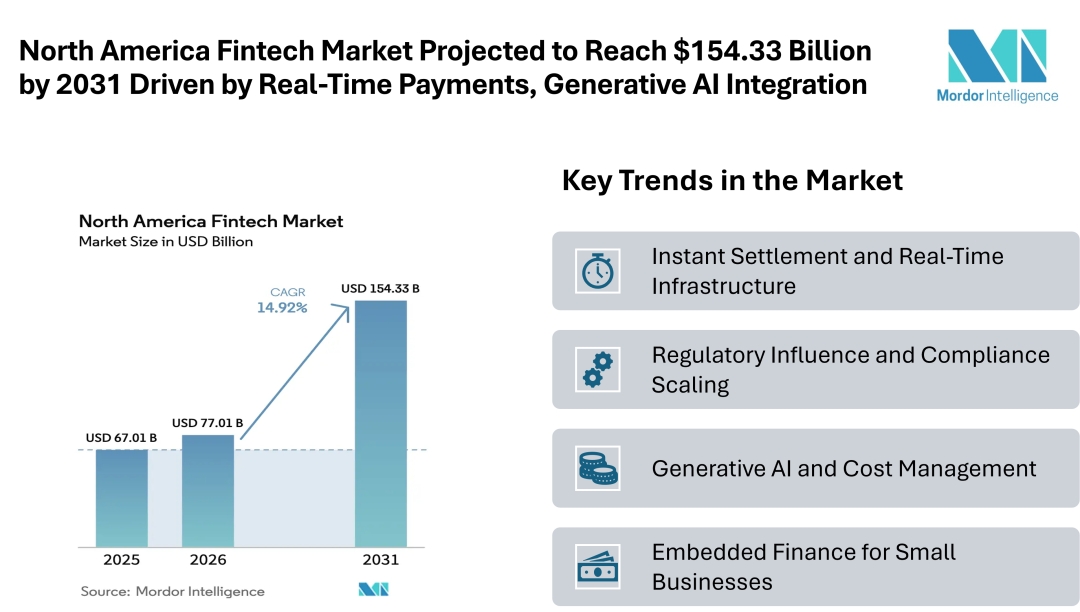
According to recent Mordor Intelligence, the North America fintech market size in 2026 is estimated at USD 77.01 billion, showing steady momentum from its 2025 value of USD 67.01 billion. As consumer habits shift toward instant gratification and seamless digital interfaces, the market forecast indicates a climb to USD 154.33 billion by 2031. This trajectory represents a compound annual growth rate (CAGR) of 14.92%, fueled by a mix of regulatory updates and a surge in automated financial tools.
Furthermore, the environment is being influenced by the Federal Reserve’s efforts to connect hundreds of financial institutions to modern settlement systems. As these systems become more accessible, the North America fintech market share is increasingly being captured by firms that can offer low-cost, high-efficiency services. By lowering the cost of acquiring new users and focusing on high-volume, low-margin transactions, digital providers are successfully challenging traditional banking models. The current market dynamics suggest a move toward more integrated services where banking, investing, and insurance are all managed through a single digital gateway.
North America Fintech Market Trends
Instant Settlement and Real-Time Infrastructure
The backbone of the current market expansion is the rise of instant payment systems. With hundreds of U.S. financial institutions now linked to modernized payment rails, the ability to settle transactions immediately has become a standard expectation. This infrastructure allows for better liquidity management for small businesses and provides consumers with immediate access to their funds. The shift toward instant movement of money is a primary factor in the ongoing North America fintech market trends, making older, slower systems less competitive. As adoption grows, interoperability between different payment networks is becoming increasingly important for seamless transactions. Continuous innovation in real-time infrastructure is also enhancing security and reliability across digital payment ecosystems.
Regulatory Influence and Compliance Scaling
New rules from oversight bodies like the Consumer Financial Protection Bureau are playing a significant role in how the industry operates. These regulations are encouraging companies to merge or form strategic partnerships to better handle the costs associated with supervision and compliance. Smaller players often find it easier to join forces with larger entities to share the burden of regulatory requirements. This trend toward consolidation helps create a more stable environment for investors and ensures that consumer protections are maintained as the sector expands. Regulatory technology (RegTech) solutions are also emerging to streamline compliance processes and reduce manual workloads. As regulations evolve, firms are prioritizing transparency and risk management to maintain trust and long-term growth.
Generative AI and Cost Management
Financial firms are increasingly using advanced automation and artificial intelligence to manage their internal operations. By deploying these tools, companies can offer more personalized financial advice and catch fraudulent activities with higher accuracy. This use of technology helps in keeping operational costs low, allowing firms to offer cheaper services to the public. The integration of automated intelligence is becoming a defining characteristic of the North America fintech market share, as it helps companies scale their services without a linear increase in spending. AI-driven insights are also improving customer engagement through tailored recommendations and proactive support. Over time, these efficiencies are expected to enhance profitability while maintaining competitive pricing.
Embedded Finance for Small Businesses
There is a growing demand among small and medium-sized enterprises for financial tools that are built directly into the software they use to run their businesses. Whether it is payroll, inventory management, or point-of-sale systems, business owners want their financial services to be invisible and integrated. This demand is opening up new revenue streams for software providers who are now acting as financial intermediaries, further diversifying the market landscape. This integration simplifies financial management and reduces the need for multiple standalone platforms. As ecosystems expand, partnerships between fintech firms and software providers are expected to accelerate innovation and accessibility.
Check out more details and stay updated with the latest industry trends, including the Japanese version for localized insights: https://www.mordorintelligence.com/ja/industry-reports/north-america-fintech-market?utm_source=abnewswire
North America Fintech Market Segmentation
-
By Service Proposition
-
Digital Payments
-
Digital Lending & Financing
-
Digital Investments
-
Insurtech
-
Neobanking
-
By End-User
-
Retail
-
Businesses
-
By User Interface
-
Mobile Applications
-
Web / Browser
-
POS / IoT Devices
-
By Geography
-
United States
-
Canada
-
Mexico
Explore Our Full Library of Financial Services and Investment Intelligence Research Reports: https://www.mordorintelligence.com/market-analysis/financial-services-and-investment-intelligence?utm_source=abnewswire
Key Players in the North America Fintech Industry
-
PayPal
-
Fiserv
-
Stripe
-
Block (Square & Cash App
-
FIS
Conclusion
As we look toward the end of the decade, the financial technology landscape in North America is set for a sustained period of expansion. The combination of better infrastructure, smarter regulatory frameworks, and the use of automated tools is creating an environment where digital finance is the norm rather than the exception. While the United States remains the largest contributor to the regional total, the growing tech sectors in Canada and Mexico are adding a diverse range of solutions to the ecosystem.
The focus for the coming years will likely remain on reducing the friction of moving money and making financial tools more accessible to a wider demographic. With neobanks capturing the interest of younger generations and established players investing heavily in secure, high-speed networks, the industry is well-positioned to meet its long-term targets. The North America fintech market will continue to be a hub of activity as it adapts to the changing needs of a digital-first society, ensuring that the movement of capital is as fast and efficient as possible.
For more insights on the North America fintech market, please visit the Mordor Intelligence page: https://www.mordorintelligence.com/industry-reports/north-america-fintech-market?utm_source=abnewswire
Industry Related Reports:
The Banking-as-a-Service (BaaS) market is estimated to reach USD 1.58 billion in 2026, up from USD 1.37 billion in 2025, and is projected to grow to USD 3.21 billion by 2031, registering a CAGR of 15.23% during 2026–2031. Growth is driven by increasing collaboration between fintech companies and traditional banks, the expansion of API-based financial infrastructure, and rising demand for embedded banking capabilities in digital platforms.
UAE Fintech Market Size
The UAE fintech market is estimated at USD 52.07 billion in 2026, rising from USD 46.67 billion in 2025, and is expected to reach USD 90.06 billion by 2031, growing at a CAGR of 11.58% from 2026 to 2031. Market expansion is supported by strong government initiatives toward digital finance, rapid adoption of cashless payments, and the growth of fintech startups across payments, lending, and digital banking solutions.
Get more insights: https://www.mordorintelligence.com/industry-reports/uae-fintech-market?utm_source=abnewswire
Embedded Finance Market Share
The embedded finance market is projected to grow from USD 155.96 billion in 2026 (from USD 155.98 billion in 2025) to USD 454.48 billion by 2031, expanding at a CAGR of 23.84% during 2026–2031. This rapid growth is driven by increasing integration of financial services into non-financial platforms, rising e-commerce ecosystems, and growing demand for seamless payment, lending, and insurance services within digital applications.
Get more insights: https://www.mordorintelligence.com/industry-reports/embedded-finance-market?utm_source=abnewswire
About Mordor Intelligence:
Mordor Intelligence is a trusted partner for businesses seeking comprehensive and actionable market intelligence. Our global reach, expert team, and tailored solutions empower organizations and individuals to make informed decisions, navigate complex markets, and achieve their strategic goals.
With a team of over 550 domain experts and on-ground specialists spanning 150+ countries, Mordor Intelligence possesses a unique understanding of the global business landscape. This expertise translates into comprehensive syndicated and custom research reports covering a wide spectrum of industries, including aerospace & defense, agriculture, animal nutrition and wellness, automation, automotive, chemicals & materials, consumer goods & services, electronics, energy & power, financial services, food & beverages, healthcare, hospitality & tourism, information & communications technology, investment opportunities, and logistics.
For any inquiries or to access the full report, please contact:
media@mordorintelligence.com https://www.mordorintelligence.com/
Mordor Intelligence, 11th Floor, Rajapushpa Summit, Nanakramguda Rd, Financial District, Gachibowli, Hyderabad, Telangana – 500032, India
Media Contact
Company Name: Mordor Intelligence
Contact Person: Jignesh Thakkar
Email: Send Email
Phone: +1 617-765-2493
Address:11th Floor, Rajapushpa Summit, Nanakramguda Rd, Financial District, Gachibowli media@mordorintelligence.com
City: Hyderabad
State: Telangana 500008
Country: India
Website: https://www.mordorintelligence.com/