
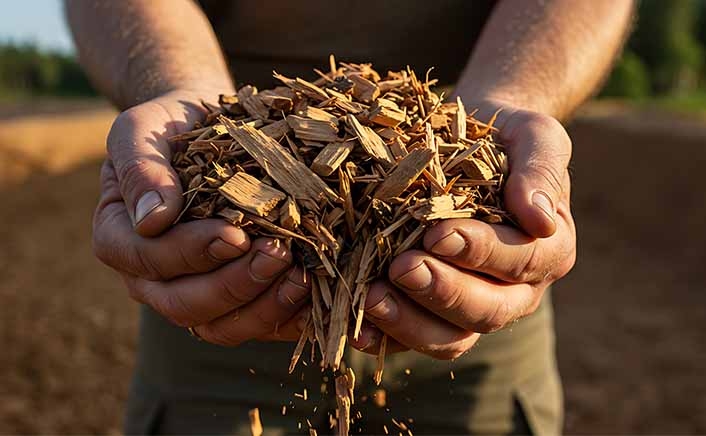
In numerous Nordic and Baltic cities, over half of all building heat now originates from centralized district heating systems. An increasing portion of this heat is produced by combusting wood chips instead of fossil fuels. This transition is propelling the Global Woody Biomass Fuel Market, which consumed 14.90 million metric tons in 2025 and is expected to grow to 21.14 million metric tons by 2033, at a CAGR of 4.8% during the forecast period.
Why Centralized Heating Changes the Economics of Biomass
District heating operates differently from individual home boilers. Instead of each building burning fuel independently, a centralized plant produces thermal energy and delivers it via insulated pipelines as hot water or steam. The International Energy Agency reports that district heating accounts for about 9% of global building heat needs, with some Nordic and Baltic countries exceeding 50% penetration.
Centralization is crucial for biomass economics. A sizable district heating plant can annually use 100,000 to 500,000 metric tons of woody biomass through multi-year contracts. This scale and predictability enable producers to invest confidently in pellet mills, storage facilities, and regional supply chains, rather than dealing with the uncertain and fragmented demand from thousands of individual household boilers.
Access the Full Report Here:https://marksparksolutions.com/reports/global-woody-biomass-fuel-market
Where Wood Chips Beat Wood Pellets, and Vice Versa
Not all biomass district heating systems use the same type of fuel, and the distribution of fuel choices reflects genuine operational tradeoffs. Wood chips are prevalent in facilities where cost-efficiency and local availability are key, as they tend to be cheaper to obtain regionally. Conversely, premium wood pellets are preferred in urban areas, where consistent fuel quality, automated handling, and lower moisture content ensure more reliable and predictable combustion—crucial when a plant supplies heat to thousands of homes throughout the winter.
The Technology That’s Made This Genuinely Efficient
Biomass heating has evolved beyond the basic image of a simple wood furnace. Modern systems, including high-efficiency boilers, flue gas condensation, and automated fuel feeding, achieve thermal efficiencies over 90%. This impressive efficiency makes biomass competitive with fossil fuels based purely on energy use, not just emissions. Combining biomass district heating with combined heat and power plants enhances this further by simultaneously generating electricity and heat, thus capturing significantly more energy than traditional heating systems.
Where Biomass Actually Wins Against the Alternatives
Biomass fuel’s competitive position varies meaningfully by application, and understanding where it’s strongest reveals where future growth is likely concentrated:
-
District heating shows the highest biomass penetration at roughly 46% among renewable heating installations in biomass-centric regions — the clear leading application
-
Combined heat and power (CHP) follows at an estimated 38% penetration among renewable thermal fuels, valued for generating both electricity and process heat with efficiencies often topping 80–90%
-
Industrial heat generation shows around 27% penetration in biomass-appropriate facilities, particularly strong in pulp and paper, sawmills, and food processing — industries that often already produce wood residue on-site, turning a waste stream into fuel.
That last point matters more than it might first appear: industries generating their own wood residue face minimal feedstock procurement cost, which makes biomass adoption there almost self-reinforcing once the initial equipment investment is made.
Download Free Sample Report Here:https://marksparksolutions.com/sample-reports?1000&Download_Free_Sample
Where the Consumption Actually Concentrates
The United States accounts for 17.8% of global consumption, primarily due to widespread use in industrial boilers, CHP facilities, and residential heating. This is supported by one of the world’s largest wood pellet manufacturing industries. China comes next at 13.9%, with biomass usage growing for industrial thermal purposes and power generation as part of its broader energy diversification initiatives.
Across Europe, Germany (8.6%), Sweden (7.4%), and Finland (5.9%) have well-developed district heating systems centered on wood chips and pellets. Japan, with a 6.8% share, stands out despite its dependence on imports, sourcing wood pellets to operate its biomass power plants—demonstrating that biomass use isn’t limited to domestic forests, but depends on a reliable supply chain. The UK’s 5.1% share indicates its ongoing shift of large power stations from coal to biomass. Meanwhile, Canada, France, and Italy exhibit more stable, diversified biomass applications across residential, commercial, and industrial sectors, rather than focusing on one area.
A Field Built on Forestry and Renewable Energy Expertise
Competition in this market involves well-known biomass fuel producers and forestry-related energy firms such as Enviva, Drax Group, AS Graanul Invest, Lignetics, Pfeifer Holding, Fram Renewable Fuels, Andritz AG, Stora Enso, UPM-Kymmene, Westervelt Renewable Energy, Vida AB, and Södra Skogsägarna. These companies compete primarily on supply chain reliability and sustainable sourcing credentials, in addition to raw fuel pricing.
Where This Market Is Headed
As municipalities increasingly replace old fossil-fuel heating systems with renewable district energy solutions, the demand for sustainably sourced wood chips and pellets is expected to grow steadily. This trend strengthens woody biomass’s role as a truly dispatchable renewable energy source in the transition, which still requires dependable heat options beyond just solar and wind.
Energy utilities, district heating operators, and biomass fuel suppliers evaluating this market can access full application, regional, and competitive segmentation through Mark & Spark Solutions’ complete market study.
Organizations exploring district heating investment, CHP integration, or specific regional biomass sourcing strategies are welcome to request a tailored data excerpt aligned to their strategic priorities.
Media Contact
Company Name: Mark & Spark Solutions
Contact Person: Sushil
Email: Send Email
Phone: 9158340999
Address:2nd Floor, Panchsheel Park, Aundh
City: Pune
State: Maharashtra
Country: India
Website: https://marksparksolutions.com/reports/global-woody-biomass-fuel-market