
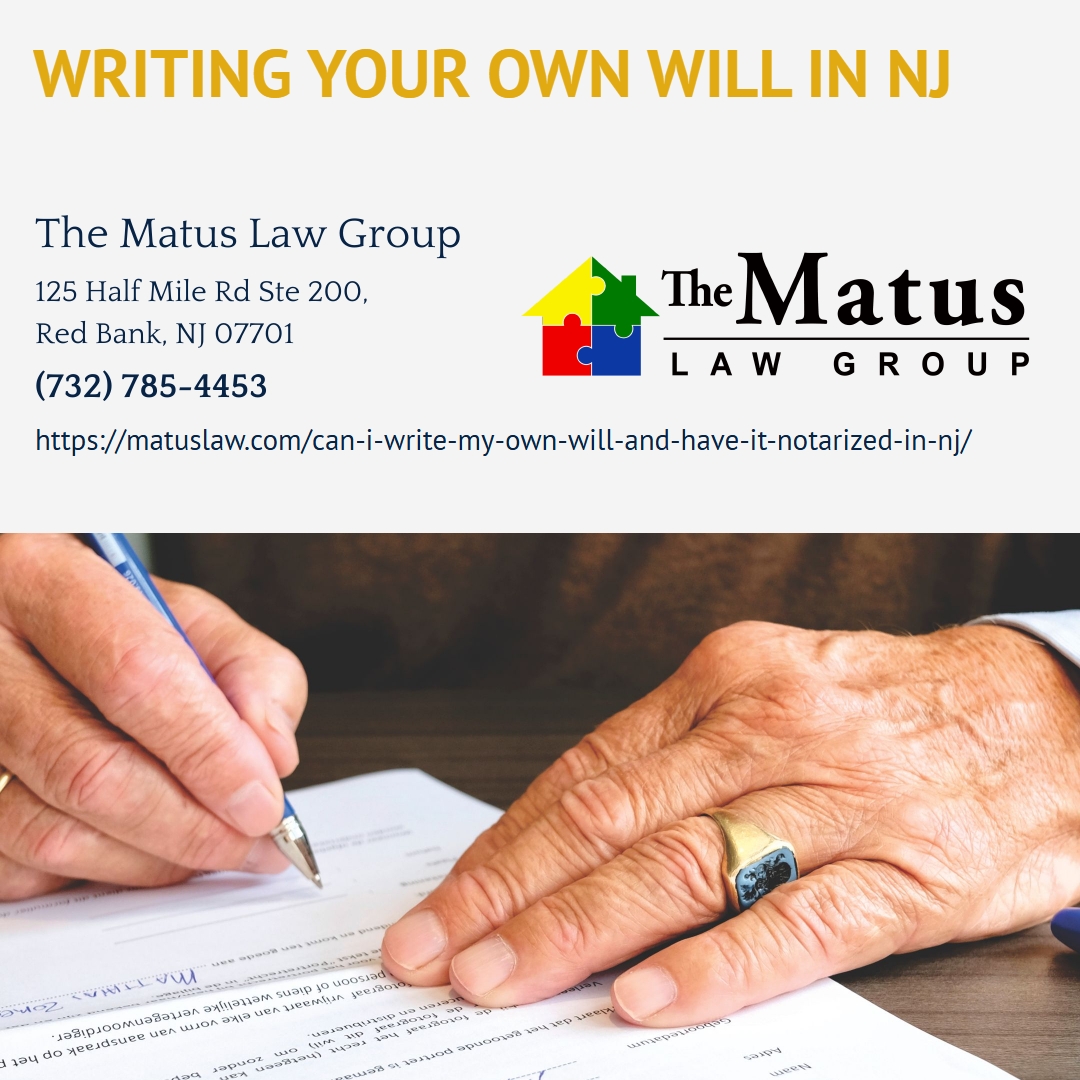
RED BANK, NJ – October 08, 2026 – New Jersey residents considering whether to prepare their own will can do so, but the document must meet specific legal standards to be recognized by the probate court. NJ wills lawyer Christine Matus of The Matus Law Group (https://matuslaw.com/can-i-write-my-own-will-and-have-it-notarized-in-nj/) has released guidance explaining New Jersey’s requirements for a valid will, the role of notarization, who can notarize a will, and the common mistakes people make when drafting one on their own.
According to NJ wills lawyer Christine Matus, a will does not have to be notarized to be legally valid in New Jersey, but making a will “self-proving” through the proper signatures and affidavits allows the probate court to accept it immediately. “A self-proving will spares loved ones the stress of tracking down witnesses or navigating extra legal steps when the time comes,” Matus explains. This step, she notes, can significantly ease the burden on families during an already difficult period.
NJ wills lawyer Christine Matus points out that under N.J.S.A. 3B:3-1, any person who is at least 18 years old and of sound mind may make a will, and no attorney is required to create one that the law recognizes. Under N.J.S.A. 3B:3-2, a will generally must be in writing, signed by the testator or in the testator’s name at their direction, and signed by at least two witnesses within a reasonable time after each witness observed the signing or the acknowledgment of the signature.
New Jersey also recognizes handwritten, or holographic, wills. Matus observes that a holographic will can be valid if the signature and the material portions of the document are in the testator’s own handwriting, even without witnesses. Clear intent, however, remains essential, as vague or conflicting language can create confusion and disputes during probate.
On the subject of notarization, Attorney Matus emphasizes that while it is not required for validity, it enables a self-proving affidavit under N.J.S.A. 3B:3-4. “When a will has been properly executed and acknowledged as self-proved, the surrogate can admit it to probate without further affidavit, deposition, or proof of execution,” she says. A notarized acknowledgment also makes it more difficult for anyone to later contest that the will was signed under pressure or that the signatures are not genuine.
The Matus Law Group notes that any notary public commissioned by the state may notarize a will, including notaries found at banks, law offices, and town halls, and that New Jersey attorneys-at-law are authorized to take acknowledgments and administer oaths as part of preparing an estate plan. Matus highlights an important limitation: although New Jersey permanently permits Remote Online Notarization for many documents, electronic signatures and remote online notarization are not permitted for wills, codicils, or testamentary trusts, and remote witnessing of a will is not allowed. A will and its self-proving affidavit must be executed with physical, wet-ink signatures in the in-person presence of the witnesses and notary.
Matus advises that if a will is not notarized, it is not automatically invalid. As long as the document meets New Jersey’s core requirements, a court can still honor it, though without a self-proving affidavit the court may need one of the witnesses who has knowledge of the will’s execution. If those witnesses are unavailable or have passed away, additional proof or a different probate procedure may be required.
Addressing DIY wills, the NJ wills lawyer notes that such documents can be a reasonable, lower-cost choice for straightforward estates, but simple oversights carry real risk. Common mistakes include failing to meet signing or witnessing requirements, using ambiguous language, providing incomplete instructions, and omitting backup plans for a beneficiary who passes away or an executor who cannot serve. “Even small errors can lead to family disputes and stressful probate delays,” Matus adds, noting that a well-drafted, specific will is the best way to prevent ambiguity.
Attorney Matus explains that both DIY and attorney-drafted wills are valid options when compliant with state law, and the right choice depends on the size of the estate, individual goals, and the level of certainty a person seeks. Even for a simple situation, she notes, having an attorney review a will can catch costly errors before they ever affect a family.
For individuals considering how to prepare or update their estate plan, consulting a New Jersey wills attorney may help ensure the document is legally sound, compliant with state requirements, and reflective of their true wishes.
About The Matus Law Group:
The Matus Law Group is a New Jersey law firm focused on estate planning, wills, trusts, elder law, and special needs planning. Led by attorney Christine Matus, the firm serves families throughout New Jersey and Monmouth County, helping them create legally sound plans that honor their wishes and provide lasting peace of mind. For consultations, call (732) 785-4453.
Embeds:
Youtube Video: https://www.youtube.com/watch?v=hs3ofH6vPio
GMB: https://www.google.com/maps?cid=3241702663730814860
Email and website
Email: admin@matuslaw.com
Website: https://matuslaw.com/monmouth-county-nj/
Media Contact
Company Name: The Matus Law Group
Contact Person: Christine Matus
Email: Send Email
Phone: (732) 785-4453
Address:125 Half Mile Rd Ste 200
City: Red Bank
State: New Jersey 07701
Country: United States
Website: https://matuslaw.com/monmouth-county-nj/