
In some industrial areas of Brazil, surface water and groundwater sources contain relatively high levels of suspended solids, colloids, and sediment. Compounded by water temperatures that remain high throughout the year, these conditions create significant operational hurdles. When implementing reverse osmosis (RO) water reuse systems, local industrial projects commonly face challenges such as pretreatment units being prone to fouling and clogging, shortened membrane element lifespans, and high operation and maintenance costs.
To address these complex environmental factors, the Industrial Water Treatment Pretreatment Project in São Paulo, Brazil, recently deployed a specialized filtration solution engineered by QILEE. A vertical pressure-type multi-media filter package from QILEE was provided for a local Brazilian industrial engineering EPC contractor to serve as the core pretreatment unit upstream of an RO system. Used to treat surface water from the plant, the equipment produces qualified pretreatment water for the downstream RO system while meeting the relevant operational and environmental requirements of Brazil’s CONAMA 430/11 regulations.
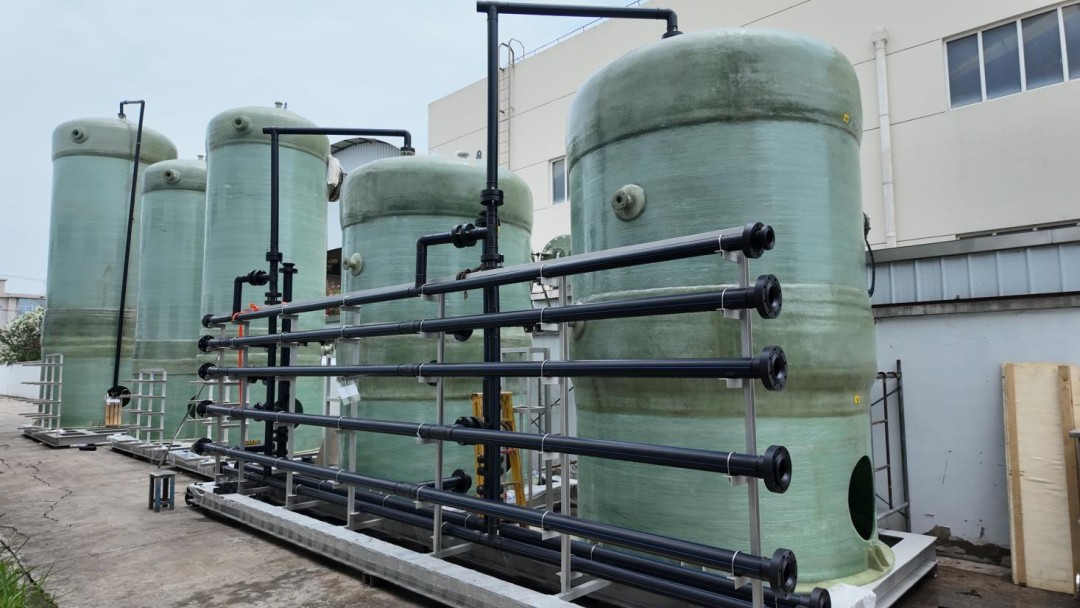
Complex Customer Requirements
The raw water at the São Paulo site is surface water with significant turbidity fluctuations ranging from 5 to 80 NTU. It contains sediment, colloids, and a small amount of suspended solids. The customer required a system that could consistently reduce incoming turbidity, protect the downstream RO membrane elements, reduce membrane fouling risks, and extend membrane service life.
The equipment was required to withstand Brazil’s high-temperature and high-humidity site conditions, meaning the tank required specialized corrosion protection. The electrical system needed to be compatible with the local 60 Hz power supply standard. Furthermore, the system needed to support Modbus communication for integration with the customer’s existing PLC control system.
Because the technical skill level of local maintenance personnel was limited, the customer requested equipment with a simple structure that would be easy to maintain and allow convenient replacement of spare parts. Automatic backwashing was explicitly required to reduce manual operations. Finally, the treatment capacity needed to meet the feed-water requirements of the downstream RO system, while keeping overall operating energy consumption and backwash water consumption within a reasonable range to control the project’s full life-cycle costs.
Project delivery needed to include English technical drawings, operation manuals, and remote technical guidance.
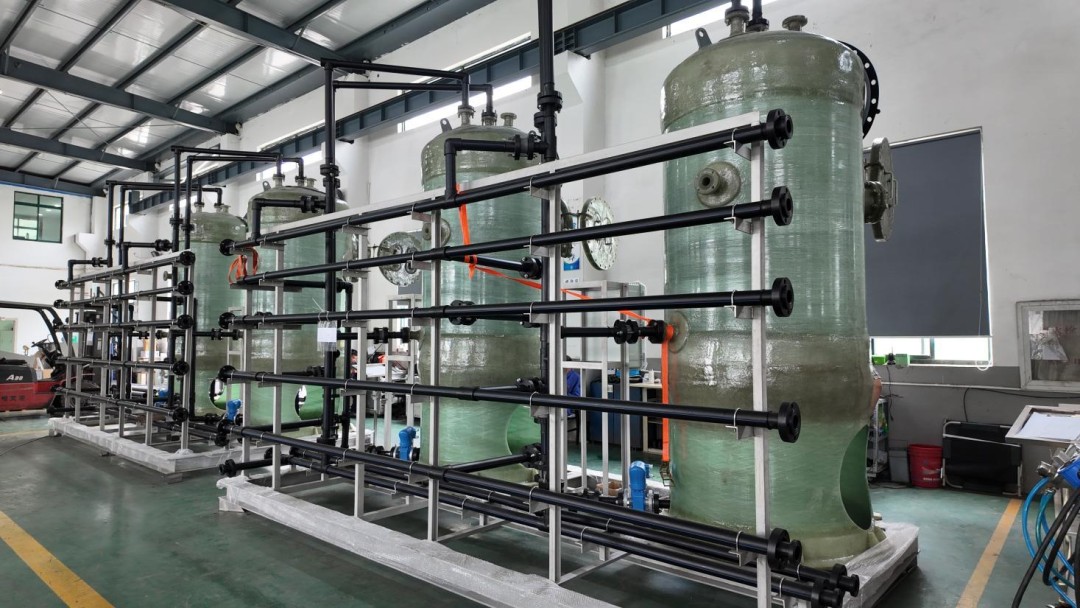
A Graded Filter-Bed Solution
Based on the customer’s operating conditions, QILEE engineers provided a vertical multi-media filter package equipped with graded filter-bed technology. The filter media uses a multi-layer graded media configuration consisting of anthracite in the upper layer, quartz sand in the middle layer, and garnet in the bottom layer.
Filter media with different densities and particle sizes are arranged in layers to achieve deep filtration. These multiple layers progressively capture large particles and fine colloids. This coarse-to-fine gradient filter bed enables layered removal of impurities, improving dirt-holding capacity and extending the filtration cycle. Compared with conventional single-sand filtration, the QILEE system provides longer filtration cycles and reduces the frequency of backwashing.
To address the tropical environment, the QILEE carbon steel tank was designed specifically for hot, humid, and corrosive conditions. The interior is treated with a customized anti-corrosion coating optimized for high-temperature and high-humidity environments, improving equipment service life in coastal and industrial areas of South America by slowing down tank corrosion and aging.
Automation and Integration
The QILEE system’s control mode features fully automatic differential-pressure-triggered air-water combined backwashing, with a manual mode also available. Equipped with automatic valves and a differential-pressure sensor, the system continuously monitors the pressure differential between the tank inlet and outlet. This automatic differential-pressure backwash triggering initiates backwashing when the preset value is reached, eliminating the need for scheduled manual operation and allowing the system to adapt to fluctuating water quality.
During the air-water combined backwashing process, air scouring is performed first to loosen the filter bed, followed by water washing. This combination provides more thorough cleaning of the filter media, reduces media compaction, and lowers backwash water consumption.
The electrical system is fully compatible with the local 60 Hz power supply. Utilizing an open communication protocol, standard Modbus-RTU communication enables seamless integration with the customer’s existing automation local PLC control system, facilitating centralized monitoring and operation and maintenance management.
To ensure low maintenance requirements, the QILEE equipment utilizes a simple structure without precision components that are prone to wear. The filter media itself boasts a long service life and extended replacement intervals, meaning local operators can perform routine operation and maintenance after basic training.
To support the local EPC contractor, the complete QILEE delivery scope included the filter vessel, piping and valve assemblies, filter media, complete English technical drawings, operation and maintenance manuals, remote commissioning guidance, and online technical training. This complete English technical documentation was provided for convenient use by local engineers.
Operational Results and Benefits
Since its implementation, the QILEE multi-media filter has delivered stable and reliable operation. The equipment operated continuously throughout the year with very few unplanned shutdowns, ensuring stable water production across the entire water treatment system and supporting the plant’s production water requirements.
Despite raw-water turbidity fluctuating between 5 and 80 NTU, the QILEE system’s effluent turbidity has remained consistently at ≤1 NTU. By effectively removing suspended solids and colloidal impurities, the system significantly reduced the risk of fouling in downstream RO membranes. Consequently, the RO system’s cleaning intervals were significantly extended, and the service life of the membrane elements improved. This led to lower O&M costs by reducing chemical consumption as well as material and labor costs associated with membrane replacement.
The QILEE system also provided substantial water and energy savings. Thanks to the air-water combined backwashing, backwash water consumption accounted for only 2-4% of the total treated-water production. The equipment maintains low operating resistance and low overall power consumption, helping reduce the plant’s electricity costs. Ultimately, the pretreatment effluent met the feed-water conditions required by the downstream process, while overall system operation complied with applicable local environmental control requirements in Brazil.
A representative for the client provided positive feedback regarding the installation, “The QILEE multi-media filter performs well under our fluctuating raw-water turbidity condition. The effluent quality is stable, greatly reducing RO membrane fouling frequency. The equipment is easy for our local operators to maintain. Complete English documents and remote technical support from QILEE bring us great convenience. We are satisfied with this solution and hope for further cooperation in future water-treatment projects.
To learn more, visit https://qileegroup.com/
Inquiries can be sent to ina@qileegroup.com or WhatsApp +86 13636655908.
Media Contact
Company Name: Qilee Group
Contact Person: Tina
Email: Send Email
Phone: +86 133 7003 5529
Country: China
Website: www.qileegroup.com