
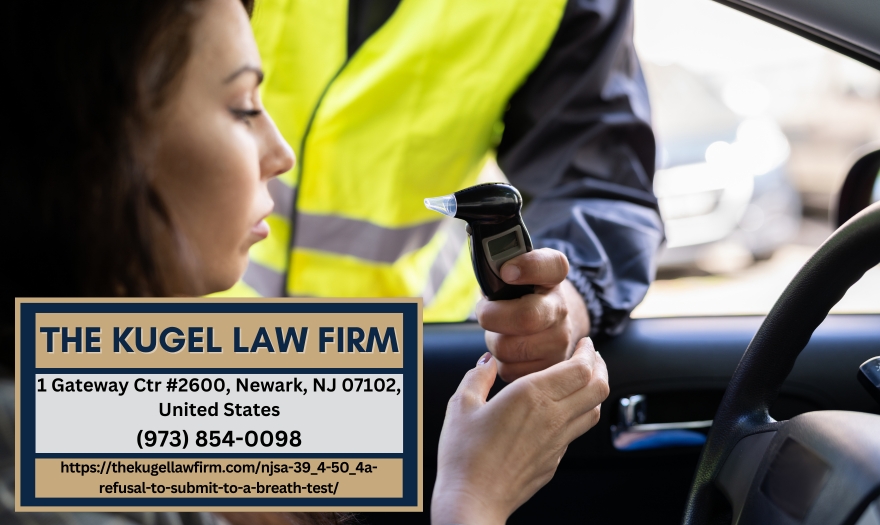
JERSEY CITY, NJ – Drivers who refuse to submit to a breathalyzer test in New Jersey face immediate and severe penalties under N.J.S.A. 39:4-50.4a, including automatic license suspension, mandatory fines, and ignition interlock device installation, even without a DUI conviction. New Jersey DUI defense attorney Rachel Kugel of The Kugel Law Firm (https://thekugellawfirm.com/njsa-39_4-50_4a-refusal-to-submit-to-a-breath-test/) explains the state’s implied consent law and the legal consequences of refusing chemical testing during a traffic stop.
According to New Jersey DUI defense attorney Rachel Kugel, holding a driver’s license in New Jersey means motorists have already consented to chemical testing when an officer has probable cause to believe they are impaired. This is known as the implied consent law. Refusing a breath test triggers a separate motor vehicle offense under Title 39, distinct from any underlying drunk driving charge. “These penalties apply even if you are never convicted of a DUI,” Kugel explains. “In New Jersey, refusal is a separate offense, and the consequences are often more severe than the penalties for the underlying drunk driving charge.”
New Jersey DUI defense attorney Rachel Kugel notes that first-time refusal offenders face fines ranging from $300 to $500, license forfeiture until an ignition interlock device is installed, and a mandatory ignition interlock period of nine to fifteen months after license restoration. Additional requirements include attendance at the Intoxicated Driver Resource Center and annual surcharges of $1,000 for three years to the Motor Vehicle Commission. Second offenses carry fines of $500 to $1,000, license suspension of one to two years, and ignition interlock installation during the suspension period plus two to four years after restoration. Third or subsequent refusals result in $1,000 fines, eight-year license suspensions, and extended ignition interlock requirements.
Attorney Kugel emphasizes that refusal charges differ fundamentally from DUI charges in their legal basis and proof requirements. A DUI charge requires evidence of impairment, such as blood alcohol content results, observations of impaired behavior, or field sobriety test performance. A refusal charge arises solely from noncompliance with a lawful request to take a breath test and does not require proof of intoxication. “You can face a refusal charge even if no DUI conviction is pursued, because the refusal itself violates the implied consent law,” Kugel notes.
Prosecutors must prove refusal occurred and that all required legal protocols were followed. Kugel explains that the state typically relies on police records documenting the traffic stop, proof that the officer read the Standard Statement for Operators of Motor Vehicles, video or audio recordings from dashcams or bodycams, and testing equipment records. The Standard Statement informs drivers of the consequences of refusing a breath test and must be read in full and in a clear manner. “Any procedural misstep by law enforcement can cast doubt on the validity of the refusal charge,” advises Kugel.
Several legal defenses may be raised to dispute a refusal charge depending on the circumstances. Kugel outlines that challenging the legality of the traffic stop is one of the most common defenses. Law enforcement must have reasonable suspicion to stop a driver, such as observing swerving, speeding, running a red light, or other traffic violations. If the stop was made without reasonable suspicion, any evidence gathered afterward, including the refusal charge, may be inadmissible in court.
Medical conditions or language barriers can also provide valid defenses against refusal charges. “Certain conditions, such as respiratory issues, may make it physically impossible for a driver to provide an adequate sample for a breath test,” Kugel points out. Drivers who do not speak or understand English fluently may not fully grasp the consequences of refusing a breath test, even if the Standard Statement is read to them. Courts may consider these factors when evaluating a refusal case, particularly if the officer failed to address these issues during the interaction.
Procedural errors by law enforcement represent another critical defense avenue. Officers must read the Standard Statement in its entirety and clearly explain the consequences of refusal. Drivers must be given multiple chances to comply with the breath test request. “If the officer prematurely deemed your actions as refusal, this can be challenged,” Kugel adds. Issues with breath test equipment calibration or failure to follow testing protocols may also be questioned in court.
Jersey City Municipal Court and Hudson County Superior Court routinely impose refusal penalties independent of any drunk driving conviction. The consequences extend beyond fines and suspension to impact employment, family responsibilities, and daily independence. For those facing refusal charges under N.J.S.A. 39:4-50.4a, consulting with a DUI defense attorney may provide critical guidance on available defenses and legal options. To schedule a consultation, contact The Kugel Law Firm at (973) 854-0098.
About The Kugel Law Firm:
The Kugel Law Firm is a Jersey City-based law firm dedicated exclusively to DUI defense throughout New Jersey. Led by attorney Rachel Kugel, the firm represents clients facing drunk driving and refusal charges in Jersey City, Hudson County, and across the state. For consultations, call (973) 854-0098.
Embeds:
Youtube Video: https://www.youtube.com/watch?v=NvkmpIJIn0s
GMB: https://www.google.com/maps?cid=3822170752710866861
Email and website
Email: admin@thekugellawfirm.com
Website: https://thekugellawfirm.com/
Media Contact
Company Name: The Kugel Law Firm
Contact Person: Rachel Kugel
Email: Send Email
Phone: (973) 854-0098
Address:1 Gateway Center 2600
City: Newark
State: New Jersey 07102
Country: United States
Website: https://thekugellawfirm.com/