
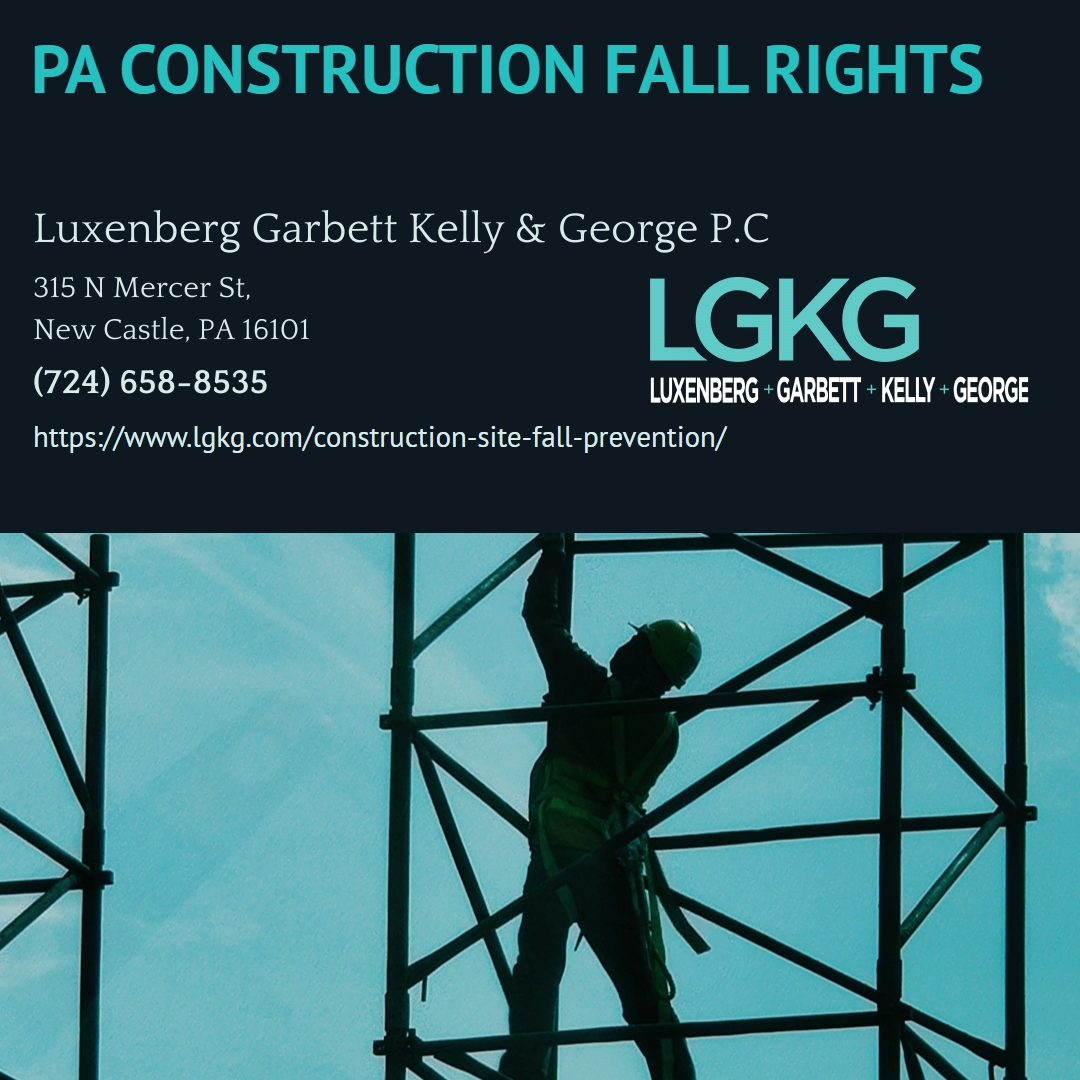
NEW CASTLE, PA – October 28, 2026 – Construction falls remain a leading cause of serious workplace injuries and fatalities across Pennsylvania, and injured workers often face difficult questions about their legal rights and available benefits. New Castle construction accident attorney Lawrence M. Kelly of Luxenberg Garbett Kelly & George P.C. (https://www.lgkg.com/construction-site-fall-prevention/) has released guidance explaining the fall protection standards that apply on job sites, who can be held liable for a fall, and the compensation and deadlines that affect these claims.
According to New Castle construction accident attorney Lawrence M. Kelly, the Occupational Safety and Health Administration requires fall protection when construction workers are exposed to falls of six feet or more, while the scaffold standard applies when workers are more than ten feet above a lower level. “When employers fail to provide appropriate fall protection, an injured worker can seek workers’ compensation benefits and, in some cases, pursue a claim against a negligent third party,” Kelly explains. Falls from an elevation caused 389 of the 1,034 construction fatalities recorded nationwide in 2024, accounting for roughly 38 percent of all construction deaths.
New Castle construction accident attorney Lawrence M. Kelly notes that construction falls often result from recurring hazards such as unprotected edges, floor openings, unsafe scaffolds, roof work, and improperly used ladders. Scaffolding accidents frequently involve incomplete planking, missing guardrails, unstable footing, or damaged components, while ladder falls often stem from improper setup, overreaching, or failing to extend an access ladder at least three feet above the landing. Roof falls commonly involve unprotected edges, skylights, roof hatches, or slippery walking surfaces made worse by rain and ice.
Several OSHA standards govern fall protection on Pennsylvania construction sites, including 29 C.F.R. § 1926.501 for general fall protection, § 1926.451 for scaffolds, and § 1926.1053 for ladders. Because Pennsylvania does not operate an OSHA-approved State Plan, federal OSHA enforces workplace safety requirements for most private-sector construction employers in the Commonwealth. Kelly points out that while an OSHA citation does not determine civil liability on its own, inspection reports, photographs, and witness statements collected during an investigation can provide important evidence in a construction accident claim.
Under 29 C.F.R. § 1926.501(b), workers on a surface with an unprotected side or edge at a height of six feet or more must be protected by a guardrail system, safety net system, or personal fall arrest system. The requirement applies to leading-edge work, hoist areas, holes and skylights, formwork and reinforcing-steel work, certain excavations, and low-slope roofing work. A limited exception exists for certain leading-edge, precast concrete, and residential construction work when conventional systems are infeasible or would create a greater hazard, provided the employer satisfies the written fall-protection plan requirements of § 1926.502(k).
Attorney Kelly emphasizes that fall prevention begins before work starts. “Employers should identify fall hazards during each phase of a project so that guardrails, anchor points, and other systems are in place before workers are ever exposed,” he says. Personal fall arrest systems should be inspected before each use, any component subjected to impact loading must be removed from service until a competent person confirms it remains safe, and workers must be trained on the fall-protection systems used on the job site.
On the question of liability, the New Castle firm notes that an injured construction worker usually cannot sue a direct employer because workers’ compensation provides the exclusive remedy. However, a third-party claim may be available against a general contractor, another subcontractor, a property owner, an equipment manufacturer, or an equipment rental company. Kelly adds that a general contractor may be immune from a tort claim if it qualifies as a statutory employer, an issue addressed by the Pennsylvania Supreme Court in Patton v. Worthington Associates, Inc., 89 A.3d 643 (Pa. 2014). Pennsylvania also follows a modified comparative negligence rule under 42 Pa.C.S. § 7102, under which recovery is barred if the injured person’s negligence is greater than that of the defendants.
The construction accident team at the firm explains that a fall can give rise to both a workers’ compensation claim and a third-party personal injury claim. Workers’ compensation covers medical treatment, wage-loss benefits, specific-loss benefits, and death benefits regardless of fault, but it does not provide compensation for pain and suffering. A third-party claim can allow an injured worker to recover past and future medical expenses, lost earnings, diminished earning capacity, pain and suffering, disfigurement, and loss of consortium when supported by the evidence.
Deadlines vary by claim type. In most cases, a personal injury lawsuit must be filed within two years of the injury under 42 Pa.C.S. § 5524, while workers’ compensation notice must generally be given within 120 days, with a claim petition due within three years if a claim is denied. Additional notice requirements under 42 Pa.C.S. § 5522 apply when a government entity is involved. Kelly advises that missing a filing or notice deadline can affect an injured worker’s ability to recover.
The firm investigates how a fall happened, obtains OSHA records and contract documents, identifies every liable party, and litigates in the Lawrence County Court of Common Pleas and neighboring county courts when a fair settlement is not offered. For those injured in a construction site fall, contacting an experienced Pennsylvania construction accident attorney may help protect their right to workers’ compensation benefits, a third-party claim, or both.
About Luxenberg Garbett Kelly & George P.C.:
Luxenberg Garbett Kelly & George P.C. has represented injured workers and their families since 1933. Based in New Castle, Pennsylvania, the firm focuses on construction accidents, personal injury, workers’ compensation, and related matters, serving clients throughout Lawrence County, Butler County, and the surrounding region. For consultations, call (724) 658-8535.
Embeds:
Youtube Video: https://www.youtube.com/watch?v=LHvMTgorGVU
GMB: https://www.google.com/maps?cid=1349618312503922919
Email and website
Email: jgeorge@lgkg.com
Website: https://www.lgkg.com/
Media Contact
Company Name: Luxenberg Garbett Kelly & George P.C.
Contact Person: Joseph A. George
Email: Send Email
Phone: (724) 658-8535
Address:315 N Mercer St, New Castle, PA
City: New Castle
State: Pennsylvania 16101
Country: United States
Website: https://www.lgkg.com/