
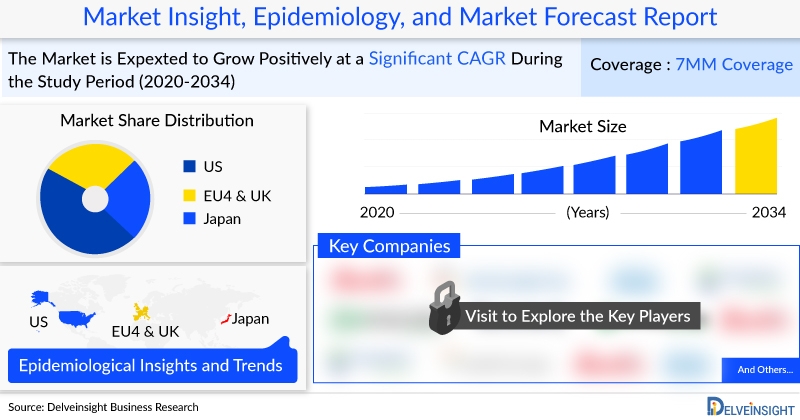
In 2024, the overall Myelofibrosis market was valued at approximately USD 2.2 billion, with the United States accounting for the largest share at nearly USD 1.7 billion, significantly outperforming the EU4, the UK, and Japan.
JAK inhibitors continue to form the backbone of Myelofibrosis treatment, with JAKAFI/JAKAVI (ruxolitinib) leading the segment and generating close to USD 1.5 billion in revenue in 2024. Other prominent JAK inhibitors, including INREBIC, VONJO, and OJJAARA, offer differentiated mechanisms of action by targeting multiple molecular pathways. Although JAKAFI remains the dominant therapy, upcoming patent expirations between 2027 and 2028 for Novartis and Incyte are anticipated to reshape the competitive landscape. To maintain its leadership position, Incyte is actively evaluating combination regimens aimed at prolonging JAKAFI’s clinical and commercial relevance.
Novel therapies such as imetelstat, a telomerase inhibitor; navtemadlin, an MDM2 inhibitor; and pelabresib, a BET inhibitor, are advancing in development to address persistent unmet needs, particularly among patients who show inadequate response to JAK inhibitor therapy.
Market growth in the coming years is expected to be fueled by innovative treatment approaches, including therapies for lower-risk patient populations, next-generation first-line or combination regimens, and drugs focused on managing cytopenias—an area that continues to represent a major unmet clinical challenge.
Key players active in the Myelofibrosis market include Lynk Pharmaceuticals, Samus Therapeutics, Taiga Biotechnologies, Bristol-Myers Squibb, Sumitomo Pharma Oncology, Inc., Keros Therapeutics, Inc., Galecto Biotech AB, Actuate Therapeutics Inc., Karyopharm Therapeutics, AbbVie, Sierra Oncology, and several others.
According to DelveInsight’s latest publication, “Myelofibrosis Market Insights, Epidemiology, and Market Forecast–2034,” the Myelofibrosis market in 7MM is poised for notable growth throughout the next decade.
Access the full Myelofibrosis Market Forecast through 2034 to gain detailed insights into epidemiology trends, competitive dynamics, and emerging therapies shaping the future treatment landscape.
Increasing Burden of Myelofibrosis
Myelofibrosis is an uncommon bone marrow malignancy characterized by abnormal blood cell formation that leads to fibrosis of the bone marrow, impairing normal hematopoiesis. This condition results in symptoms such as anemia, chronic fatigue, and splenomegaly. It predominantly affects elderly individuals and may arise as a primary condition or evolve from related disorders like polycythemia vera or essential thrombocythemia.
In 2024, the total prevalent population of Myelofibrosis across the seven major markets (7MM) – the United States, EU4 (Germany, France, Italy, and Spain), the United Kingdom, and Japan was estimated at roughly 55,900 cases. This figure is expected to steadily increase through 2034. Among these regions, the United States represented the largest market, valued at approximately USD 1,700 million, surpassing the EU4, the UK, and Japan.
The report highlights that high-risk patients constituted the majority of diagnosed cases in the US in 2024. Furthermore, individuals aged 70 years and older formed the largest age group, with nearly 12,100 cases reported within this segment.
Download DelveInsight’s comprehensive Myelofibrosis Market report to explore in-depth analysis of key drugs, late-stage pipeline assets, and growth opportunities across the 7MM @ Myelofibrosis Treatment Market
Major Drivers of the Myelofibrosis Market
The rising incidence of Myelofibrosis is being supported by several factors, including aging populations, enhanced disease awareness, advances in diagnostic technologies, and continuous progress in therapeutic development.
Key growth drivers include:
- Heightened investment in R&D aimed at developing targeted and disease-modifying treatments
- Increasing focus on biologics and immunotherapy-based approaches to address unmet clinical needs
- Broadening of therapeutic options beyond JAK inhibitors by targeting alternative pathways
Stay ahead of market shifts in Myelofibrosis therapeutics by uncovering actionable intelligence on pricing, drug uptake, and unmet clinical needs driving investment decisions @ Myelofibrosis Drugs Market and Clinical Trial Analysis
Myelofibrosis Market Outlook and Key Therapies
At present, JAKAFI/JAKAVI (ruxolitinib), developed by Incyte and Novartis, remains the standard-of-care therapy for Myelofibrosis. In 2024, it generated the highest market revenue, reaching nearly USD 1,500 million across the 7MM. Its continued demand is supported by proven efficacy in symptom relief and reduction of spleen volume.
Other important marketed therapies for Myelofibrosis include:
- INREBIC (fedratinib) – Bristol Myers Squibb
- XPOVIO (selinexor) – Karyopharm Therapeutics
- RYTELO (imetelstat) – Geron Corporation
- REBLOZYL (luspatercept) – Bristol Myers Squibb
- Navtemadlin (KRT-232) – Kartos Therapeutics
Emerging Myelofibrosis therapies are expected to significantly reshape the treatment paradigm. Drug candidates such as Pelabresib (Novartis), Bomedemstat (Merck), TL-895 (Telios Pharma), and TP-3654 (Syntara) are progressing through advanced clinical development and may offer solutions for patients who do not respond adequately to existing options.
Companies Driving Innovation in the Myelofibrosis Market
A broad range of pharmaceutical and biotech companies is actively working to expand the Myelofibrosis treatment arsenal. Prominent market participants include Lynk Pharmaceuticals, Samus Therapeutics, Taiga Biotechnologies, Bristol-Myers Squibb, Sumitomo Pharma Oncology, Inc., Keros Therapeutics, Inc., Galecto Biotech AB, Actuate Therapeutics Inc., Karyopharm Therapeutics, AbbVie, Sierra Oncology, and others.
These Myelofibrosis companies are advancing a diverse pipeline of innovative candidates, including LNK01002, PU-H-71, TBX-2400, BMS-986158, TP-3654, KER-050, GB2064, 9-ING-41, Selinexor, Navitoclax, and Momelotinib. Collectively, these developments are expected to intensify competition and enhance treatment options for Myelofibrosis patients.
Recent Myelofibrosis Clinical Trials and Research Highlights
Recent years have seen a significant increase in clinical research activity and late-stage trials aimed at improving outcomes and overcoming resistance to current JAK inhibitor therapies:
- September 2025: Karyopharm Therapeutics Inc. announced the completion of patient enrollment for its Phase III SENTRY trial evaluating selinexor in combination with ruxolitinib in JAK inhibitor – naïve Myelofibrosis patients.
- November 2024: MorphoSys reported favorable topline results from the Phase III MANIFEST-2 trial assessing pelabresib in combination with Jakafi (ruxolitinib).
- October 2024: Ajax Therapeutics, Inc. administered the first dose to a patient in a Phase I trial of AJ1-11095, a next-generation Type II JAK2 inhibitor for Myelofibrosis.
These developments highlight the accelerating pace of Myelofibrosis research, with multiple therapies demonstrating potential for disease modification and enhanced patient quality of life.
Request a sample or customization of the Myelofibrosis Market Forecast report to align strategic planning with evolving clinical, regulatory, and commercial developments @ Myelofibrosis Clinical Trials and FDA Approvals
Myelofibrosis Epidemiology Overview
The Myelofibrosis Market Report delivers an in-depth epidemiological assessment across the 7MM from 2020 to 2034, covering total and diagnosed prevalence, severity distribution, and gender-based trends.
In 2024, total prevalence across the seven major markets was estimated at approximately 55,900 cases, with a consistent upward trend anticipated through 2034. Within the EU4 and the UK, Germany recorded the highest number of diagnosed cases, followed by Spain, while the UK reported the lowest. In the US, the majority of patients were categorized as high-risk, and primary Myelofibrosis accounted for nearly 75% of all cases. Patients aged 70 years and above formed the largest age cohort, with about 12,100 cases in 2024. Additionally, nearly 60% of US patients carried JAK2 mutations, underscoring its central role in disease pathogenesis.
Myelofibrosis Drug Uptake and Market Dynamics
Myelofibrosis Market Drivers:
- Growing prevalence of Myelofibrosis in aging populations
- Continuous innovation in targeted and precision therapies
- Improved access to diagnostics and early detection initiatives
Myelofibrosis Market Restraints:
- High treatment costs and reimbursement limitations in certain regions
- Adverse effects associated with prolonged JAK inhibitor therapy
- Clinical complexities in managing advanced or treatment-resistant disease
Despite these hurdles, optimism remains high as numerous therapies advance through Phase II and Phase III trials, demonstrating encouraging efficacy and safety profiles.
Myelofibrosis Market Scope
- Study Timeline: 2020–2034
- Geographical Coverage: United States, EU4 (Germany, France, Italy, Spain), United Kingdom, and Japan
- Key Parameters: Market size, therapy adoption, epidemiology segmentation, treatment patterns, and pipeline evaluation
The report also incorporates competitive intelligence analyses such as SWOT, PESTLE, and Porter’s Five Forces, along with insights into reimbursement frameworks, market entry strategies, and unmet medical needs.
For in-depth insights into Myelofibrosis epidemiology, market projections, and emerging therapies, explore the Myelofibrosis Market Forecast
Future Outlook for the Myelofibrosis Market
The Myelofibrosis market is anticipated to expand steadily, supported by increasing disease awareness, advancements in molecular diagnostics, and the launch of novel therapeutic agents. The integration of targeted treatments, established JAK inhibitors, and next-generation immunotherapies is expected to significantly transform the care landscape by 2034.
With multiple high-potential candidates in late-stage development and strong investment from major pharmaceutical companies, the Myelofibrosis market is set to undergo dynamic growth, marked by enhanced therapeutic diversity and improved patient outcomes.
Media Contact
Company Name: DelveInsight Business Research LLP
Contact Person: Ankit Nigam
Email: Send Email
Phone: +14699457679
Address:304 S. Jones Blvd #2432
City: Albany
State: New York
Country: United States
Website: https://www.delveinsight.com/consulting