
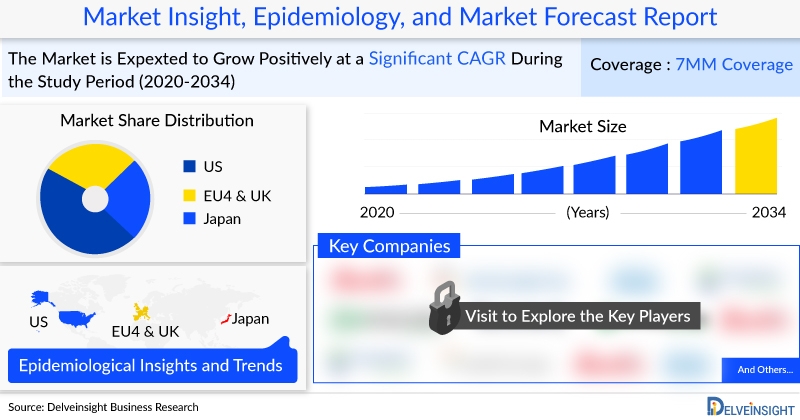
The myasthenia gravis (MG) market was valued at nearly USD 4.5 billion in 2024 and is expected to grow at a strong CAGR of 10.4% through 2034. In the same year, the seven major markets (7MM) recorded around 310,000 diagnosed Myasthenia Gravis cases, with approximately 137,000 patients in the United States alone and a slight male predominance. The treatment paradigm is rapidly shifting toward precision-driven immunomodulatory therapies, supported by increasing uptake of targeted biologics such as FcRn inhibitors (RYSTIGGO, VYVGART, IMAAVY) and complement inhibitors (SOLIRIS, ULTOMIRIS, ZILBRYSQ).
A new generation of pipeline therapies including RNA-based approaches, CAR-T-like treatments, dual complement inhibitors, and BLyS/APRIL pathway blockers aims to achieve sustained imm0075ne rebalancing rather than short-term symptom relief. However, despite these innovations, significant unmet needs remain, particularly for therapies that offer rapid onset, long-lasting efficacy, and improved safety, as many patients still face delayed responses, relapses, or adverse effects.
DelveInsight’s Myasthenia Gravis Market Insights report provides a comprehensive analysis of existing treatment strategies, upcoming therapies, individual drug market shares, and historical as well as forecasted market size from 2020 to 2034 across the 7MM, including the United States, EU4 (Germany, France, Italy, and Spain), the United Kingdom, and Japan. The Myasthenia Gravis market is anticipated to undergo notable transformation in the coming years, driven by improved diagnostics, rising disease awareness, increasing healthcare spending, and the launch of innovative treatment options.
Discover which therapies are expected to grab the major myasthenia gravis market share @ Myasthenia Gravis Market Report
Key Highlights from the Myasthenia Gravis Market Report
- According to DelveInsight’s assessment, the myasthenia gravis market is projected to register robust CAGR growth through 2034.
- The total market size across the 7MM was estimated at approximately USD 4.5 billion in 2024 and is expected to expand substantially during the forecast period.
- In the United States, nearly 129,000 individuals were diagnosed with myasthenia gravis in 2023, with prevalence anticipated to rise steadily from 2020 to 2034.
- Prominent companies such as Horizon Therapeutics, Amgen, Janssen Research & Development, Hoffmann-La Roche, Immunovant Sciences GmbH, Alexion, AstraZeneca Rare Disease, Regeneron Pharmaceuticals, Kyverna Therapeutics, Cartesian Therapeutics, Dianthus Therapeutics, Takeda, COUR Pharmaceuticals, and others are advancing next-generation Myasthenia Gravis therapies expected to enter the market in the coming years.
- Notable Myasthenia Gravis therapies include DAS-001, Amifampridine Phosphate, MuSK-CAART, Nipocalimab, Efgartigimod IV, Rozanolixizumab, ALXN1720, Batoclimab, Descartes-08, Zilucoplan (RA101495), and others.
- In January 2026, argenx SE (Euronext & Nasdaq: ARGX), a global immunology company committed to improving the lives of people suffering from severe autoimmune diseases, today announced that the U.S. Food and Drug Administration (FDA) has accepted for priority review a supplemental Biologics License Application (sBLA) for VYVGART® (IV: efgartigimod alfa-fcab) for the treatment of adults with acetylcholine receptor antibody (AChR-Ab) seronegative generalized myasthenia gravis (gMG). The application has been granted a Prescription Drug User Fee Act (PDUFA) target action date of May 10, 2026.
- In December 2025, Amgen (NASDAQ:AMGN) today announced that the U.S. Food and Drug Administration (FDA) has approved UPLIZNA® (inebilizumab-cdon) for the treatment of generalized myasthenia gravis (gMG) in adults who are anti-acetylcholine receptor (AChR) and anti-muscle specific tyrosine kinase (MuSK) antibody positive. The approval offers patients a new targeted treatment option that has the potential for long-term disease control with just two doses a year, after two initial loading doses.
- In October 2025, Johnson & Johnson (NYSE: JNJ) announced plans to launch the first head-to-head clinical trial comparing FcRn inhibitors in patients with generalized myasthenia gravis (gMG), with the goal of positioning IMAAVY™ (nipocalimab-aahu) as a preferred FcRn therapy. Details from the EPIC study design and Vibrance-MG Phase 2/3 LTE data were among 38 abstracts presented at the 2025 MGFA Scientific Session and AANEM Annual Meeting.
- Also in October 2025, COUR Pharma revealed that the US FDA granted Orphan Drug Designation (ODD) to CNP-106, its investigational antigen-specific immune tolerance therapy for gMG.
- In August 2025, Kyverna Therapeutics announced a virtual KOL event focused on its neuroimmunology CAR-T platform for stiff person syndrome and myasthenia gravis.
- In April 2025, positive Phase 3 trial (NCT05737160) results evaluating telitacicept (RC18; 泰爱®) in gMG patients were presented during the Late-Breaking Science Session at the American Academy of Neurology Annual Meeting.
- In March 2025, Immunovant decided not to pursue regulatory approval for batoclimab in Myasthenia Gravis despite successful Phase III results, opting instead to advance IMVT-1402 using the trial data.
- During the same month, the FDA approved an expanded pediatric indication for Alexion/AstraZeneca’s Soliris (eculizumab), making it the first approved treatment for children aged six years and older with AChR-positive gMG.
- In January 2025, Cartesian Therapeutics received FDA Special Protocol Assessment (SPA) agreement for its Phase 3 AURORA trial evaluating Descartes-08, an mRNA cell therapy for MG.
- In December 2024, Alexion Pharmaceuticals initiated an open-label, multicenter study assessing the efficacy, safety, pharmacokinetics, and pharmacodynamics of eculizumab in pediatric refractory gMG patients.
- In October 2023, UCB announced FDA approval of ZILBRYSQ (zilucoplan) for adult AChR-positive gMG, marking a major advancement in targeted Myasthenia Gravis treatment.
- In September 2023, Recipharm AB partnered with AHEAD THERAPEUTICS S.L. to scale up manufacturing capabilities for emerging Myasthenia Gravis therapies.
Myasthenia Gravis Overview
Myasthenia gravis is a chronic autoimmune neuromuscular disease marked by fluctuating muscle weakness and fatigue caused by impaired neuromuscular transmission. The condition is most commonly driven by autoantibodies against acetylcholine receptors (AChR) or muscle-specific kinase (MuSK), disrupting synaptic signaling. Common symptoms include drooping eyelids, double vision, swallowing difficulties, limb weakness, and, in severe cases, respiratory failure. Myasthenia Gravis can present at any age, with early-onset disease often associated with thymic abnormalities and late-onset disease more frequent in older adults. Diagnosis relies on clinical evaluation, antibody testing, electrophysiology, and thymic imaging. Management includes acetylcholinesterase inhibitors, immunosuppressants, biologics such as complement inhibitors and FcRn blockers, and thymectomy in selected patients. Advances in targeted immunotherapies continue to improve long-term disease control and patient outcomes.
Myasthenia Gravis Epidemiology
In 2024, the United States reported approximately 137,000 diagnosed Myasthenia Gravis cases, with prevalence expected to increase through 2034 due to improved awareness and diagnostics. Across EU4 and the UK, Germany recorded the highest prevalence at nearly 37,000 cases, while Spain had the lowest at around 14,000. In Germany, women accounted for about 52% of diagnosed cases. Mild generalized Myasthenia Gravis (Class II) represented the largest disease segment, followed by ocular Myasthenia Gravis (Class I) and moderate generalized disease (Class III). Severe Myasthenia Gravis cases (Classes IV and V) remained relatively uncommon. In Japan, anti-AChR–positive patients constituted the majority of gMG cases, with smaller proportions of anti-MuSK and seronegative patients.
Myasthenia Gravis Epidemiology Segmentation
The epidemiology section of the report evaluates historical trends, current patient populations, and future forecasts across the 7MM, drawing on published studies and expert opinions. The analysis segments data by total diagnosed gMG prevalence, gender-specific cases, and antibody-specific populations for the period 2020–2034.
Download the report to understand which factors are driving myasthenia gravis epidemiology trends @ Myasthenia Gravis Epidemiological Insights
Myasthenia Gravis Treatment Market
MG management typically follows a combination approach focused on symptom control and quality-of-life improvement. First-line therapy commonly includes acetylcholinesterase inhibitors such as pyridostigmine. Immunosuppressive agents—including corticosteroids, azathioprine, and mycophenolate mofetil—are often used to suppress autoimmune activity. In severe or crisis situations, IVIG or plasmapheresis may be employed for rapid disease control. Thymectomy remains a valuable option for selected patients. Given the variability in treatment response, individualized care plans and regular monitoring are essential for effective long-term disease management.
Learn more about the FDA-approved drugs for myasthenia gravis @ Drugs for Myasthenia Gravis Treatment
Myasthenia Gravis Competitive Landscape
Key therapies and developers include:
- Tolebrutinib (Sanofi)
- Descartes-08 (Cartesian Therapeutics)
- Mezagitamab / TAK-079 (Takeda)
- DAS-001 (DAS Therapeutics)
- Rozanolixizumab (UCB Biopharma)
- Zilucoplan (UCB Biopharma)
- Subcutaneous Efgartigimod (argenx-Halozyme)
- Uplizna (Horizon Therapeutics)
- Enspryng (Hoffmann-La Roche)
- Nipocalimab (Janssen R&D)
- Batoclimab (Immunovant Sciences)
To know more about clinical trials, visit @ Myasthenia Gravis Treatment Drugs
Myasthenia Gravis Market Dynamics
Market Drivers
- Rising prevalence and improved diagnostics
- Growing adoption of precision and targeted biologics
- A strong and diverse R&D pipeline
- Expanding healthcare expenditure and reimbursement support
- Shift toward long-term immune modulation strategies
Market Barriers
- High costs of biologics and advanced therapies
- Delayed therapeutic onset and relapse concerns
- Disease heterogeneity across antibody subtypes
- Limited long-term safety data for novel treatments
- Dependence on specialist care and infusion-based administration
Scope of the Myasthenia Gravis Market Report
- Study Period: 2020–2034
- Geographic Coverage: 7MM (US, EU4, UK, Japan)
- Key Companies: DAS-MG, Catalyst Pharmaceuticals, Cabaletta Bio, Janssen R&D, argenx, UCB Pharma, Alexion, Immunovant, Cartesian Therapeutics, Ra Pharmaceuticals, and others
- Key Therapies: DAS-001, Amifampridine Phosphate, MuSK-CAART, Nipocalimab, Efgartigimod IV, Rozanolixizumab, ALXN1720, Batoclimab, Descartes-08, Zilucoplan, and others
- Analysis Includes: Market dynamics, competitive intelligence, unmet needs, KOL perspectives, and access and reimbursement insights
Discover more about myasthenia gravis drugs in development @ Myasthenia Gravis Clinical Trials and FDA Approvals
About DelveInsight
DelveInsight is a leading healthcare consulting and market research firm dedicated exclusively to the life sciences sector. The company supports pharmaceutical and biotech organizations with end-to-end strategic solutions, helping them enhance performance, accelerate growth, and overcome market challenges through data-driven insights and practical expertise.
Media Contact
Company Name: DelveInsight Business Research LLP
Contact Person: Ankit Nigam
Email: Send Email
Phone: +14699457679
Address:304 S. Jones Blvd #2432
City: Albany
State: New York
Country: United States
Website: https://www.delveinsight.com/consulting