
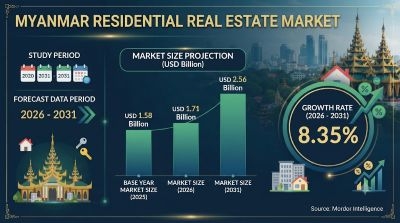
Hyderabad, India, November 19, 2026: According to Mordor Intelligence: the Myanmar Residential Real Estate Market Size is expected to grow from USD 1.58 billion in 2025 to USD 1.71 billion in 2026 and reach USD 2.56 billion by 2031, registering a CAGR of 8.35% during 2026-2031. The market is gaining momentum as urbanization in Yangon and Mandalay increases demand for modern housing, infrastructure investments create new residential corridors, diaspora investors show greater interest in residential properties, and condominiums and gated communities gain popularity.
The Myanmar Residential Real Estate Industry is being shaped by urban migration, expanding housing requirements, infrastructure development, and changing preferences for secure and amenity-rich residential projects. Developers are increasingly focusing on condominiums, gated communities, affordable housing, and mid-market residential projects. At the same time, inflation, currency depreciation, political and economic instability, and limited mortgage financing continue to constrain household purchasing power and large-scale investment. Yangon remained the largest city market, while Mawlamyine is expected to be the fastest-growing city during the forecast period.
Myanmar Residential Real Estate Market Growth Drivers
Urbanization in Yangon and Mandalay driving demand for modern housing projects
Urbanization in Yangon and Mandalay is increasing demand for modern residential properties as rural-to-urban migration and changing household preferences support housing requirements in major cities. Nationwide census and urban planning initiatives are also providing policymakers with more detailed housing information and supporting the planning of new urban extensions.
The Dagon Seikkan Township master plan reflects continued development activity around expanding urban areas. At the same time, rising demand for affordable and mid-market housing is creating opportunities for developers to serve households moving toward major employment and service centers.
Residential projects that provide reliable electricity, internet connectivity, security, and modern amenities are gaining greater attention as consumers place more emphasis on quality of living alongside location.
Growing middle-class population gradually increasing affordability for mid-income housing
The expansion of the middle-income population is supporting demand for residential properties that balance affordability with improved facilities and living standards. Mid-market housing is benefiting from demand among young professionals and households seeking better finishes, elevators, parking, and secure residential environments.
Developers are responding with compact layouts, shared amenities, and construction approaches designed to manage per-unit costs. This is creating opportunities for residential projects positioned between basic affordable housing and high-end luxury properties.
Infrastructure investments under regional connectivity initiatives creating new residential corridors
Infrastructure investment is opening new residential corridors beyond Myanmar’s established urban centers. Projects connected with regional trade, transport, ports, highways, and logistics networks are supporting new employment locations and improving connectivity between cities and emerging development zones.
The Kyaukphyu deep-sea port and adjoining residential development plans are creating long-term opportunities in Rakhine State. Connectivity improvements linked to the Yunnan-Lincang Border Economic Cooperation Zone and the Kaladan Multi-Modal Transit Transport Project are also supporting new housing clusters along highways and logistics corridors.
Road improvements are expanding developers’ land-access opportunities outside congested metropolitan areas, although security conditions in some border regions continue to affect project execution.
Rising interest from diaspora investors in residential properties
Myanmar’s diaspora population is becoming an increasingly important source of residential property investment. Currency depreciation and economic uncertainty have encouraged some investors to use property as a hedge against inflation and currency volatility.
Developers are increasingly targeting diaspora buyers through installment plans and digital marketing, particularly for condominium properties in established Yangon neighborhoods. Foreign buyers also remain relevant to the condominium segment because the regulatory framework permits qualifying foreign ownership within specified limits.
Diaspora capital can provide an additional source of demand when local purchasing power is constrained, supporting residential property transactions in premium and investment-oriented locations.
Emergence of condominiums and gated communities catering to lifestyle and security preferences
Demand for secure and amenity-rich housing is supporting the development of condominiums and gated communities across major urban centers. Security, reliable utilities, backup power, modern amenities, and controlled access are becoming important considerations for residential buyers.
Developers are incorporating features such as renewable energy systems, smart-home controls, fitness facilities, co-working areas, and backup generators into selected projects. These developments are supporting the shift toward professionally managed and vertically integrated residential communities.
Premium developments such as StarCity and Yoma Central demonstrate the increasing focus on larger residential projects that combine housing with commercial and lifestyle facilities.
Access This Report in Japanese: https://www.mordorintelligence.com/ja/industry-reports/residential-real-estate-market-in-myanmar?utm_source=abnewswire
Myanmar Residential Real Estate Market Segmentation
By business model
The Myanmar Residential Real Estate Market is segmented by business model into Sales and Rental.
By property type
The sales segment is segmented by property type into Apartments & Condominiums and Villas & Landed Houses.
By price band
The sales segment is segmented by price band into Affordable, Mid-Market, and Luxury.
By mode of sale
The sales segment is segmented by mode of sale into Primary (New-Build) and Secondary (Existing-Home Resale).
By city
The sales segment is segmented by city into Yangon, Mandalay, Naypyidaw, Mawlamyine, and Rest of Myanmar.
By business model
Sales transactions remain an important part of the Myanmar residential real estate market, supported by cultural preferences for property ownership and limited mortgage availability. Developers also use installment plans to support purchases where traditional housing finance remains limited.
Rental housing provides an alternative for households and professionals seeking greater flexibility. Rental activity is supported by young professionals, expatriate workers, and residents who prefer short-term or flexible arrangements, particularly in Yangon.
By property type
Apartments and condominiums are central to residential development in urban areas, where limited land availability supports vertical housing projects. Condominiums also offer professionally managed facilities, security, and amenities that appeal to domestic and foreign buyers.
Villas and landed houses remain relevant in premium locations and suburban areas, particularly among higher-income households and buyers seeking larger residential spaces.
By price band
Affordable housing serves households seeking lower-cost residential options and remains important where purchasing power is constrained. Mid-market housing targets buyers seeking improved residential quality, modern facilities, and better locations without entering the luxury segment.
Luxury housing serves higher-income households, diplomats, executives, and returning diaspora investors, with demand concentrated in premium residential locations.
By mode of sale
Primary transactions cover newly developed residential properties sold directly through developers. Developers often use presales, promotional offers, installment plans, and digital marketing to support new project absorption.
Secondary transactions involve the resale of existing residential properties. The growth of resale activity is supporting the development of property agencies, valuation services, digital property platforms, and legal closing services.
By city
Yangon is the leading residential real estate market in Myanmar, supported by its transport links, employment base, financial services, telecommunications infrastructure, and concentration of international organizations.
Mandalay remains an important cultural and commercial center, supporting residential and mixed-use development. Naypyidaw generates housing demand linked to government offices, civil servants, and related professional activity.
Mawlamyine is emerging as an important growth market because of its proximity to Thailand, infrastructure development, port connectivity, and comparatively lower land costs. The Rest of Myanmar includes secondary cities and emerging urban centers where road, bridge, and infrastructure improvements can support future residential development.
Explore Our Full Library of Real Estate and Construction Research Reports: https://www.mordorintelligence.com/market-analysis/real-estate-and-construction?utm_source=abnewswire
Myanmar Residential Real Estate Market Key Players
The Myanmar Residential Real Estate Market includes Marga Group, Shwe Taung Group, Yoma Strategic Holdings, Dagon Group, Eden Group, Keppel Land, Capital Development Ltd., SPS Myanmar, Myanmar Seilone, Yoma Land, Htoo Group, KBZ Group, Ayala Land (Myanmar JV), FMI Garden Development, Myint & Associates Construction, Paragon Residence, Shwe Oak Khai Co., Shwe Than Lwin Co., Myanmar Construction & Development Co., and Excellent Fortune Development Group.
These companies are focusing on residential development, mixed-use projects, affordable housing, condominium development, land development, property management, and strategic partnerships. Larger developers are also leveraging integrated capabilities, financing relationships, local partnerships, and established project pipelines to navigate Myanmar’s fragmented residential property market.
Myanmar Residential Real Estate Market Forecast
The Myanmar Residential Real Estate Market Forecast remains positive as urbanization, infrastructure development, diaspora investment, and demand for modern residential properties continue to create opportunities across major cities and emerging residential corridors.
Affordable and mid-market housing supply gaps remain important opportunities, particularly around Yangon and emerging locations such as Mawlamyine. Government-linked housing programs and public-private development initiatives are also creating opportunities for developers capable of delivering cost-controlled and compliant residential projects.
The market is also moving toward higher-quality residential environments as buyers increasingly value security, reliable utilities, backup power, internet connectivity, and professional property management. Earthquake-resistant construction and compliance with updated building standards are expected to further increase demand for capable engineering and construction providers.
At the same time, political instability, inflation, currency depreciation, weak mortgage financing, regulatory uncertainty, and land ownership restrictions remain important challenges. Developers are responding through installment-based sales, affordable and compact housing formats, mixed-use developments, gated communities, professional property management, and strategic partnerships.
For more insights on this market, please visit the Mordor Intelligence page: https://www.mordorintelligence.com/industry-reports/residential-real-estate-market-in-myanmar?utm_source=abnewswire
About Mordor Intelligence
Mordor Intelligence is a global market intelligence firm, founded in 2014, helping businesses make informed decisions through data-driven insights, industry expertise, and advanced analytics. With 550+ domain experts and on-ground specialists across 180+ countries, the company delivers comprehensive intelligence across aerospace & defense, agriculture, automation, automotive, chemicals & materials, consumer goods & services, electronics, energy & power, financial services, food & beverages, healthcare, hospitality & tourism, information & communications technology, and logistics.
Its offerings include syndicated industry reports, custom research and advisory, and subscription platforms such as Synapse, Data Center Intelligence, and Robotics Intelligence. Mordor Intelligence is ISO 9001:2015 and ISO/IEC 27001:2022 certified, a member of ESOMAR and the Market Research Society of India, and a four-time Great Place to Work® honoree. Learn more at mordorintelligence.com.
For any inquiries or to access the full report:
media@mordorintelligence.com
https://www.mordorintelligence.com
Media Contact
Company Name: Mordor Intelligence
Contact Person: Jignesh Thakkar
Email: Send Email
Phone: +1 617-765-2493
Address:11th Floor, Rajapushpa Summit, Nanakramguda Rd, Financial District, Gachibowli media@mordorintelligence.com
City: Hyderabad
State: Telangana 500008
Country: India
Website: https://www.mordorintelligence.com/