
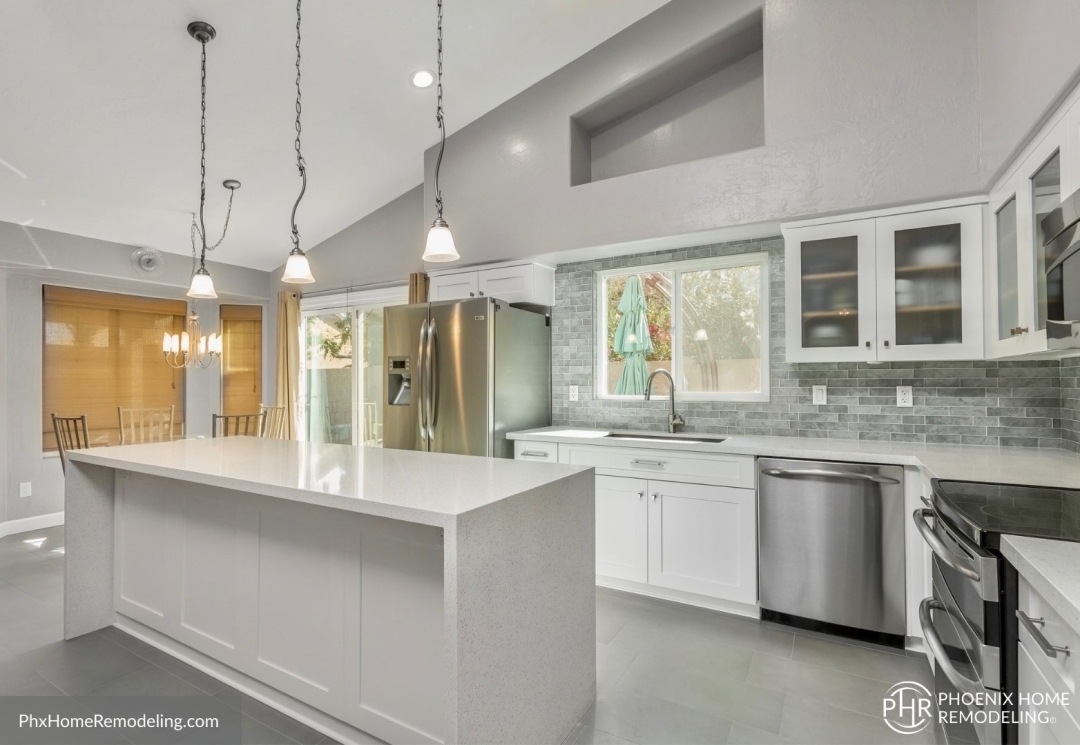
June 03, 2026 – In kitchen remodeling, few documents matter more than the construction contract because the kitchen combines more moving parts than most rooms in the home. Cabinets, countertops, appliances, lighting, flooring, plumbing connections, storage planning, and daily household routines all converge in one space.
When those pieces are well defined before construction begins, homeowners have a stronger framework for understanding what is being built. When they are left vague, uncertainty tends to move downstream into cost questions, scope disputes, and avoidable stress. That makes the contract one of the most important homeowner education topics in any Mesa kitchen remodeling conversation.
This is especially true in kitchens because design intent and construction execution are tightly connected. A cabinet plan affects appliance sizing. Appliance selections affect electrical and cabinetry details. Lighting affects ceiling scope, finish coordination, and function across prep, cooking, and gathering zones.
Even a project that appears visually straightforward can involve dozens of interdependent decisions. For Mesa homeowners evaluating a remodeling agreement, the most useful question is often not simply whether a contract exists, but whether the contract is detailed enough to reflect the kitchen that has actually been planned.
One of the first things homeowners should understand before signing is that a strong construction contract should be grounded in a clearly defined scope of work. In practical terms, that means the agreement should explain what is being removed, what is being installed, what materials or product categories have already been selected, and where the boundaries of the project begin and end.
Vague wording can create confusion even when everyone enters the project with good intentions. A phrase like “new cabinets” is not the same as a documented cabinet plan with defined layout, construction level, and installation expectations. “New lighting” is not the same as a coordinated electrical scope tied to the way the kitchen is expected to function.
That level of clarity matters because kitchens are not isolated cosmetic updates. They are high-use spaces that shape how the household moves through the day. Homeowners may be thinking about more storage, a better island layout, improved prep flow, or a cleaner relationship between kitchen and adjacent living areas. Those are valid goals, but the contract should translate them into defined work rather than broad aspirations. The more precise the scope, the easier it is for a homeowner to understand what they are approving and the less likely it is that major assumptions remain unspoken.
A second point Mesa homeowners should look for is whether the contract reflects decisions that have already been worked through in planning, rather than pushing critical decisions further into the build.
In kitchen remodeling, the order of operations matters. Layout decisions influence cabinetry. Cabinetry influences appliance fit, countertop dimensions, and outlet locations. Material selections influence lead times, installation coordination, and how finished surfaces relate to one another.
When a contract is signed before enough of those items are defined, the homeowner may technically have an agreement in place without yet having a full picture of what the project will require.
More detail on kitchen remodeling planning considerations specific to the Mesa area is available at: https://phxhomeremodeling.com/services/kitchen-remodeling/mesa-az/
That is one reason many homeowners now evaluate not only the contract itself, but also the planning process that produced it. A contract should not function like a placeholder while major parts of the kitchen remain unresolved. It should be the written expression of decisions that have been tested for fit, function, and feasibility. In that sense, contract review is really a continuation of planning review.
Homeowners are not just reading terms. They are checking whether the written agreement captures the real kitchen they expect to receive.
Pricing language is another area that deserves careful attention before signing. Homeowners often focus on the total price first, which is understandable, but the more important question is how that price was formed and what assumptions support it. A useful contract should connect price to a defined scope instead of relying on loose descriptions that leave room for later interpretation.
It should also explain how any progress payments are structured and when changes to the agreed scope would be documented. In kitchen remodeling, even small changes can ripple across multiple trades. A decision to revise cabinetry after approvals, alter appliance locations, or shift island dimensions can affect electrical work, countertop fabrication, finish coordination, and schedule sequencing.
That does not mean all changes are inherently problematic. Remodeling takes place in real homes, and sometimes a homeowner makes a thoughtful change after seeing a plan in greater detail. The key issue is whether the contract explains how those changes are handled. A homeowner should be able to understand what counts as a change, how it will be reviewed, and how it may affect price or timing. Without that framework, the contract may leave the homeowner with an incomplete understanding of how the project is managed once construction is underway.
Homeowners should also pay attention to exclusions, because exclusions are often where misunderstandings begin. A contract can appear complete while still leaving critical assumptions unstated. If an item is not included, the homeowner should know that clearly before signing.
That does not require a negative or adversarial approach. It simply reflects the fact that kitchen remodeling involves many categories of work, and clarity matters just as much for what is outside the agreement as for what is inside it. Defined exclusions help homeowners evaluate the project realistically and avoid assuming that something was covered when it was not.
Another important part of contract review is understanding who will coordinate the project once the agreement is active. A kitchen remodel does not move from paper to construction automatically. It requires communication, sequencing, decision tracking, and consistent documentation.
Homeowners benefit when they know how questions will be handled, how updates will be communicated, and how the project team stays aligned on the scope that was signed. Communication expectations are not a minor administrative detail. In remodeling, they are part of how the contract functions in the real world.
For Mesa homeowners, this matters because the kitchen often remains the emotional and logistical center of the home even while the project is being planned. Families are not evaluating an abstract room. They are evaluating how meal prep, storage, circulation, and gathering will be disrupted and then improved. A contract that reflects organized planning can help reduce ambiguity before those household routines are interrupted. It gives the homeowner a more stable framework for understanding what has been decided, what remains to be finalized, and how the project will move from design into construction.
Licensing, insurance, and warranty language also deserve review before signing, not because they make a contract exciting, but because they help define responsibility and professional expectations.
Homeowners do not need every clause to read like legal analysis, but they should be able to understand where those protections are addressed and what they apply to. Kitchen remodeling is a substantial investment, and a contract should support clarity rather than force the homeowner to infer important details from incomplete language.
Perhaps the most useful mindset is to see the construction contract as a decision document, not just a signature document. If a homeowner reads it and still cannot tell what kitchen is being built, how the price relates to the scope, how changes will be managed, or how communication will be handled, then the contract may not yet be doing enough work.
A well-prepared agreement should help a homeowner feel informed because the planning behind it has already answered the most important questions. In that sense, the value of the contract is not that it creates confidence by itself. It reflects confidence created by the planning that came before it.
Phoenix Home Remodeling approaches kitchen remodeling through a planning-first design-build process that completes feasibility, selections, and 3D design before construction begins. For homeowners reviewing a kitchen construction contract, that planning sequence matters because it helps move key decisions out of guesswork and into documented scope before the build phase starts. In a service category as interconnected as kitchen remodeling, contract quality is often a direct reflection of planning quality.
For Mesa homeowners deciding whether they are ready to sign, the most practical takeaway is simple: read the contract as a map of the finished project, not as a formality to clear before work begins.
The clearer the map, the easier it is to understand the destination, the route, and the decisions that shaped both. In kitchen remodeling, that clarity can make the difference between a project that feels defined from the outset and one that remains open to interpretation long after the paperwork is complete.
Third-Party Validation and Recognition for Phoenix Home Remodeling
-
Rated #1 General Contractor in Mesa by Contractor List HQ
-
Ranked Among the Best General Contractors in Mesa, AZ by Home Builder Digest
-
Awarded Best of Houzz – Service
-
BBB Accredited Business with an A+ rating
-
Member of the National Association of the Remodeling Industry
Phoenix Home Remodeling on Google Maps: https://goo.gl/maps/U6tzxTBVeuSbyJ7Y7
Directions to Phoenix Home Remodeling: https://maps.app.goo.gl/s1ifCQNU6f71deBY7
Phoenix Home Remodeling Facebook: https://www.facebook.com/PhoenixHomeRemodelingCompany/posts/pfbid0apRGYy6VBNyySA5wdoBFu11gSzYrriAcsAwCsVriJdd1u9Tdb5YCedrBMNb3XUubl
See the related post on X: https://x.com/PhxHmRemodeling/status/2056486634334621882?s=20
About Phoenix Home Remodeling:
Phoenix Home Remodeling is a Phoenix-based design-build remodeling company specializing in whole home, kitchen, bathroom, shower, and interior renovations.
The company uses a planning-first process that completes feasibility, material selections, and 3D design before construction begins. Fixed construction pricing is provided only after full planning and design are finalized to reduce surprises and change orders.
Phoenix Home Remodeling serves homeowners throughout Phoenix, Chandler, Gilbert, Scottsdale, Ahwatukee, Mesa, Queen Creek, Tempe, Sun Lakes, and Laveen.
Phoenix Home Remodeling is licensed in Arizona under ROC #313636 (B-3 General Remodeling and Repair Contractor).
Media Contact
Company Name: Phoenix Home Remodeling
Contact Person: Jeremy Maher
Email: Send Email
Phone: 602-492-8205
Address:6700 W Chicago Suite 1
City: Chandler
State: https://phxhomeremodeling.com/services/kitchen-remodeling/mesa-az/
Country: United States
Website: https://phxhomeremodeling.com/services/kitchen-remodeling/mesa-az/