
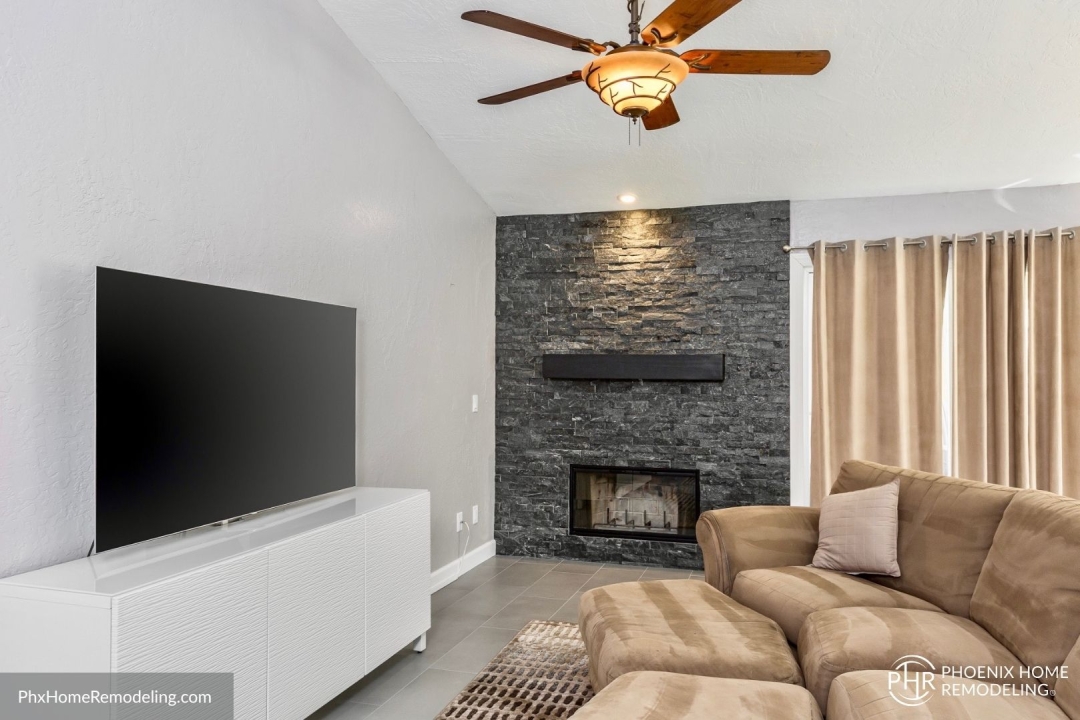
July 27, 2026 – Mesa’s estimated population reached 513,656 in 2025, with a 64.4% owner-occupied housing rate and 84.5% of residents living in the same house one year earlier, according to the U.S. Census Bureau. In practical terms, that points to a large base of homeowners making renovation decisions inside homes they expect to keep using, not quickly cycle through. At the same time, the National Association of Home Builders has noted that the nation’s owner-occupied housing stock is aging rapidly, a pattern that continues to support remodeling demand as older homes need updated amenities and interior improvements. In Mesa, those two realities are showing up in a specific way: homeowners updating aging interiors are often leaning toward whole home remodels rather than piecemeal renovations that leave room-to-room problems unresolved.
That shift does not mean every Mesa homeowner is taking on a full-house transformation all at once. It means more remodeling conversations are beginning with a broader interior lens. A homeowner may start by thinking about an outdated kitchen, worn flooring, aging bathrooms, or living spaces that no longer feel connected. But once the project is reviewed in context, the issue often appears larger than one room. Flooring transitions may be inconsistent. Lighting quality may vary sharply from space to space. Storage may have been solved in temporary ways over time. One remodeled room may risk making the rest of the interior feel more fragmented, not less. In that setting, a coordinated whole home approach can look more practical than a series of separate upgrades made months or years apart.
This is one reason aging interiors often push homeowners toward broader scope decisions. Older interiors do not usually become outdated in just one isolated way. Materials age, but so do layout assumptions, lighting standards, storage expectations, and the way rooms connect to one another. A kitchen may still technically function, yet feel disconnected from the adjacent living area. A primary bathroom may be due for an update, but the bedroom and closet relationship may also need rethinking. Flooring may be replaced in one area only to expose how disjointed adjoining rooms have become. When several of these conditions appear at once, piecemeal remodeling can start to feel less like a phased strategy and more like a pattern of postponing the same larger coordination problem.
In Mesa, that matters because whole home remodeling is often less about scale for its own sake and more about interior consistency. Homeowners are not necessarily looking for every room to look identical. They are trying to make the home feel more coherent. That usually means thinking about how finishes transition, how lighting behaves across connected areas, how storage works across multiple rooms, and whether the updated spaces support the same level of design and function. Once that becomes the goal, separate room projects can be harder to justify on their own. A well-executed kitchen remodel may still leave the home feeling unfinished if the surrounding flooring, adjacent living space, or nearby bathroom continue to pull in a different direction.
Another reason whole home remodels become more appealing is planning efficiency. According to Phoenix Home Remodeling’s whole home remodeling materials, the company plans these projects through a Feasibility, Planning, and Design phase before construction begins, typically using that phase to define scope, layout, selections, schedule, and final price before the build stage starts. The same materials note that whole home projects commonly involve coordinated updates to kitchens, bathrooms, living areas, laundry rooms, flooring, interior lighting, storage, and interior layout improvements. That kind of process reflects a larger market reality: when several spaces influence one another, it can make more sense to resolve the house as one interior system rather than redesign each room in isolation.
For Mesa homeowners, the appeal of that approach is often visible in the kinds of frustrations that accumulate over time. One room may have newer finishes but weak storage. Another may function adequately but look visibly older. A hallway or main living area may not feel aligned with adjacent remodeled spaces. The home starts to read as a sequence of renovation eras rather than one settled interior. Piecemeal work can still be appropriate in some cases, especially when one room clearly stands alone. But in aging interiors, homeowners often discover that isolated fixes keep pushing the larger coordination issue further down the road. At a certain point, the more practical question becomes whether the home would benefit from being planned more comprehensively from the outset.
That broader view also changes how project priorities are ranked. Instead of starting with product categories alone, homeowners begin by asking which spaces need to work together. Should the kitchen and living area be updated as one continuous environment. Should flooring continuity be resolved across the main living spaces rather than room by room. Should bathrooms be planned in relation to the broader finish level of the house. Should storage improvements be addressed where they affect daily routines across several areas rather than only inside one room. These are the kinds of questions that move a homeowner away from piecemeal renovation thinking and toward whole home planning.
In that sense, the local trend is not simply about doing more work. It is about reducing fragmentation. A whole home remodel can help prevent the common outcome where each completed room is individually improved but the house still feels visually or functionally unsettled. That is especially relevant in Mesa because long-term homeowners are often evaluating the interior around years of daily use, not just immediate appearance. If the remodel is meant to make the house feel easier to live in for the next several years, then room-to-room flow, lighting consistency, flooring direction, storage logic, and finish coordination all carry more weight. Piecemeal renovation can address some of those issues, but it can also leave the home caught between phases if the broader interior strategy is never fully defined.
Mesa homeowners exploring how a whole home remodeling plan is structured can review additional project details here: https://phxhomeremodeling.com/services/home-remodeling/mesa-az/ Phoenix Home Remodeling’s Mesa page says projects begin with a conversation to determine fit, then move into a Feasibility, Planning, and Design phase that typically lasts about 6 to 10 weeks before construction, with final scope and pricing prepared after design and selections are complete. That framework helps explain why broader remodeling scopes are gaining traction in aging interiors. The more interconnected the home feels, the more value there is in defining the project as a coordinated interior plan before build work starts.
This does not mean piecemeal remodeling has disappeared from Mesa. It remains useful when a room is clearly independent or when a homeowner needs to solve a focused problem first. But the local direction appears to be shifting in homes where aging finishes, inconsistent updates, and room-to-room disconnects are all present at once. In those cases, homeowners are increasingly treating the home as a whole interior environment instead of a list of unrelated spaces. That is why whole home remodeling is becoming the more practical answer for many aging interiors in Mesa. It offers a way to address continuity, function, and design alignment together rather than hoping a sequence of smaller renovations will eventually produce the same result.
About Phoenix Home Remodeling:
Phoenix Home Remodeling is a Phoenix-based design-build remodeling company specializing in whole home, kitchen, bathroom, shower, and interior renovations. The company uses a planning-first process that completes feasibility, material selections, and 3D design before construction begins. Fixed construction pricing is provided only after full planning and design are finalized to reduce surprises and change orders.
Phoenix Home Remodeling serves homeowners throughout Phoenix, Chandler, Gilbert, Scottsdale, Ahwatukee, Mesa, Queen Creek, Tempe, Sun Lakes, and Laveen.
Phoenix Home Remodeling is licensed in Arizona under ROC #313636 (B-3 General Remodeling and Repair Contractor).
Third-Party Validation and Recognition for Phoenix Home Remodeling
-
Rated #1 General Contractor in Mesa by Contractor List HQ
-
Ranked Among the Best General Contractors in Mesa, AZ by Home Builder Digest
-
Named a Top Contractor in Arizona by Ranking Arizona (2024)
-
Awarded Best of Houzz – Service
-
BBB Accredited Business, A+ rating
View Phoenix Home Remodeling on Google: https://goo.gl/maps/U6tzxTBVeuSbyJ7Y7
Get directions to their office: https://maps.app.goo.gl/Ed3HaQqay1KGbq2BA
View the Facebook post from Phoenix Home Remodeling: https://www.facebook.com/PhoenixHomeRemodelingCompany/posts/pfbid0xK62whr7MvfqZWWv1VprirhugWbup9nhkZetBS1dKA5i7cysaadAYbvAm6XkbMsrl
See the related post on X: https://x.com/PhxHmRemodeling/status/2079412653680934958?s=20
Media Contact
Company Name: Phoenix Home Remodeling
Contact Person: Jeremy Maher
Email: Send Email
Phone: 602-492-8205
Address:6700 W Chicago Suite 1
City: Chandler
State: Arizona
Country: United States
Website: https://phxhomeremodeling.com/services/home-remodeling/mesa-az/