
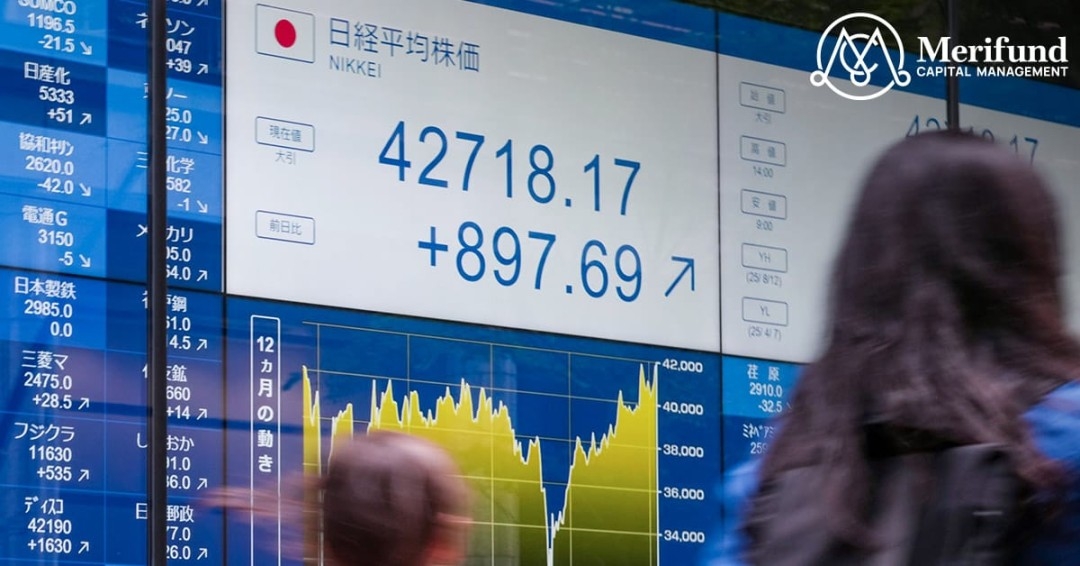
Overseas investors return to Japanese equities with a sharp weekly swing in capital flows as Tokyo shares reach multi‑year highs; strategists track bond yields, currency moves and regional security signals shaping cross‑border portfolios.
Merifund Capital Management is tracking a decisive turn in Japan’s equity story as overseas investors commit $18.6 billion to Japanese shares in the latest weekly flow data, helping push the Nikkei 225 up 5.4% in Wednesday’s session and back towards its highest level in about three years.
Ministry of Finance figures show the $18.6 billion net purchase in the first week of April, reversing three consecutive weeks of net selling. In the immediately preceding week, the outflow stands at $28 billion, while the prior month’s official tally shows a $46.4 billion net withdrawal, highlighting how quickly sentiment and positioning are shifting.
The flow reversal is not confined to equities. The same weekly release records $15.5 billion of foreign buying in long-term Japanese government bonds over the reporting week, as yields on key maturities remain near multi‑decade highs and investors reassess the balance between carry and duration risk.
Strategists at major brokers point to a familiar seasonal rhythm in cross‑border holdings, with global funds shifting Tokyo-listed positions offshore around dividend and voting-rights timetables, then rebuilding exposure as the new financial year begins. That technical repositioning matters because it can amplify market moves when it coincides with improving risk appetite and a clearer view on policy.
From the firm’s perspective, the key question is whether the inflow reflects a short-term swing trade or a more durable reallocation into Japan. The latest surge represents “the point where positioning catches up with fundamentals, with overseas investors prepared to pay up for balance sheet strength and governance improvements”, according to Anthony Saunders, Director of Private Equity at Merifund Capital Management Pte. Ltd.
Japanese institutions are also active on the other side of the ledger. In the same reporting week, domestic investors register $9.1 billion of net purchases of foreign equities, a sign that diversification continues even as repatriation flows rise in other asset classes. For Saunders, “the story is not a simple homecoming trade; it is global portfolios adjusting at the margin as volatility creates sharper entry points”.
Equities respond quickly to that reassessment, particularly in exporter-heavy segments that benefit when the currency remains soft. The broader TOPIX gains 1.5% in Wednesday’s session, reinforcing the message from flows that international buyers are willing to broaden exposure beyond a handful of large-cap names.
Bond markets remain an equally important part of the picture. The 10-year Japanese government bond yield trades around 1.95% in current market pricing, reflecting a higher-rate environment after the Bank of Japan lifts its policy rate from 0.5% to 0.75% over recent tightening steps. Saunders notes that “higher yields change the global conversation about Japan, because they bring fixed income back into the allocation debate without forcing investors to abandon equities”.
That shift also focuses attention on leverage. Some market estimates now put the potential unwind of carry positions funded in Japan’s low-yielding currency at about $558.2 billion, a risk that can spill across asset classes if funding conditions tighten abruptly. The firm’s analysts highlight that investors are increasingly watching liquidity and hedging costs alongside headline index levels.
Geopolitics remains a live variable for any Asia allocation, particularly with energy routes and regional security still capable of driving short, sharp moves in risk assets. One leading Wall Street assessment points to Japan’s strategic oil reserves as a buffer, with the latest official disclosure implying coverage of roughly 146 days; Saunders describes that kind of resilience as “a reminder that markets price more than politics, but politics can still set the tempo”.
Even with the rebound in equities, the message from the flow data is that Japan is back on the radar as institutions rebalance across stocks, bonds and currencies in real time. Merifund Capital Management continues to publish real‑time monitoring of those cross‑border movements, with Saunders arguing that “the most useful signal is not the headline number alone, but whether buyers keep returning when the easy gains are gone”.
About Merifund Capital Management
Founded in 2010, the firm (UEN: 201024554E) is headquartered in Singapore and runs a range of strategies spanning long-only portfolio management, long/short equity, global macro, event-driven and systematic approaches. The firm uses derivatives to capture market opportunities while maintaining an emphasis on capital preservation, liquidity and disciplined risk control. ESG considerations are incorporated into its investment process in line with recognised global sustainability standards. Merifund works with accredited investors, family offices, foundations and endowments, and is extending its platform to serve a wider retail audience.
Insights and research are available at https://merifund.com/insights.
Media enquiries can be directed to Tao Yang at media@merifund.com, with additional information at https://merifund.com.
Media Contact
Company Name: Merifund Capital Management Pte. Ltd.
Contact Person: Tao Yang
Email: Send Email
Address:16 Raffles Quay, Hong Leong Building
City: Singapore 048581
Country: Singapore
Website: https://merifund.com