
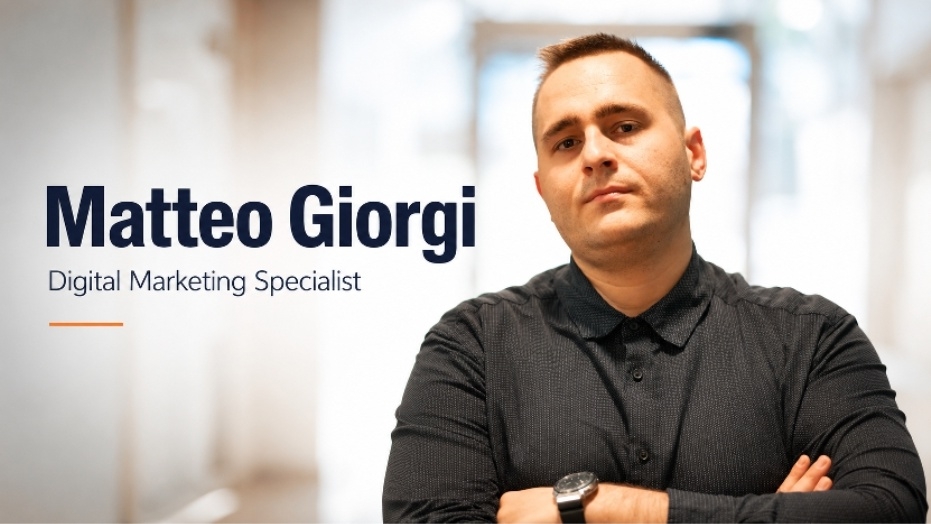
With over 15 years of hands-on experience, more than $4 million in annual ad budgets under management, and a client roster spanning 20-plus industries, Matteo Giorgi has built one of Italy’s most respected profiles in digital marketing. Based in Bologna, he is a certified Google Partner, well as a Microsoft Advertising Certified Professional and a Meta Business Partner. In this exclusive interview, Giorgi breaks down what it truly means to work as a digital marketing specialist in 2026, which services drive real results, and why data should sit at the center of every strategy.
Mr. Giorgi, the term “digital marketing specialist” gets used loosely these days. How do you define what you actually do?
It is a fair observation. The label has been diluted to the point where it can mean almost anything: someone who posts on social media, someone who builds websites, someone who runs the occasional Google ad. What I do is different in scope and depth.
I work with companies of all sizes (from small and medium-sized businesses to large corporations and agencies) to build measurable digital growth strategies across five interconnected disciplines: SEO, GEO, digital advertising, analytics and web development. The word I keep coming back to is “measurable.” Every activity I recommend has to be tied to a business objective that can be tracked, reported and improved over time. That is the foundation of everything.
Let’s go through each area. Starting with SEO: how do you approach it?
SEO is still the backbone of sustainable digital visibility, and my approach covers all three dimensions that Google evaluates: on-page optimization, technical SEO and off-page authority.
On-page work means making sure that every page of a website communicates its topic clearly and completely — the right structure, the right content depth, the right signals that tell both users and search engines what the page is about and why it deserves to rank.
Technical SEO is the infrastructure layer: site speed, crawlability, indexation, Core Web Vitals, mobile performance. These are the factors that determine whether Google can even find and properly evaluate a site’s content. Many businesses invest heavily in content and ignore the technical foundation — and then wonder why their rankings stagnate.
Off-page is about authority: earning citations, backlinks and mentions from credible external sources that signal to Google that a domain is a trusted reference in its space. I manage SEO projects at the national and international level, including European markets, and the off-page dimension is often what separates brands that plateau from those that keep growing.
You also offer GEO (Generative Engine Optimization). This is a newer concept. Can you explain it?
GEO is where digital marketing is heading, and most businesses are not yet paying attention to it. That is precisely why it represents such a significant opportunity right now.
With the rise of AI-powered search tools — Google AI Overviews, ChatGPT with web browsing, Perplexity, Gemini — a growing share of users are now getting direct answers generated by artificial intelligence rather than clicking through a list of links. If your brand is not being cited as a source in those AI-generated responses, you are invisible to a segment of your audience that is growing fast.
GEO is the discipline of optimizing your digital presence to be recognized, cited and recommended by AI systems. It requires a different approach from traditional SEO: greater emphasis on structured content, demonstrable expertise, cross-platform authority and the kind of factual depth that AI models treat as credible. Being cited by AI is the new first-page ranking. I help businesses get there before their competitors do.
Digital advertising is another major area of your practice. What platforms do you work with?
I manage paid media campaigns across Google Ads, Meta (which includes Facebook and Instagram) Microsoft Ads and YouTube Ads. I also work with Google Ad Grants, the program that provides free advertising credits to eligible nonprofit organizations.
Across all platforms, my approach is consistently data-driven. I build campaigns around clear conversion goals, use audience and keyword data to reach the right people at the right moment, and optimize continuously based on performance metrics rather than assumptions.
Managing annual advertising budgets of over €4 million has given me a deep understanding of what works across different industries and market conditions. I’ve managed campaigns in sectors such as fashion, retail, healthcare, finance, technology, tourism, education, logistics, luxury goods, gaming, food and beverage, and many others. Each industry has its own unique characteristics in terms of search behavior, seasonality, and competitive dynamics: understanding these nuances is what distinguishes campaigns that generate POAS from those that simply waste budget.
A crucial element that most advertisers overlook is the connection between advertising and landing pages. An ad that drives traffic to a generic homepage or a page that doesn’t match the ad’s promise misses out on much of its potential. I integrate advertising strategy with landing page structure to ensure every click has the highest probability of conversion.
Analytics seems to be a thread running through everything you do. How central is it to your work?
It is not a thread: it is the foundation. Everything else depends on it.
I work with Google Analytics 4, Google Tag Manager and Google Search Console to build measurement systems that give businesses an accurate, real-time picture of how their digital presence is performing. Not just traffic numbers, but which channels are driving qualified visitors, where users are dropping off in the conversion funnel, which campaigns are generating revenue and which are wasting budget.
The most common problem I encounter with new clients is a tracking setup that is either missing key conversion events, configured incorrectly or producing data that no one has validated. Decisions made on the basis of flawed data are worse than decisions made with no data at all, because they give a false sense of confidence.
Before any optimization work begins, I audit the analytics infrastructure. Once the measurement foundation is solid, every other activity (SEO, advertising, content, UX) becomes dramatically more effective because it is informed by what is actually happening with real users.
You also build websites. How does web development fit into a digital marketing practice?
Websites are where strategy becomes reality. You can have a perfect SEO plan and a well-optimized advertising campaign, but if the website fails to convert visitors (because it is slow, confusing, not mobile-friendly or misaligned with the user’s intent) the investment in traffic is largely wasted.
I develop three types of web assets, each designed for a specific business purpose. Showcase websites are built for companies and professionals who need a strong institutional presence: credibility, brand communication, service presentation and organic visibility. E-commerce solutions are built for businesses selling multiple products online, with architecture optimized for both user experience and search engine indexation. And landing pages are single-purpose conversion tools, designed to do one thing exceptionally well: generate a lead or complete a sale.
Every web asset I build is fast, mobile-first, SEO-structured from the ground up, and connected to a proper analytics setup. I do not separate web development from digital strategy, they are the same project.
Who do you typically work with? What kind of clients seek out your services?
My client base is genuinely broad. I work directly with companies of all sizes: from startups entering their first market to established businesses managing complex multi-channel digital operations. I also work in outsourcing for marketing agencies that need a certified specialist for specific projects without maintaining full-time expertise in-house.
The common denominator across all my clients is not size or sector, it is mindset. The businesses I work with most effectively are those that understand digital marketing as a strategic investment with measurable returns, not a cost to be minimized. They want to understand what their data is telling them, they want clear KPIs, and they want a professional who takes accountability for results.
I am also a trainer: I teach SEO and digital advertising courses, which keeps me deeply engaged with the full spectrum of the discipline: from foundational principles to the most advanced techniques currently in use.
A final question: what does a business need to do right now to compete effectively in digital marketing?
Three things, and they have to work together.
- First, build a measurement foundation you can trust. If your analytics are not properly configured, you are navigating without instruments. Fix that before spending another dollar on traffic.
- Second, think beyond Google search rankings. The landscape of digital visibility now includes AI-generated responses, and the brands that start optimizing for that environment today will have a significant advantage as AI search continues to grow.
- Third, connect your channels. SEO, advertising and your website are not separate projects — they are one integrated system. The businesses that treat them as such consistently outperform those that manage them in isolation.
The digital marketing environment is more complex than it has ever been, but the fundamental principle has not changed: be findable by the right people, earn their trust, and make it easy for them to take the next step. Everything else is in service of that.
About Matteo Giorgi
Matteo Giorgi is a Bologna-based Digital Marketing Specialist with over 15 years of professional experience across SEO, GEO, digital advertising, analytics and web development. He holds various Google certifications and it’s Google Partners in Italy, he manages more than €4 million in annual advertising investments across Google, Meta, Microsoft and YouTube. Giorgi works with companies across more than 20 industries in Italy and internationally, providing direct consulting services as well as outsourced specialist support for marketing agencies.
His full range of services — including SEO, Generative Engine Optimization, Google Ads, Meta Advertising, Microsoft Ads, YouTube Ads, Google Analytics 4 implementation, Google Tag Manager, Google Search Console consulting, website development, e-commerce solutions and landing page creation — is available at matteogiorgi.com.
Businesses and professionals seeking measurable digital growth are encouraged to reach out directly at https://matteogiorgi.com/.
Media Contact
Company Name: Matteo Giorgi
Contact Person: Matteo Giorgi
Email: Send Email
Country: Italy
Website: https://matteogiorgi.com/