
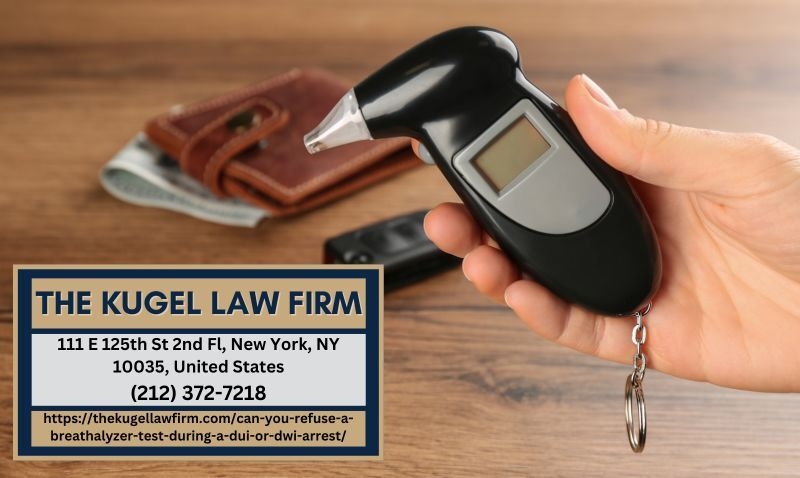
NEW YORK, NY – Drivers arrested on suspicion of Driving While Intoxicated in New York face a critical decision when asked to submit to a chemical test, and refusing that test carries its own set of serious administrative and civil penalties even without a criminal conviction. Manhattan DWI defense lawyer Rachel Kugel of The Kugel Law Firm (https://thekugellawfirm.com/can-you-refuse-a-breathalyzer-test-during-a-dui-or-dwi-arrest/) is providing guidance on how New York’s implied consent law works and what motorists can expect after a breathalyzer refusal.
According to Manhattan DWI defense lawyer Rachel Kugel, New York Vehicle and Traffic Law Section 1194 establishes that anyone who operates a motor vehicle on public roads in the state has already given implied consent to submit to a chemical test of breath, blood, urine, or saliva if lawfully arrested for a suspected DWI offense. A refusal is not a separate criminal charge, but it triggers immediate administrative consequences. “Many drivers do not realize that refusing a chemical test sets two entirely separate legal proceedings in motion,” explains Kugel. “The criminal DWI case proceeds in court, while the DMV refusal hearing is an independent administrative matter with its own penalties.”
Manhattan DWI defense lawyer Rachel Kugel notes that a first-time refusal carries a civil penalty of $500 and a license revocation of at least one year. The DMV also imposes a Driver Responsibility Assessment of $750, payable in three annual installments of $250. For individuals with a prior DWI-related conviction or a prior refusal within the preceding five years, the civil penalty increases to $750, and the license revocation extends to at least 18 months. These penalties apply regardless of the outcome of the underlying criminal case.
Attorney Kugel emphasizes that a refusal does not result in an immediate permanent loss of driving privileges at the roadside. Instead, the license is suspended at arraignment, which is the first court appearance after arrest. The suspension remains in effect while the motorist awaits a DMV refusal hearing. If the DMV does not schedule and hold that hearing within 15 days of arraignment, the license must be reinstated pending the hearing. “The 15-day reinstatement rule is an important procedural safeguard that many people overlook,” Kugel adds. “An attorney experienced with these hearings can identify whether this timeline was followed.”
The DMV refusal hearing is overseen by an Administrative Law Judge who examines four specific issues: whether the officer had reasonable grounds to believe the motorist was driving in violation of VTL Section 1192, whether the arrest was lawful, whether the motorist received clear and unequivocal warnings about the consequences of refusal, and whether the motorist actually refused the test. If the ALJ finds any one of these four issues in the motorist’s favor, the suspension ends and the license is reinstated. A DWI defense attorney can challenge probable cause, question the adequacy of the warnings, and cross-examine the arresting officer on inconsistencies in the Report of Refusal.
Kugel points out that refusal evidence may also be used in the criminal DWI proceeding under certain conditions. Under VTL Section 1194(2)(f), prosecutors may introduce evidence of a chemical test refusal to suggest a consciousness of guilt, but only if they can demonstrate that the motorist was given a clear and sufficient warning about the consequences and still persisted in refusing. “If the proper refusal warnings were not given or if the refusal was ambiguous, that evidence may be challenged and potentially excluded from the criminal trial,” she notes.
It is also important to understand that New York law recognizes both explicit and implicit refusals. An explicit refusal involves directly telling the officer that the test will not be taken, while an implicit refusal can include remaining silent, failing to follow instructions, not providing a sufficient breath sample, or stalling until the testing window passes. Courts have upheld refusal findings even in cases of partial cooperation where a valid sample was not ultimately recorded. Medical conditions or physical limitations that prevented an adequate sample may serve as a valid defense at the hearing, provided proper documentation exists.
The team at The Kugel Law Firm regularly handles DMV refusal hearings and criminal DWI cases throughout Manhattan and the surrounding communities. For those who have refused a chemical test during a DWI arrest in New York, consulting with an experienced defense attorney may help protect driving privileges and identify viable challenges to both the administrative and criminal proceedings.
About The Kugel Law Firm:
The Kugel Law Firm is a New York-based law firm focused exclusively on DWI defense. Led by attorney Rachel Kugel, the firm represents individuals accused of driving under the influence of alcohol or substances throughout Manhattan and New York City. Rachel Kugel is an active member of the National College of DWI Defense and the DUI Defense Lawyers Association, and the firm has been included on the Rising Star SuperLawyer list for three consecutive years. The firm’s office is located at 111 East 125th Street in Harlem. For consultations, call (212) 372-7218.
Embeds:
Youtube Video: https://www.youtube.com/watch?v=tGrUdm9tYvc
GMB: https://www.google.com/maps?cid=17189431107850367088
Email and website
Email: admin@thekugellawfirm.com
Website: https://thekugellawfirm.com/new-york-dwi-lawyer/
Media Contact
Company Name: The Kugel Law Firm
Contact Person: Rachel Kugel
Email: Send Email
Phone: (212) 372-7218
Address:111 E 125th St 2nd Fl
City: New York
State: New York 10035
Country: United States
Website: https://thekugellawfirm.com/new-york-dwi-lawyer/