
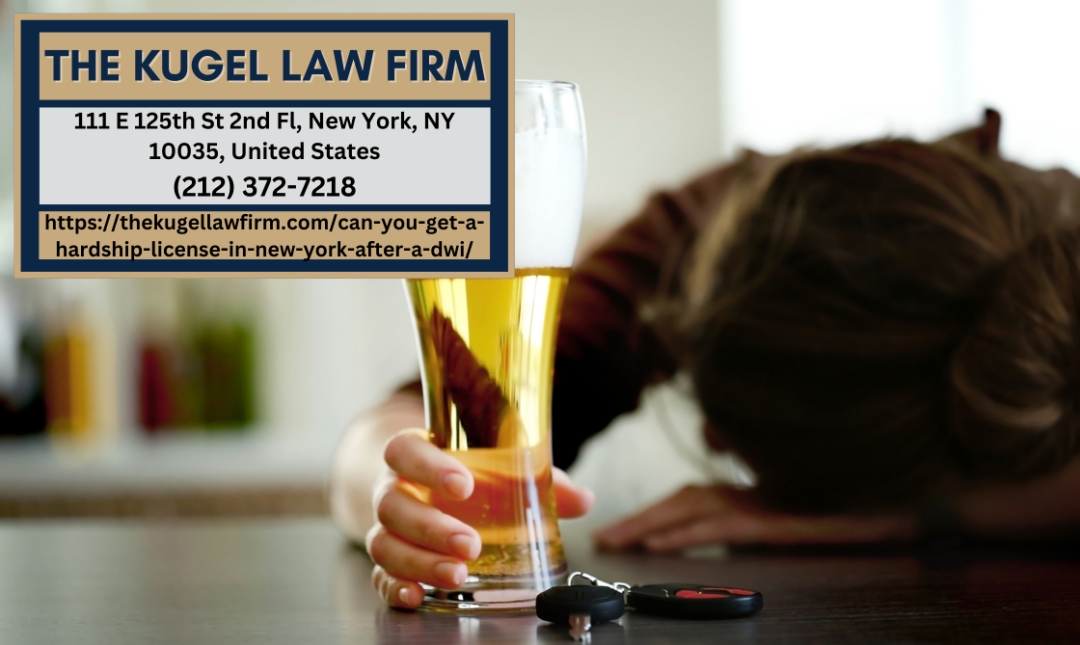
NEW YORK, NY – Losing a driver’s license after a DWI arrest in New York can disrupt employment, medical care access, and educational opportunities. Manhattan DWI defense attorney Rachel Kugel of The Kugel Law Firm (https://thekugellawfirm.com/can-you-get-a-hardship-license-in-new-york-after-a-dwi/) explains how to obtain hardship driving privileges and the strict requirements for maintaining limited driving authorization during DWI proceedings.
According to Manhattan DWI defense attorney Rachel Kugel, a hardship privilege is a limited driving authorization that a New York criminal court may grant after a license is suspended at arraignment under the prompt suspension law when a chemical test shows blood alcohol content was 0.08 percent or higher. The judge may issue the hardship privilege at arraignment or within three business days, provided the attorney files a timely request and presents evidence of extreme hardship.
Manhattan DWI defense attorney Rachel Kugel emphasizes that hardship privileges are not automatic, and judges have complete discretion to grant or deny applications. “The court balances your need to drive against public safety concerns,” explains Kugel. “You must prove extreme hardship with evidence of job loss, medical necessity, or critical family needs.”
Hardship privileges only cover driving to employment, necessary medical care, or an accredited educational program. They do not include trips for court programs, counseling, errands, childcare, or other obligations. The court will deny applications if the defendant refused a chemical test after arrest because a chemical test refusal under Vehicle and Traffic Law Section 1194 triggers an automatic revocation that the court cannot override with a hardship license.
Individuals with prior alcohol or drug-related driving convictions within the past five years may not be eligible because the court may suspend the license under a different section of law and views repeat offenders as higher public safety risks. Out-of-state drivers can apply for hardship privileges in Manhattan courts, but the privilege only allows driving within New York State.
Attorney Kugel notes that applying for a hardship privilege requires preparation before the court. “Your attorney will work with you to collect evidence of when and where you work, the difficulty of using public transportation in your specific case, the extraordinary expense of hiring a car service, and other facts that demonstrate extreme hardship,” she adds.
In Manhattan DWI cases, attorneys apply to the Manhattan Criminal Court located at 100 Centre Street in Lower Manhattan. Arraignments occur seven days a week, and hardship license applications are typically heard during or immediately after arraignment. If the judge grants the hardship privilege, the defendant receives a court order specifying exact times, locations, and purposes for which driving is permitted.
Violating hardship privilege terms results in immediate revocation and serious criminal consequences. Driving outside authorized times or locations can result in arrest for Aggravated Unlicensed Operation under Vehicle and Traffic Law Section 511, typically charged as a criminal misdemeanor in the second degree. Any moving violation while driving on a hardship license, including speeding, running red lights, or cell phone use, typically results in revocation.
“If you are arrested for DWI or any drug-related offense while holding a hardship privilege, the consequences are severe,” observes Kugel. “The court will revoke your privilege immediately and may set bail or impose other restrictive conditions on your release.”
Once a hardship license is revoked, individuals cannot drive at all until the criminal case concludes. Driving after revocation can result in Aggravated Unlicensed Operation charges, with second-degree being a misdemeanor and first-degree being a felony if combined with intoxication or multiple suspensions. The revocation also influences how judges handle the underlying DWI case, as violations demonstrate an unwillingness to follow court orders.
The hardship privilege differs from the DMV conditional license, which may become available 30 days after suspension begins, even while the criminal case is still pending. Hardship privileges exist because New York recognizes that some people face extreme consequences if they cannot drive at all while cases are pending, but courts carefully balance driving needs against public safety.
For those whose licenses were suspended after DWI arrests in Manhattan, consulting with an experienced criminal defense attorney may help determine eligibility for hardship privileges and protect legal rights throughout the criminal process.
About The Kugel Law Firm:
The Kugel Law Firm is a Manhattan-based criminal defense law firm representing drivers facing DWI charges and license suspensions throughout New York. Led by attorney Rachel Kugel, the firm handles hardship privilege applications and DWI defense in Manhattan Criminal Court and courts throughout New York City. For consultations, call (212) 372-7218.
Embeds:
Youtube Video: https://www.youtube.com/watch?v=pJk_FNutRcA
GMB: https://www.google.com/maps?cid=17189431107850367088
Email and website
Email: admin@thekugellawfirm.com
Website: https://thekugellawfirm.com/new-york-dwi-lawyer/
Media Contact
Company Name: The Kugel Law Firm
Contact Person: Rachel Kugel
Email: Send Email
Phone: (212) 372-7218
Address:111 E 125th St 2nd Fl
City: New York
State: New York 10035
Country: United States
Website: https://thekugellawfirm.com/new-york-dwi-lawyer/