
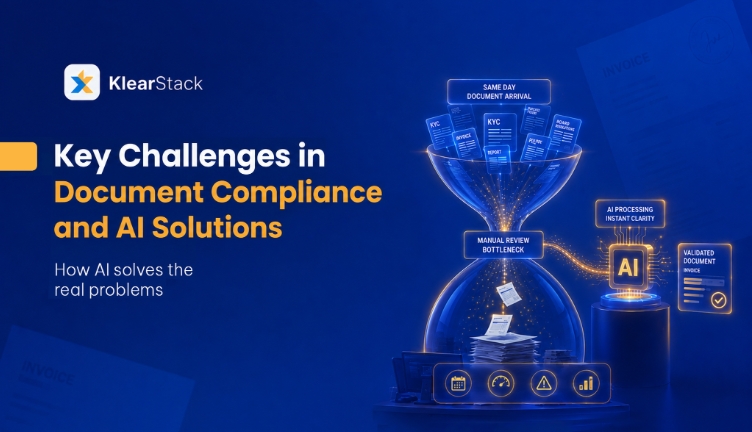
MUMBAI, India – May 27, 2026 – KlearStack, an AI-powered Intelligent Document Processing (IDP) platform, has identified four document infrastructure failures driving compliance breakdowns across BFSI, logistics and manufacturing finance teams.
According to the Institute of Finance and Management, manually processing a single invoice costs $10.89 on average compared to $3.40 with automation.
At 10,000 documents per month, that gap reaches $75,000 in annual excess spend before error corrections or compliance penalties are counted.
Finance teams are not failing at compliance because they lack effort. The problem is the document infrastructure underneath it.
Why Document Compliance Keeps Breaking Down
Most compliance failures do not start with policy. They start with documents.
A single KYC packet for a new corporate client can contain 15 to 40 separate files: identity proofs, beneficial ownership declarations, utility bills and board resolutions. Each file requires field extraction, validation against policy rules and a complete audit trail. When one field is misread, the review cycle restarts from the beginning.
At $10 or more per document in staff time and exception handling across invoice processing workflows, the operational cost becomes a compliance exposure in itself.
The financial services compliance software that most mid-market teams run today was not built for this document volume or format variety.
Four Failure Points That Drive Most Compliance Breakdowns
KlearStack’s analysis identifies four recurring points where document compliance breaks down consistently across BFSI, logistics and manufacturing workflows:
-
Inconsistent extraction accuracy: Different staff extract the same document differently. Handwritten fields, non-standard layouts and multi-language documents produce variable outputs depending on who handles them.
-
No straight-through processing: Most teams manually touch every document, even routine low-risk ones. Team time goes to repetitive work rather than exception management.
-
Audit trail gaps: Manual processing leaves logs dependent on whoever remembered to record the action. Gaps are a direct compliance exposure during audits.
-
Format fragmentation: Invoices arrive by email, FTP and upload in dozens of vendor layouts. Template-based OCR tools require a separate template for each document layout and break whenever a vendor updates their format.
“Finance teams are not failing at compliance because they lack effort. The problem is the document infrastructure underneath it,” said Ashutosh Saitwal, Founder and CEO, KlearStack. “Template-free AI processes documents by learning structure and context, not fixed field positions. Format changes from vendors no longer break the workflow.”
How AI Addresses Document Compliance at the Processing Level
Modern AI document processing does more than read fields. It applies learned document models to flag anomalies, compare extracted data against known patterns and route exceptions without manual sorting.
The compliance logic sits inside the extraction layer, removing the need for a separate rules engine.
Template-free AI learns from document structure rather than fixed field positions, so vendor layout changes do not break the workflow.
AI extraction models hold accuracy above 99%, and within AP automation platforms that connect directly to ERP systems, those results carry through to payment without additional manual touchpoints.
Processing Model Comparison
|
Processing Model |
Exception Rate |
Cost Per Document |
Team Focus |
|
Manual review |
15-20% |
$10-12 |
Document handling |
|
Rule-based OCR |
8-12% |
$6-8 |
Format maintenance |
|
Template-free AI |
3-5% |
$3-4 |
Exception management |
For standard-format compliant documents, straight-through processing rates of 85% to 95% are achievable within weeks of deployment. The compliance team reviews only what actually needs review, shifting from volume processing to risk-based review.
How One Logistics Company Reduced Its Exception Rate by 78% in 90 Days
A regional logistics company processed 12,000 documents per month: invoices, delivery notes and customs declarations. Their compliance team flagged 18% as exceptions, each requiring manual re-review before sign-off.
After moving to an AI-based processing model, the exception rate dropped below 4%. Cost-per-document fell from $11.20 to $3.80 within 90 days of go-live.
The compliance team shifted from document handling to exception management, which is what document compliance automation is supposed to deliver.
About KlearStack
KlearStack is an AI-powered Intelligent Document Processing platform that automates high-volume, semi-structured document workflows across BFSI, logistics and manufacturing. The platform delivers 99% extraction accuracy, template-free AI processing and ERP integrations with NetSuite, SAP, QuickBooks, Microsoft Dynamics and Sage.
KlearStack is GDPR and DPDPA compliant and serves mid-market companies processing 5,000 to 50,000+ documents per month. For more information, visit klearstack.com.
Media Contact
Company Name: Klearstack
Contact Person: Kalpesh Wadekar
Email: Send Email
Country: United States
Website: https://klearstack.com/