
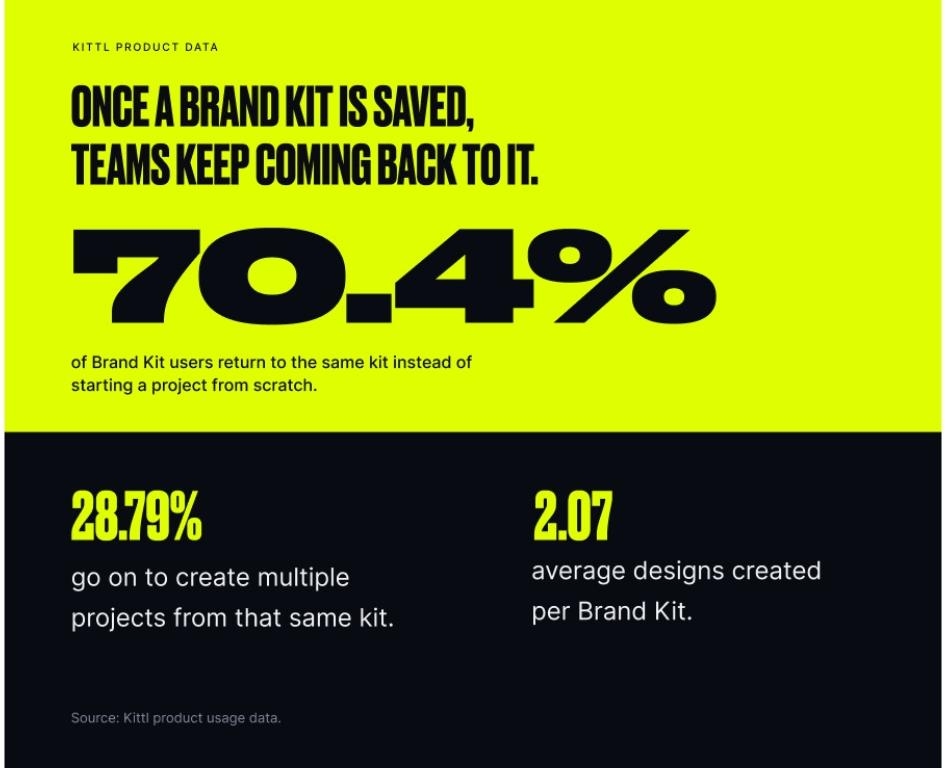
BERLIN, GERMANY – September 14, 2026 – Kittl and Monotype are expanding their partnership so teams that license fonts through Monotype Connect or Monotype Fonts can use that managed font inventory directly inside Kittl. The fonts appear in the editor, stay editable, can be replaced across a whole design, and can be saved to a Kittl Brand Kit for future work.
What actually breaks it
Brand drift rarely starts with someone deciding to ignore the guidelines. More often, someone simply has the wrong version of the right thing.
Monotype’s research with more than 1,000 creative professionals found that 42% of respondents struggle with font version control, while 68% said font licensing complexity affects their work. Perhaps more tellingly, 82% now consider font management essential to creative operations.
There’s also a wider cost to all this admin. In the same research, 57% of creative teams said they spend more than a quarter of their time on non-creative work such as font and asset management, compliance checks, and workflow bottlenecks
Kittl has seen a similar problem in its own research with product-based businesses. Recreating brand colours, fonts, and text styles at the start of every new project came up across an interview they made. The absence of a Brand Kit was the single most cited daily friction point for the segment.
So maybe the problem was never a lack of rules.
It was the gap between the rule and the person trying to follow it.
So what changes with Kittl x Monotype?
The latest Monotype collaboration with Kittl is aimed at that gap.
For teams using Monotype Connect or Monotype Fonts, the fonts their organisation already licenses can now appear in a dedicated panel inside the Kittl editor. Each designer connects through the Monotype access their team already manages, with the Monotype desktop app running locally.
That means you don’t have to find a font file, upload it into another tool, and hope you grabbed the right version before you start designing.
You choose from the managed library where you’re already working.
But this gets more interesting than simply putting a font menu in another place.
Kittl can show exactly which fonts are being used across the current design. If one is wrong or needs updating, “Replace everywhere” changes every text layer using that typeface in one go.
So an outdated font hiding in text layer 17 is less likely to survive just because nobody noticed it.
Once the typography is right, licensed fonts can also be saved to a Kittl Brand Kit and reused as the starting point for future work.
Fixing one file solves today’s problem. Saving the decision means the next campaign doesn’t have to start by solving it again.
The type stays usable, not flattened into an asset
There’s another detail that matters if the goal is consistency rather than simply access.
The connected fonts remain live, editable typography inside Kittl.
Teams can rewrite the text, change the typeface, and use Kittl’s text effects without turning the approved font into a static graphic.
That gives teams room to make different work without quietly replacing the brand underneath it.
A packaging label doesn’t have to look like a social ad. A campaign headline shouldn’t behave like the ingredients list on a bottle. The applications change, but the underlying type can stay the same.
And for teams working with AI, Kittl says the connected typefaces themselves are not used to train its AI, generated by it, or modified by it. AI can work on imagery around the type while the font remains the licensed asset the team selected.
That distinction becomes more important as more brand work starts involving AI.
Generating something that vaguely resembles your typography is not the same as using your typography.
This gets harder when a brand gets bigger
The collaboration also makes more sense when you look at the scale Monotype is dealing with.
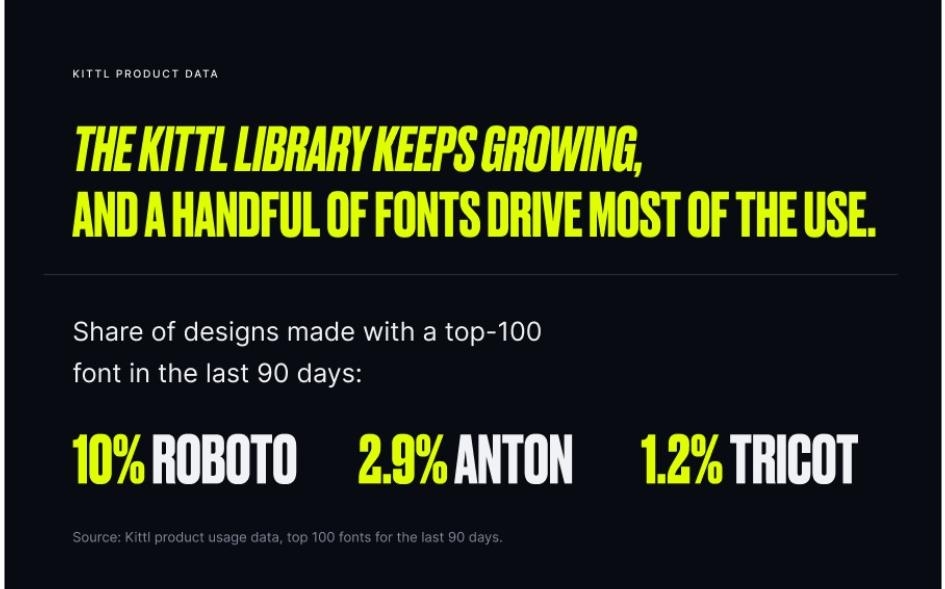
As of August 2026, the Monotype library includes more than 400,000 font styles from over 5,000 foundries, with support for more than 300 languages. Kittl’s own library keeps growing on top of that — Roboto, Anton, and Tricot currently lead usage, together accounting for a large share of designs made in the last 90 days alone.
That does not mean every Monotype customer suddenly gets 400,000 fonts inside Kittl.
What appears in Kittl is the font inventory that the organisation already manages and licenses through Monotype.
That difference is the point.
A brand working across several teams, markets, or languages doesn’t necessarily need more typography choices. It needs the approved choices to survive as the number of people and assets grows.
An agency picks up a campaign. Someone adapts packaging for another market. A new designer joins halfway through the year. Each of those handoffs is another opportunity for “close enough” to enter the brand.
The Monotype connection doesn’t remove those handoffs.
It gives the people involved a more reliable starting point.
Where it stops
None of this makes brand consistency automatic.
The exact approved font can be sitting in front of someone and they can still choose the wrong weight, ignore the hierarchy, change the spacing, or use it in a way that has nothing to do with the brand.
Typography is also only one part of the identity. Colours, logos, photography, layout, and language still need their own rules and assets.
And that’s probably the right boundary.
Kittl x Monotype doesn’t make the creative decision disappear. It removes some of the unnecessary work around carrying a decision that has already been made into the next piece of work.
So, does Kittl x Monotype make brand consistency easier?
Yes, in a specific and fairly practical way.
Monotype handles the typography an organisation has licensed and manages. Kittl gives those teams another place to actually create with it.
The right font can appear where the design is being made. You can see what typefaces a file is using, correct one across the whole design, keep the text editable, and save the approved typography to a Brand Kit for the next project.
That doesn’t guarantee every asset will be on-brand.
But it removes a surprisingly common reason for one not to be: the correct font existed, somebody just couldn’t get to it when they needed it.
About Kittl
Kittl is a design platform that enables users and creative teams to create visual content, manage brand assets and develop designs through an integrated creative workflow.
Media Contact
Company Name: Kittl
Contact Person: Vignesh Shankar
Email: Send Email
Country: Germany
Website: http://kittl.com