
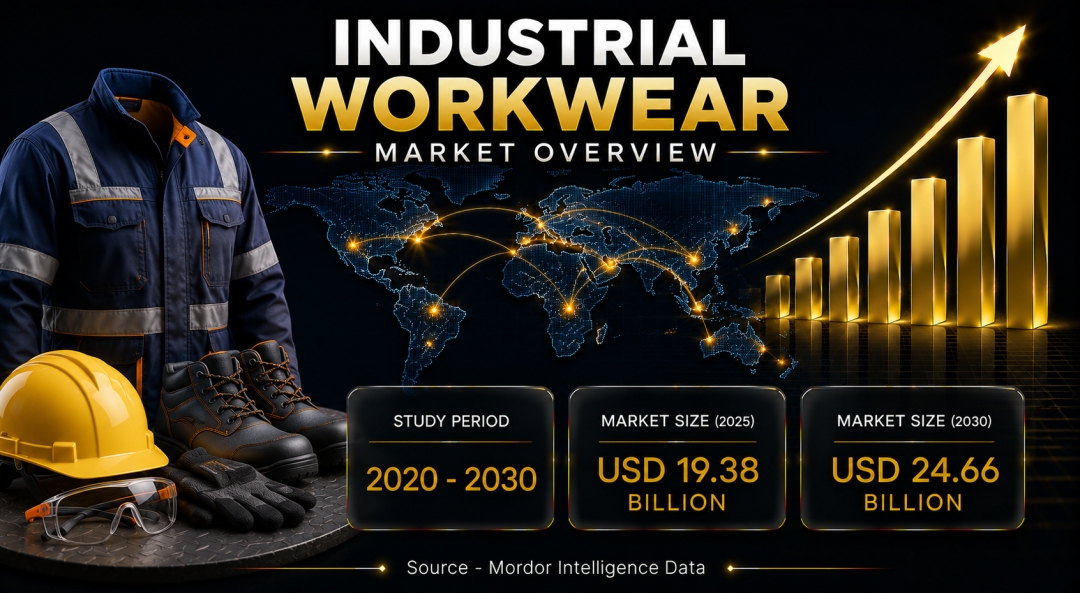
According to Mordor Intelligence, the industrial workwear market size is estimated at USD 19.38 billion in 2025 and is projected to reach USD 24.66 billion by 2030, registering a CAGR of 4.93% during the forecast period. The market continues to expand as employers prioritize workplace safety standards and injury-prevention initiatives to manage operational risks. Growing regulatory scrutiny, expanding manufacturing activities, and the rising popularity of flame-resistant and high-visibility apparel continue to support demand across commercial and industrial sectors worldwide.
The industrial workwear market growth is also influenced by changing safety mandates and evolving worker expectations regarding garment ergonomics, mobility, and inclusive fit. Garment manufacturers are investing in advanced protective fabric blends while adopting specialized designs catering to diverse body types. These developments are helping businesses respond to stricter safety compliance rules while maintaining wearer comfort and extended garment durability throughout rigorous work shifts. Together, these factors continue to strengthen the integrated industrial workwear market forecast across developed and emerging industrial markets.
Industrial Workwear Market Trends
Regulatory Fit Mandates Support Accelerated Replacement Cycles
One of the leading industrial workwear market trends is the heightened emphasis on proper personal protective equipment (PPE) fit across diverse workforces. Mandates reinforcing garment fit requirements continue to drive quicker replacement cycles and encourage adoption of tailored protective apparel. The increasing availability of specialized cuts for female workers and diverse body profiles has expanded market demand across heavy industries. This steady shift toward ergonomic and inclusive safety design continues to support the industrial workwear industry.
Protective Workwear Maintains Dominant Category Volume
While general workwear serves everyday operational needs, protective garments hold a major portion of the industrial workwear market share. Flame-resistant, chemical-resistant, and high-visibility options remain essential for workers in hazardous environments like oil and gas, construction, and chemical manufacturing. Industrial apparel producers are expanding high-performance protective lines to satisfy corporate liability guidelines while aligning with broader safety standards seen across the integrated food ingredients industry for cleanroom and food-grade protective wear.
Procurement Digitization and Channel Synergy Drive Availability
Another important industrial workwear market trend is the rapid growth of e-commerce procurement channels. Online sales platforms provide corporate buyers with extensive product catalogs, competitive volume pricing, and automated reordering convenience. Meanwhile, brick-and-mortar distributors remain essential by offering local inventory availability, immediate fulfillment, and personalized fit assessments. Strategic multi-channel distribution alignments are becoming an important area of competition across the industrial workwear industry.
Advanced Fabric Innovations Enhance Comfort and Durability
Material choices continue to play a significant role in the industrial workwear market growth. Lightweight, breathable, and moisture-wicking synthetic blends remain widely adopted because they help reduce heat stress during extended outdoor or high-temperature work. At the same time, eco-friendly recycled fibers and durable anti-static fabrics are attracting greater interest as companies strive to align corporate procurement with environmental sustainability objectives. These textile developments help manufacturers balance safety protection with worker comfort while meeting retailer standards.
Asia-Pacific Leads Market Share While Middle East and Africa Drive Rapid Growth
Regional consumption patterns continue to influence the industrial workwear market forecast. Asia-Pacific represents the largest regional market, supported by expanding manufacturing networks, infrastructure development, and growing industrialization. Meanwhile, the Middle East and Africa region exhibits fast-growing demand as investments in energy projects, mining, and industrial diversification initiatives drive adoption of certified safety wear. Increasing safety enforcement across developing markets continues to create new opportunities for producers expanding their global footprint.
Check out more details and stay updated with the latest industry trends, including the Japanese version for localized insights: https://www.mordorintelligence.com/ja/industry-reports/industrial-workwear-market?utm_source=abnewswire
Industrial Workwear Market Segmentation
By Product Type
- General Workwear
- Protective Workwear
By Gender
- Male
- Female
By End-User Industry
- Oil and Gas
- Manufacturing
- Construction
- Mining
- Chemicals
- Pharmaceuticals/Health Care
- Others
By Distribution Channel
- Offline Channels
- Online Channels
By Geography
- North America
- Europe
- Asia-Pacific
- South America
- Middle East and Africa
Competitive Landscape of the Industrial Workwear Industry
The industrial workwear industry remains moderately competitive, with major safety equipment manufacturers, commercial apparel suppliers, and specialized protective wear brands focusing on fabric engineering, ergonomic design, regulatory compliance, and wider distribution coverage. Companies are strengthening their market presence by expanding certified protective lines while improving supply chain management to meet specific corporate safety requirements.
Design innovation and material performance continue to be an important area of competition as manufacturers invest in lightweight, multi-hazard protective fabrics that offer flame and arc resistance without restricting mobility. Businesses are also refining distribution partnerships to ensure immediate product access for industrial clients. These initiatives are helping companies strengthen their industrial workwear market share while maintaining quality consistency across global markets.
Regional expansion also remains an important business strategy. Leading companies continue to strengthen distribution partnerships, expand multi-hazard product portfolios, and improve logistics capabilities to meet growing demand across both mature and high-growth markets. As corporate demand for compliant, high-comfort safety garments continues to rise, the industrial workwear market forecast remains supported by ongoing investments in fabric research, product customization, and international market expansion.
Key Players
Major companies operating in the industrial workwear market include:
- Carhartt Inc.
- VF Corporation
- Cintas Corporation
- Honeywell International
- 3M Company
Conclusion
The industrial workwear market forecast remains positive as commercial enterprises continue choosing certified, ergonomic protective solutions that fit modern safety regulations and worker comfort needs. Manufacturers are responding by expanding inclusive product lines, improving fabric breathability, and investing in sustainable materials that balance protection with environmental responsibility. These developments are expected to support continued demand across multiple industrial sectors.
Strategic product design is becoming increasingly important as companies adapt to changing safety regulations and workplace diversity requirements. At the same time, advanced multi-hazard protection fabrics and streamlined digital procurement tools are helping businesses enhance overall supply efficiency while supporting corporate safety goals. These developments continue to influence long-term industrial workwear market trends.
Regional opportunities also remain strong. Asia-Pacific provides a robust commercial baseline, while emerging industrial hubs in the Middle East and Africa offer attractive growth opportunities as local safety enforcement mandates professional protective wear. This shift is expected to create new opportunities for manufacturers expanding their presence in developing markets.
Overall, the industrial workwear market size is expected to benefit from changing corporate safety preferences, growing demand for specialized protective apparel, wider availability through digital and physical distribution networks, and continued investment in garment quality. Together, these factors are expected to support sustained industrial workwear market growth while strengthening the long-term outlook for the global industrial workwear industry.
Industry Related Reports
Functional Apparel Market: The global functional apparel market is projected to reach USD 634.62 billion by 2031, growing at a 6.62% CAGR from its 2026 valuation of USD 460.56 billion. Market growth is driven by the expansion of athleisure and the migration of high-performance attributes—such as moisture management, thermal regulation, and UV protection—into everyday casualwear, travel, and workwear. Leading apparel manufacturers are actively commercializing proprietary fabric technologies and sustainable material innovations to capture multi-category retail demand.
Second Hand Apparel Market Share: The global second-hand apparel market is set to expand to USD 429.32 billion by 2031, registering a robust CAGR of 8.55% from 2026 to 2031. Resale has transitioned into a mainstream retail channel, now representing 10% of total global clothing expenditures. Growth is supported by circular economy trends, digital discovery platforms, and direct brand participation in trade-in programs, with industry leaders prioritizing automated verification and supply intake workflows to protect operating margins.
Hoodies and Sweatshirts Market Size: The global hoodies and sweatshirts market is forecast to grow from USD 221.09 billion in 2026 to USD 303.62 billion by 2031, tracking a steady 6.55% CAGR. Category momentum is sustained by the ongoing dominance of casualwear preferences across diverse demographic segments. To capitalize on e-commerce discovery and customization trends, manufacturers are continuously deploying advanced textile blends, incorporating moisture-wicking properties, lightweight stretch, and recycled fiber content.
About Mordor Intelligence:
Mordor Intelligence is a trusted partner for businesses seeking comprehensive and actionable market intelligence. Our global reach, expert team, and tailored solutions empower organizations and individuals to make informed decisions, navigate complex markets, and achieve their strategic goals.
With a team of over 550 domain experts and on-ground specialists spanning 150+ countries, Mordor Intelligence possesses a unique understanding of the global business landscape. This expertise translates into comprehensive syndicated and custom research reports covering a wide spectrum of industries, including aerospace & defense, agriculture, animal nutrition and wellness, automation, automotive, chemicals & materials, consumer goods & services, electronics, energy & power, financial services, food & beverages, healthcare, hospitality & tourism, information & communications technology, investment opportunities, and logistics.
Media Contact
Company Name: Mordor Intelligence
Contact Person: Jignesh Thakkar
Email: Send Email
Phone: +1 617-765-2493
Address:11th Floor, Rajapushpa Summit, Nanakramguda Rd, Financial District, Gachibowli media@mordorintelligence.com
City: Hyderabad
State: Telangana 500008
Country: India
Website: https://www.mordorintelligence.com/industry-reports/industrial-workwear-market?utm_source=abnewswire