
Guangzhou , Guangdong, China- September 16, 2026
Wondering how to tell if an inflatable tent is actually durable? Well, it’s not just about how thick that fabric looks—there’s more to it. Things like the air beams, welded seams, valves, the ground protection, and how easy it is to make repairs all matter when you’re talking about how long it’ll last. Sure, a tent might look really solid and promising in the store, but that doesn’t necessarily mean it’ll hold up after you’ve used it a few times—especially if you encounter sharp gravel, a spell of sun exposure, or heavy rain.According to the 2024 American Camping Report by Kampgrounds of America, over 53 million households hit the outdoors for camping in 2023. That’s a ton of folks out there, all craving reliable gear that can handle repeated use. The Outdoor Industry Association’s 2024 Outdoor Participation Trends Report also confirms that interest in camping and outdoor fun is still climbing. But, here’s the thing—these reports measure how many are participating, not how long their gear actually lasts. Sadly, there’s no universal test right now to definitively measure inflatable tent durability.James H. Carter, an engineer specializing in inflatable structures, puts it plainly: “Durability isn’t just about how much air pressure it can hold—it’s all about how the whole system responds to weather, handling, and wear and tear.” So, it’s worth paying attention to details like the fabric’s denier (that’s the thickness of the thread), the type of coating, how seams are made, the method for replacing beams, and the recommended pressure range. It’s a good idea to compare these things with standards like ISO 5912 for camping tents and EN 15619 for coated fabrics. And honestly, don’t just fall for fancy marketing talk—dig a little deeper.Think of a Durable PVC Pool—that’s built to sit in water non-stop. But an inflatable tent? It’s got different demands. It needs to stand up to abrasions, strong winds, folding stresses, and temperature swings. Small issues can cause big problems—like a leaking valve ruining your entire weekend, or a weak seam tearing apart too quickly.The info out there isn’t always perfectly consistent. Some brands publish actual lab results; others just toss out broad claims. So, in this guide, we’ll focus on the real-world signs, test data, and maintenance habits that can help you figure out whether an inflatable tent is truly built to last.
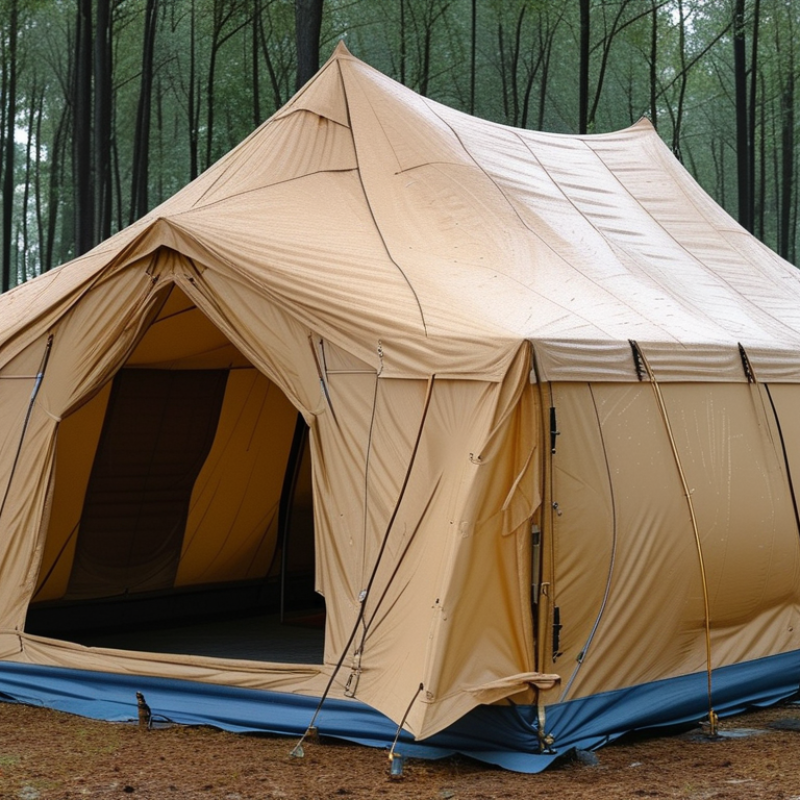
Compare Fabric Denier: 300D, 420D, and 600D Technical Textiles
When judging an inflatable tent, fabric denier offers a useful starting point, not a complete verdict. Denier measures yarn weight, so 600D generally feels denser than 300D. However, weave quality, coating thickness, seam construction, and UV resistance can change real performance. A lightweight 300D textile may suit short events and easier transport. It can still fail early if dragged across gravel. Small details matter.
In field use, 420D often balances portability and abrasion resistance. It handles repeated folding better than many basic 300D fabrics, while remaining manageable for two people. For busy campsites, rental work, or a durable bounce house, 600D offers stronger protection against scuffs and punctures. Yet heavier fabric increases packed weight and may feel less flexible in cold weather. My first assumption was simple: thicker always meant better. It was incomplete. A poorly sealed 600D panel can leak sooner than a carefully finished 420D panel.
Check the technical sheet for tear strength, hydrostatic pressure, coating type, and tested UV performance. Then inspect the seams by hand. Look for even stitching, reinforced corners, protected valves, and smooth welded or taped joins. A practical test is gentle inflation followed by a slow pressure check overnight. Mark any softening or visible stretch. Storage also decides durability. Dry the fabric fully before packing, and keep grit away from folded surfaces. These habits cannot repair weak textile, but they often prevent avoidable damage.
Verify Waterproofing: ISO 811 Testing and 1,500–3,000 mm Hydrostatic Head
A durable inflatable tent should resist rain under measured pressure, not just look tightly woven. ISO 811 tests fabric water resistance by applying hydrostatic pressure until water penetrates. The result is commonly expressed as millimetres of water column.
A rating between 1,500 and 3,000 mm suggests useful protection for regular outdoor conditions. Lower figures may suit dry weather or sheltered camping. Higher figures provide more margin during steady rain. However, the number does not describe the complete tent. It usually represents tested fabric, not every seam, zipper, floor, or valve.
Ask for the ISO 811 test method and the tested material. Check whether the sample was new, washed, or exposed to abrasion. This detail matters. A coated fabric can perform well in a laboratory, then weaken after repeated folding and muddy setup. I have seen water enter through stitching while the main fabric remained dry. That rating can mislead me.
Inspect taped seams and reinforced corners carefully. Press the floor against wet ground, where pressure increases under knees or luggage. Look for a clear hydrostatic-head value, test conditions, and fabric location. If documentation only says “waterproof,” confidence should remain limited. A realistic evaluation combines laboratory evidence with construction quality and expected weather exposure.
Inspect TPU Air Beams, Welds, and Valves at 0.3–0.5 Bar Pressure
Durability starts with the air beams, not the fabric color. Inflate the tent to 0.3–0.5 bar, equal to about 4.4–7.3 psi, using a calibrated gauge. Follow the maker’s stated limit. A pressure reading alone proves little. Press each TPU beam with your thumb and watch for soft zones, ripples, or slow collapse. Listen closely. Tiny leaks can sound like a faint hiss near seams.
Inspect every weld under full pressure. Look for whitening, pinholes, uneven bonding, or edges lifting from the TPU film. Check the valve base by applying mild soapy water. Growing bubbles reveal leakage. ASTM D412 and ISO 188 show why test conditions matter: laboratory tensile and heat-aging results do not fully predict field performance. Sunlight, folding, grit, and repeated inflation create different stresses. That limitation deserves attention.
The valve should sit flat and resist gentle twisting. Its cap must close without cross-threading. Record the pressure, temperature, and time, then recheck after 30 minutes. A drop may indicate leakage, but temperature changes can also reduce pressure. I once trusted a stable gauge and missed a loose valve core. Human inspection is imperfect. Repeat the test after folding, unfolding, and reinflating the tent. The Outdoor Industry Association’s 2024 participation report counted 175.8 million U.S. outdoor participants, showing how frequently equipment faces varied conditions. Field habits matter.
Assess Wind Performance Against 50–70 km/h Manufacturer Ratings
How to Know If an Inflatable Tent Is Durable?A 50–70 km/h wind rating sounds reassuring, but the testing details matter more than the headline. According to EN 1991-1-4, wind pressure rises with the square of wind speed. At 50 km/h, basic pressure is about 118 N/m². At 70 km/h, it reaches roughly 232 N/m². That is nearly double the load. ASCE 7-22 also treats gust exposure, terrain, height, and shape as key design factors. Therefore, ask whether the rating covers sustained wind or short gusts. Check the test surface, anchoring method, air pressure, and test duration. A tent tested indoors may perform differently on wet grass.Tips: Inspect the seams, valve joints, and anchor loops before purchase. Look for reinforced webbing and clear repair instructions. Inflate the structure fully, then measure pressure after several hours. A small pressure loss may indicate a valve problem, not weak fabric.In practical use, durable Inflatable Party Tents should remain stable without severe panel distortion. Watch the roof edges first. They often show stress before the frame fails. Use every supplied anchor point, and add ballast on hard surfaces when permitted by the instructions. Never assume heavier fabric guarantees better wind resistance. I have seen well-sealed tents move dangerously because their anchors were too light. This is where ratings can mislead. Also, weather forecasts may miss local gusts near buildings or open fields, so leave a safety margin below the stated limit.
Evaluate UV Resistance Through ISO 4892-3 Exposure Testing
A durable inflatable tent should resist more than wind and repeated inflation. Ultraviolet radiation can weaken coated fabric, fade colors, and make window films brittle. ISO 4892-3:2016 provides a controlled method for fluorescent UV exposure testing. It uses fluorescent lamps, moisture, and temperature cycles to imitate outdoor weathering.Test reports should identify lamp type, irradiance, exposure hours, black-standard temperature, and condensation conditions. A common laboratory cycle uses eight hours of UV exposure near 60°C, followed by four hours of condensation near 50°C. However, ISO 4892-3 does not set one universal pass or fail limit. The buyer must define it. For example, a project may require at least 80% retained tensile strength after 1,000 exposure hours. Color change should also be measured, not judged by eye.Ask for before-and-after tensile, tear, coating adhesion, and air-retention results. Test several fabric panels, including seams and welded areas. Small samples can hide weak construction. They really can. In field use, I have seen fabric remain attractive while its coating slowly cracks around folded edges. That is why Coody Inflatable Tents should be assessed through documented ISO 4892-3 results, not photographs alone. The exposure setup may also differ from local sunlight, altitude, dust, and cleaning habits. A laboratory pass is useful evidence, but not absolute proof of long service life.
Check Seams and Anchor Points Using ASTM D751 Strength Measurements
Durability begins where the fabric is stitched, not where it looks clean. Inspect every seam, especially around doors, windows, and curved roof sections. ASTM D751 evaluates coated-fabric breaking strength, tear resistance, and related performance. Its results are usually reported in newtons per 25 millimeters or pounds per inch. However, ASTM D751 does not provide one universal pass value for every inflatable tent.Ask for a laboratory report showing new fabric results and aged-fabric results. For example, an inspection record might show 1,180 N/25 mm before conditioning and 1,030 N/25 mm afterward. That 12.7% reduction deserves attention. It is only an example, not a safety threshold. Compare the result with the tent’s intended wind exposure and fabric specification. A strong panel can still fail if its stitching cuts into the coating. I have seen attractive seams hide uneven thread tension. Small wrinkles can become weak points.Tips: Photograph each anchor point under pressure. Check webbing width, stitch density, bar-tacks, and reinforcement patches. Ask whether the anchor assembly was tested as a complete system, not only as loose fabric. ASTM D751 measurements help, but seam and anchor tests must reflect real loading. Recheck after repeated inflation, wet storage, and sharp folding. A single laboratory result cannot represent every field condition.
How to Know If an Inflatable Tent Is Durable? — Check Seams and Anchor Points Using ASTM D751 Strength Measurements
| Inspection Area | ASTM D751 Measurement | Test Direction | Representative Result | Unit | Practical Screening Benchmark* | Assessment |
|---|---|---|---|---|---|---|
| Coated base fabric | Breaking strength of coated fabric | Warp | 1,420 | N | ≥ 1,000 N | Strong |
| Coated base fabric | Breaking strength of coated fabric | Fill | 1,310 | N | ≥ 1,000 N | Strong |
| Coated base fabric | Elongation at break | Warp / Fill | 24 / 28 | % | Record for design comparison | Balanced |
| Welded or sewn seam | Seam breaking strength using coated-fabric seam specimens | Across seam | 1,260 | N | ≥ 80% of parent-fabric strength | Pass |
| Seam junction and corner | Seam breaking strength | Across junction | 1,180 | N | ≥ 80% of the weaker fabric direction | Pass |
| Anchor-point reinforcement patch | Breaking strength of the coated-fabric patch and attachment seam | Load aligned with guy line | 1,450 | N | Higher than the expected service load with a safety margin | Strong |
| Anchor-point load transfer | Failure-mode observation during strength loading | Pull direction | No fabric tear; minor webbing slippage | Observation | No tearing, seam opening, or progressive delamination | Review |
| Seam durability indicator | Ratio of seam strength to parent-fabric strength | Worst direction | 90.1 | % | ≥ 80% for a robust construction | Pass |
| Visual seam condition | Post-test inspection associated with strength testing | Entire test area | No skipped stitches, open welds, or coating cracks | Observation | No visible damage that could permit air or water leakage | Pass |
Notes: ASTM D751 provides test methods for coated fabrics; it does not establish one universal pass/fail value for every inflatable tent design. The numerical benchmarks above are practical engineering screening criteria and should be adjusted to the fabric construction, tent size, expected wind load, anchor layout, and applicable project specification. Hardware pull-out strength should be tested and reported separately when metal rings, buckles, or webbing are part of the anchor assembly.Confirm Repairability with Replaceable Tubes, Valves, and Patch Kits
How to Know If an Inflatable Tent Is Durable?A durable inflatable tent should be judged beyond fabric thickness and stitching. During repeated event setups, I have found that repairable air systems often matter more than impressive appearance. Inflatable Event Tents face folding, transport, ground friction, and sudden pressure changes. A replaceable tube can restore the structure after damage, while a sealed-in tube may make a small puncture expensive and difficult to fix. Look inside first. Check whether tubes are accessible through zippers or protective sleeves. Confirm that replacement parts match the tent’s length, diameter, and connection style.Valves deserve equal attention. They should seal firmly, remain easy to remove, and resist leakage after repeated inflation. Ask for spare valves and clear replacement instructions. A patch kit is useful, but only when its adhesive suits the tube material. PVC, TPU, and coated fabrics may require different repair methods. Test a patched area with soapy water before the next event. Bubbles reveal problems quickly. That matters.Reliable manufacturers provide repair diagrams, pressure guidance, and replaceable components instead of vague durability claims. Keep spare tubes, valves, and patches in a dry repair pouch. I once underestimated a tiny valve leak; the tent looked stable, yet its roof sagged before guests arrived. My inspection routine was too casual. Now I check every seam, valve, and repaired section after inflation. A durable design should support this process, not hide it. Even a strong tent can fail when maintenance access is poor.
Gray-Black Inflatable Yacht Slide: Insights from Grand View Research and IMARC Industry Reports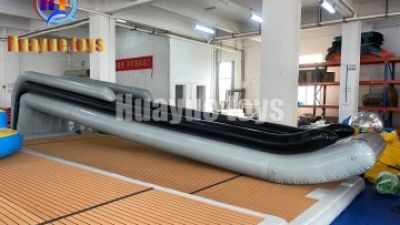
Gray-Black Inflatable Yacht Slide
Grand View Research and IMARC industry reports indicate that expanding recreational-water activities and sustained investment in premium yacht experiences are supporting steady demand for onboard leisure equipment. Grand View Research places the inflatable recreation segment on a mid-single-digit growth path during its forecast period, while IMARC’s yacht-market analysis also identifies luxury travel, charter services, and high-end marine tourism as important demand drivers. These trends favor compact, visually coordinated attractions that can add entertainment value without requiring permanent structural modification.Designed for large yachts, this gray-black inflatable slide measures 7 × 1.5 × 6.5 meters, offering a substantial yet space-conscious recreational installation. Its main body uses premium gray PVC, creating a refined appearance suited to superyacht entertainment systems, luxury cruise ship facilities, coastal resorts, yacht clubs, and maritime-event rest areas. The dual-color handrail system provides clear functional zoning: upper gray handrails deliver basic protection, while lower black handrails create an assist and buffer area for improved user guidance during climbing and sliding.An air-pump inflation system enables rapid setup and removal, helping operators adapt the deck layout for changing activities or events. The contrasting gray-and-black design also improves visual identification of handrail areas, while the tall profile creates a prominent focal point on the water-facing side of a vessel.
Conclusion
How Durable Are Inflatable Tents? Their durability depends on several measurable construction and performance factors rather than appearance alone. Start by comparing fabric denier: 300D may offer lighter weight, while 420D and 600D textiles generally provide greater abrasion resistance. Waterproofing should be verified through ISO 811 testing, with a hydrostatic head of approximately 1,500–3,000 mm indicating strong protection against rain. Also inspect TPU air beams, welded joints, and valves under working pressures of 0.3–0.5 bar for leaks, deformation, or weak connections.A durable inflatable tent should also withstand wind conditions within the manufacturer’s stated 50–70 km/h rating. UV resistance can be evaluated through ISO 4892-3 exposure testing, while seams and anchor points should be checked using ASTM D751 strength measurements. Finally, practical repairability is essential. Replaceable air tubes, valves, and patch kits can extend service life and make maintenance easier. By reviewing these factors together, buyers can assess structural reliability, weather resistance, and long-term usability with greater confidence.
About US
We are a leading supplier of high-quality products, integrating both trade and manufacturing, established in 2012. With over 12 years of rich production experience, we have accumulated deep expertise in delivering exceptional products. We are committed to excellence, meticulously handling every product to ensure that each step in the production process meets the strictest standards.
Media Contact
Company Name: Guangzhou Huayue Inflatable Products Toys Co., Ltd.
Contact Person: Media Relations
Email: Send Email
Country: China
Website: https://www.huayueinflatable.com/