
What Is Split Phase Power?
A typical electric distribution system in the United States, Canada, and several regions with like-residential power standards uses split phase power. Split Phase Power is referred to as 120 or 240 volt single-phase power because it is produced through a single transformer secondary winding having a center tap.
A neutral wire is attached at the center tap of the transformer’s winding. The two outer ends then serve as L1 and L2 respectively and are each like wires with L1 being connected to L2 through the transformer. The output voltage from each leg will be about 120 volts from the center tap or neutral wire and around 240 volts between the two wires. The reason the voltage is higher between the two wires is due to the wires being 180 degrees out of phase.
A true two phase power source has two 90 degree phase-separated signals. In today’s world of residential solar, when buyers search for “two phase inverter,” they are really looking for a split-phase inverter that provides 120/240 volts.The term “two phase inverter,” although frequently used, is misleading since this system does not produce true two-phase power. A split-phase inverter produces two single phase line voltages at 120 volts each, and the combined output is a total of 240 volts.Residential solar systems and most backup power use either a 120/240 volt single-phase, or a split-phase inverter.
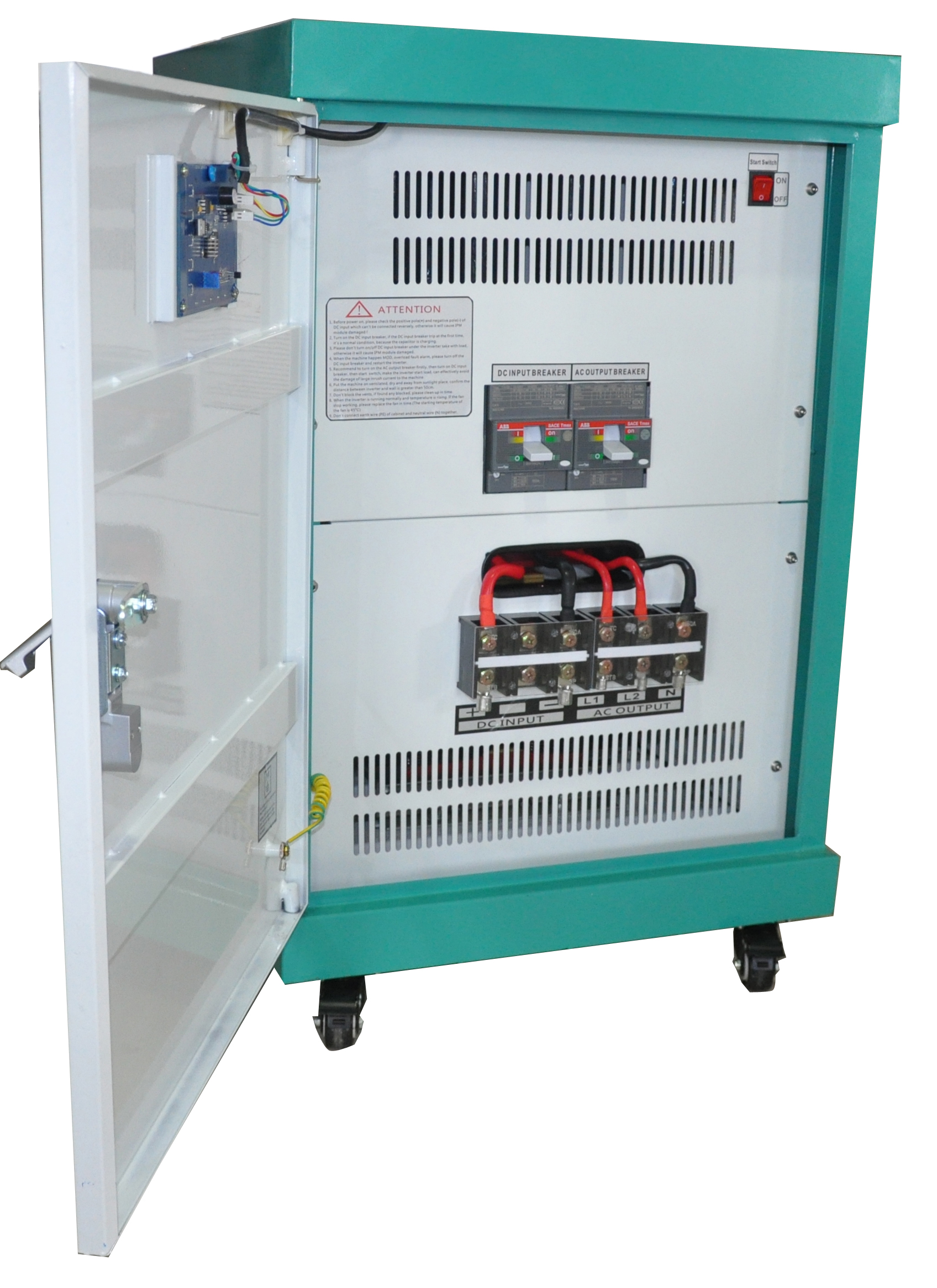
How Does a Split Phase Inverter Work?
The split phase inverter essentially takes in one source of DC power and converts it to 2 identical but opposite (180° phase difference) type of AC output with synchronized waveforms. This allows you to draw both 120v and 240v power from an inverter using two outputs.
An inverter takes a DC energy source, generally from a lithium or lead-acid battery bank or solar-based storage facility and uses high-speed electronics to change the DC electricity into AC electrical energy (inverter). Advanced electronic circuits provide control of both voltage and frequency produced by the inverter. These circuits also generate AC output waveforms that are nearly identical to those produced by utility-grade generators.
For example, in a North American-style system, the inverter may produce:
- L1 to Neutral: 120V AC
- L2 to Neutral: 120V AC
- L1 to L2: 240V AC
- Frequency: typically 60Hz
A 120/240 split-phase inverter is a popular solution for households, cabins, farms, and small businesses that require a combination of standard 120V circuits and additional, higher-powered loads at 240V.
Why Split Phase Output Matters for Home Power Systems
Different voltages are utilized for various types of electrical devices within the average household located in America. In addition to being powered with 120 volts, household items such as smaller appliances, lighting fixtures, televisions, computers, routers, and the majority of receptacles operate at 120 volts. The majority of larger appliances, including central air conditioning units, electric water heaters, deep well pumps, electric clothes dryers, and ovens require a separate 240-volt power source.
Inverters that produce only 120 volts typically only provide basic interim power, but are not adequate for providing backup power to an entire home. If inverters produce only 240 volts, and lack an adequate “neutral” for the 240-volt load, it may be inconvenient and unsafe to operate standard 120-volt circuits from the inverter. Split-phase inverters offer both voltages from a single inverter system.
This is particularly critical for Solar+Storage Projects where a home owner wants to keep certain critical 120v circuits ongoing in the event of an outage. For example, the home owner may have a well pump or an air conditioner that runs with 240V power. A split-phase Hybrid Inverter can control solar inputs, battery charging, connections to the grid, and produce split-phase AC outputs in an integrated manner.
Split Phase Hybrid Inverter vs Standard Split Phase Inverter
The primary function of a standard split phase inverter is to transform battery voltage from DC to AC, producing either 120 volts or 240 volts AC for residential use.By combining the capabilities of several different inverters, a hybrid inverter is able to connect directly to your battery system, the solar panels, the utility grid, and your backup loads simultaneously.
A split-phase inverter system provides a cost-effective method to achieve these three goals (energy independence, lower utility expenses and backup backup options). They allow homeowners using solar energy to put first solar energy in the battery; they save money on their monthly utility bills; and they make it possible for homeowners to have access to back-up power during a blackout by utilizing grid energy when required.
In most cases, the hybrid split phase inverter can handle grid-tied use, off-grid use, time of day optimization, generator input, battery management and remote monitoring – depending on the model. When comparing inverters, the most important question a potential buyer needs to answer is “Does it output 120/240V?” and not “Is it safe to use all types of renewable energy systems reliably?”
Is a Split Phase Inverter the Same as an American Standard Inverter?
The term “American Standard Inverter” is commonly used to denote the type of inverter that is suitable to use in residential applications within North America. Typically, these inverters feature 120/240 volt split phase output with 60 Hz frequency and are compatible with load panels employed in the United States.
That said, don’t rely solely on names when making a purchase; always verify technical specifications. An actual American Standard Inverter will have the following characteristics: it will specifically indicate that it offers bothsplit-phase 120/240 volts and a neutral connection as well as having the correct frequency and enough surge capability to run most major appliances in your home.
Before making any connections, please double-check your local code compliance and verify that you have an experienced electrician/installer working with you if you wish to connect your inverter to a home electrical panel, transfer switch, generator input or solar battery system.
Key Components Inside a Split Phase Inverter System
While it may appear that there’s not too much going on outside of an inverter, virtually every reliable split phase inverter depends upon many critical components both internally and externally. The DC Input stage of the inverter receives power from batteries or from a solar charging system. In general, the inverter bridge creates AC waveform patterns using electronic switches. The transformer or high frequency conversion stage is used to isolate and regulate voltage according to the design of the inverter. The control board keEPS track of timing, waveform accuracy, phase synchronization and protection.
For any system; battery stores energy; solar panel collects power to recharge battery; circuit breaker will protect the wiring; load panel will distribute electricity across circuits. A well-designed system will match inverter output. Battery voltage; size of cables; type of protection devices; grounding methods; load requirements.
One of the reasons it’s essential for you to have a professional-designed system is due to how powerful an inverter may be, and still not perform well when connected to an insufficiently sized battery bank, improperly wired to the motor or loads. An example of this scenario is when you try to turn on motors or run multiple loads at once.
Understanding L1, L2, Neutral, and Ground
To effectively utilize split-phase electrical systems, it is important to know how each component interacts with each other—the hot legs (L1/L2), neutral (N), and ground. The two hot legs (L1 & L2) give 120V; neutral (N) is the center-point that allows 120V from each of the hot legs; the safety ground conductor is used for protection in case of faults within the system, which in turn can protect both the people using the equipment and the equipment itself.
120 Volt () loads are powered from either leg L1 to neutral or leg L2 to neutral. On the other hand, 240 Volt loads are powered from leg 1 to leg 2. A balanced panel will evenly distribute 120 Volt loads across the two legs in order to reduce the total amount of current being returned through the neutral wire and increase system efficiency.
A good balance of loads is critical for off-grid systems. Loading too many electrical devices on one leg can cause one side of the inverter to be overloaded, even if the total inverter capacity has not been reached. A high-quality inverter should have specifications for both the maximum output per leg and the total output capacity.
Pure Sine Wave Output and Why It Matters
Home split-phase inverters should provide output in the form of a pure sine wave today. A pure sine wave closely resembles the power supplied by your utility company, making it much safer for delicate electronic equipment like sensitive electronics, electric motors, variable-speed appliances, medical devices, and communication equipments.
Although modified sine wave inverters typically cost less, there are a number of drawbacks—including excess noise and heating during operation, less than optimal motor operation as well as reduced life expectancy of appliances using modified sine waves. In addition to this, compatibility problems may arise when using some devices with modified sine waves. Therefore, it is highly recommended to utilize pure sine wave output for any whole house backup or solar battery installations.
When it comes to powering devices, whether that be a refrigerator or any other appliance (like a pump or an air conditioner), buying a Split Phase Pure Sine Wave Inverter generally makes sense.
How to Choose the Right Split Phase Inverter
The selection of the suitable inverter is based on the type of loads, type of battery setup, nature of solar input, environmental factors for installation and backup power expectations. To determine the type of inverter you should purchase, begin by creating a list of what you’re planning to power. Break down the list into necessary loads and optional loads, and for each necessary load, mark which appliances require either 120 volts or 240 volts.
Watch for both continuous and surge ratings from inverters. Continuous watts will tell you how much a unit can put out continuously. Surge watts will help you determine if that unit can support the short-term surge in power (starting) from motors, compressors, and pumps. For example, a well pump or air conditioner can have an unlimited amount of surge wattage when first started as compared to what it needs to maintain running.
The voltage of the batteries should also be factored in. Larger systems generally use 48V battery banks because of the lower currents produced by using higher voltages, which results in improved efficiencies compared to lower voltage systems. If you’re constructing a significant home backup or off-grid system, then generally, it is more practical to use a 48-volt, split-phase inverter rather than using a 12-volt or 24-volt inverter system.
Other key factors include: the input voltage range for the Panel Power Tracker (MPPT), battery compatibility, whether or not there is an interaction with the grid, whether or not a generator is supported, transfer times, monitoring features, certification, warranty, and after-the-sale support. To ensure long-lasting use choose one based on 1) your electric power load and 2) the local installation standard.
Common Applications for Split Phase Inverters
North American style split phase inverters have effectively become one of the most common methods of delivering 120/240V AC Power where needed (for example; homes). Residential solar systems will provide back up power and allow for reduced grid reliance. Off grid cabins can easily operate normal everyday use (110V) electrical appliances as well as larger Electrical loads (240V). They will also be extensively used within the agriculture industry (farms/rural properties), powering tools, pumps, refrigeration systems and conducting security functions.
Split phase output is frequently what makes the difference in purchasing an inverter system that can provide real household electrical service as opposed to just a small portable load, for those purchasers who would prefer to use only one inverter system for all applications. Split phase output is also used in various mobile and specialty applications such as RVs, mobile shops, emergency response trailers, and remote telecommunications sites.
Split Phase Converter Diagram: What It Usually Shows
Since many purchasers would like to see what the electrical/network connections look like before making an investment, the typical reason for looking up a split-phase converter schematic is simply to understand how the wires are going to look when you purchase the device. A basic schematic provides you with a visual representation of the DC battery bank connected to the inverter’s DC terminals, solar panels connected to the inverter via MPPT inputs (if using a hybrid inverter), and the AC output terminals marked L1, L2, Neutral (N), and Protective Earth (PE) or Ground.
AC Output- Connect L1 and L2 to either a breaker panel or a critical loads panel. Neutral must connect to the neutral bus as per inverter instruction manual and local electrical codes. Ground must connect to an appropriate ground. If inverter is capable of grid/generator input, diagram may include AC input terminals and transfer switch.
Diagrams can be useful for planning purposes; however, they can never substitute for proper advice from a professional when installing equipment. The various rules regarding neutral-ground bonding, transfer switching, overcurrent protection and grounding are all dependent on the design of your system as well as local code requirements (which could vary significantly). Incorrect wiring could potentially cause equipment to be damaged and create life threatening safety hazards.
Can a Split Phase Inverter Convert Single Phase to Two Phase?
The question asked by many people? The answer is; Yes, the question asked by many people is one that I get asked frequently. However, I use the term “two phase” differently than most people; i.e., “two phase” usually means true two-phase AC with 90 degrees in phase; However, split phase inverters (unless otherwise noted) are not specifically designed to deliver true two-phase AC. Conversely, if you’re referring to a standard 120V/240V split-phase system with hot conductors, the correct inverter will output your two hot phase outputs via a single DC source.
Many hybrid inverters allow a single-phase AC input source to create split-phase output; however this depends on the inverter’s design. As such, many hybrid inverters can accept inputs from the grid, from generators, from solar arrays, and from battery storage. Be sure to verify whether the inverter in your battery storage project supports phase conversion; pass-through; or load balancing as applicable to your project.
Split Phase to Three Phase Converter: Is It Possible?
Many users have a need for a means to run three-phase motors or industrial machines off of their residential power, which is why they might try to look for a split phase to three phase converter. However, a normal split phase inverter does not make three-phase power, it only gives you two hot legs and the two wires would carry voltage (120 or 240) to each of the split-phase loads.
In order to operate electrical equipment that uses three phases, a dedicated device must be used such as a dedicated phase converter, VFD, and/or three-phase inverter. The best system to use for a given electrical application will depend on the size of the motor, starting torque, load type, voltage and duty cycle. For example: A VFD could work for some motors but a rotary phase converter will typically work better on all motors if there are multiple machines in the shop.
When looking for a primary residential backup power supply solution, consider using a split-phase inverter system. Conversely, if your goal is to operate three-phase industrial equipment, speak with an electrical engineer to find a system designed specifically for three-phase applications.
Installation Considerations Before You Buy
Confirm your electrical panel type, load requirements, battery voltage, solar array size, and installation location before purchasing a split-phase inverter. Inverters produce heat and will require adequate ventilation. In addition, when the inverter will be installed outdoors, it may need to be housed in weather-resistant enclosures or other equipment that is rated for the location where it will be installed.
The compatibility of batteries is a significant consideration. Generally, a lithium battery must communicate with both the battery management system (BMS) and the inverter to function properly; if the communication or charging profiles are not correct, then the entire system may not operate safely or efficiently. In addition, lead-acid batteries depend on different types of charging profiles as well as ventilation to operate safely and effectively.
Some of the local utility regulations may be applicable to grid-tied renewable energy systems. There could be requirements such as permits, inspections, anti-islanding protection systems, approved transfer equipment and certified components.For off-grid systems, it is crucial to ground your renewable energy systems, ensure appropriate circuit breaker sizing and wire sizing to ensure maximum safety.
Efficiency, Load Balance, and Real-World Performance
The inverter’s efficiency is how much of the battery’s stored energy will actually become usable alternating current power. Higher-end split-phase inverters usually provide good efficiency with typical operating loads. However, there are variances in performance with respect to load size, battery temperature, battery voltage, and standby load.
The way energy is utilized between L1 & L2 affects the real-life performance of the amperages as well. For example, if one of the L1 legs has many kitchen Appliances, but very few lights are connected on the L2 leg, then the inverter may not achieve full capability before it has run into its limit of either leg. Design of the breaker panel properly may assist in balancing the load on the two legs more equally.
Similarly, surge performance is also critical. Many compressors for motors require very high starting current. If an inverter’s surge rating is insufficient, a trip, shutdown or failure to run may occur. Always consider both the running wattage and the starting wattage when sizing a system.
FAQ About Split Phase InvertersWhat is split phase?
Split-phase power systems consist of two hot legs that are 120 volts each, connected to a common neutral. The electrical service provided by this system permits the use of both 120 volt and 240 volt loads. The two hot legs of a split-phase power supply are 180 degrees apart in their phase relationship (or angle), which means that the voltage between the two hot legs is 240 volts; however, the voltage between each hot leg and the neutral is 120 volts.
How to convert single phase to two phase?
“First off, let’s clarify what you mean by “two-phase”. If you require split-phase (120/240 voltage) power, a properly engineered split-phase inverter, or a transformer based system (depending on the source and application), is a good bet. If you need true two-phase power, you’re going to need specialized equipment. Most residential buyers would require a 120/240 split-phase inverter solution and not a true two-phase power converter.”
Is a split phase inverter suitable for whole-house backup?
Certainly! A split phase inverter is appropriate for whole house backup as long as enough power capacity, surge rating, battery storage, and proper installation are provided. While many homeowners have used a split phase hybrid inverser to operate essential loads and their entire home during outages, this system must be sized correctly based on the actual appliances used and the pattern of their use.
Can I use a split phase inverter with solar panels?
If your inverter has hybrid characteristics, it has a built-in solar charge controller (also known as MPPT). In the case of full load inverter-only capabilities, you will need to install a dedicated solar charge controller (MPPT) if the inverter does not have charging functions; therefore, it cannot directly connect to solar panels. Be sure to check the PV voltage range, maximum solar panel input power, and whether or not batteries will work with your design before proceeding with your overall system design.
What is the difference between a two phase inverter and a split phase inverter?
Most of us refer to a split-phase inverter as a two-phase inverter when looking for a product in everyday life. However, from a technical standpoint, these two types of inverters are distinct from one another. When you use a split-phase inverter, you will receive two (2) 120 Volt (V) legs with each leg phased 180 degrees apart to create 240 Volts. Conversely, true two-phase power is defined as having a 90-degree phase separation between the two (2) leads and is no longer used in today’s residential electrical systems.
Do I need a 240V inverter if most of my appliances are 120V?
If you have only 120v appliances, then you could probably get away with using a 120 volt inverter, however, if you’re adding a well pump, large a/c, dryer oven or any larger 240 volt appliance you should consider a split phase inverter. The more options you’ll have for home backup with 120/240 volt.
When Should You Choose a Split Phase Hybrid Inverter?
For homeowners looking to manage solar panels, batteries, grid power and backup loads with one system, split-phase hybrid inverters are a good option. A split-phase hybrid inverter will provide home owners with energy savings by lowering electricity bills, improving energy security and allow essential appliances to run during outages.
In addition, it is an alternative method of providing electricity to homes that are not connected to utility service. The use of a good combination of batteries and solar panels to create a hybrid system will allow you to produce power on a regular basis, recharge from the sun, and only use a gasoline-powered generator (when required). This reduces the amount of fuel used to produce electricity and increases your energy independence.
Buyer’s Checklist Before Requesting a Quote
To help your supplier or installer assist you with the correct inverter size and system design, prepare a simple checklist of your electricity requirements. Be sure to include your location (eg: grid-tied vs. off-grid); what your main appliances are; whether you have any 240V loads; how long you want battery backup; what type of battery you prefer; how much space there is for solar panels.
Don’t forget to inquire about warranties, certifications, technical support, service monitoring options, battery compatibility, and installation of the inverter. A lower cost inverter may be tempting, but being dependable, having good support in addition to providing safe operation throughout the life of your system is more valuable than an initial low purchase price.
The split phase inverter produces two synchronized 120 volts alternating current legs that are 180 degrees apart in phase (from one another) producing two outputs; the two outputs will supply the same two voltage levels, (120 volts and 240 volts) to furnish power for the electrical demands of North American-style structures. The use of a split phase inverter to combine the two-phase outputs of an inverter supplying lesser or equal to size 240 volts appliances will provide more flexibility when supplying your household, cabin, farm, or a solar-powered backup power supply. When considering the use of a standard inverter (singular) split-phase inverter (hybrid) standard North American inverter system none is better than another or worse than another based on load requirements, battery storage capacity, solar/energy goals, or installation; all have advantages and disadvantages.An inverter, whether the inverter is stand-alone (a standard inverter), split-phase inverter (hybrid), or North American inverter, has an appropriate-sized system that can provide you with reliable backup electric service, greater energy independence, and greater long-term value from your investment.
Media Contact
Company Name: Zhejiang Bangzhao Electric Co.,Ltd.
Email: Send Email
Country: China
Website: https://www.bzinverter.com/