
Battery high and low Temperature Test Chambers, as specialized equipment for evaluating battery environmental adaptability, help reveal the performance boundaries and safety vulnerabilities of batteries under different thermal states by constructing controllable special temperature scenarios, thereby providing a basis for improving battery safety. Its core logic lies in using the system’s temperature stimulation to reproduce the thermal environment that batteries may encounter in practical applications, observing and analyzing their response characteristics under thermal stress, and thus guiding design improvements and the formulation of protection strategies.
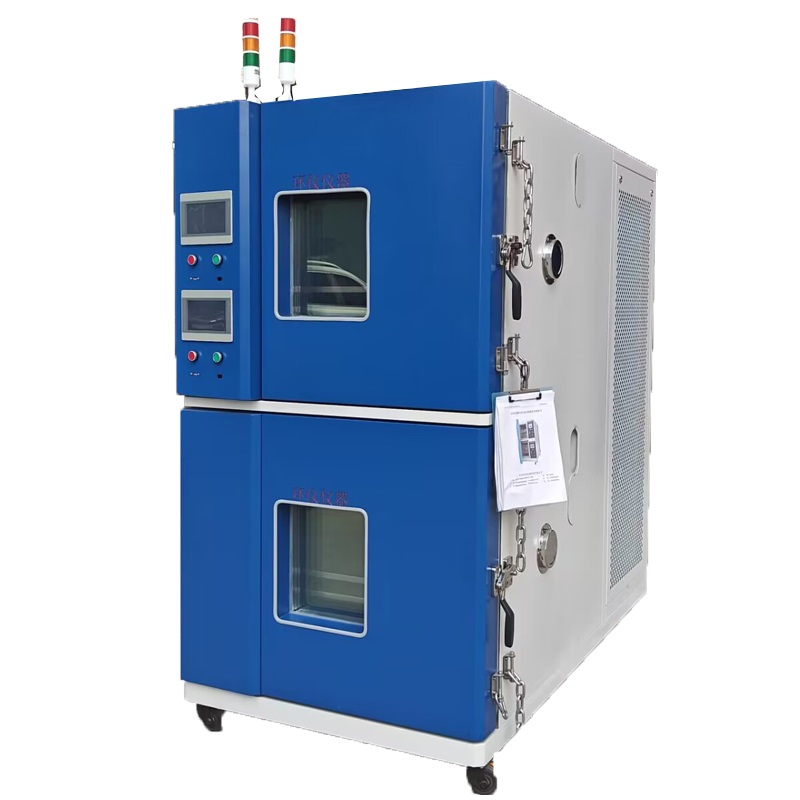
1. Enables early identification of potential causes of battery thermal runaway. Under excessively high or low temperatures, the internal chemical reaction rate and electrical characteristics of a battery change. For example, at low temperatures, impaired ion conduction may lead to increased local polarization, while at high temperatures, active side reactions can easily cause gas production and increased internal resistance. By setting continuous temperature changes from low to high or high to low in a battery high and low temperature test chamber, the evolution of parameters such as voltage, current, expansion, and gas release in different temperature zones can be observed, pinpointing the critical range that is prone to triggering unsafe conditions. This early identification helps avoid thermally sensitive points in materials and structures during the design phase, reducing unexpected risks in actual use.
2. Enables verification of the protective effectiveness of the battery management system. Modern batteries are typically equipped with temperature monitoring and protection circuits, which can take measures such as current limiting and power cut-off in case of abnormal temperatures. Using a test chamber to simulate abnormal temperature scenarios can verify the performance of the management system in terms of sensing delay, action threshold, and execution speed, confirming whether it can intervene and control before a dangerous state develops. By repeatedly testing different combinations of heating rates and durations, the reliability of the system under complex thermal processes can be evaluated, potential blind spots or response lag issues can be identified, and data support can be provided for algorithm optimization and hardware redundancy design.
3. It can be used to evaluate the thermal stability of battery packaging and structure. The temperature resistance of the casing, seals, and internal separator directly affects the battery’s integrity under special conditions. Long-term high-temperature holding and thermal cycling tests in a test chamber can detect phenomena such as casing deformation, seal failure, separator shrinkage or rupture, and determine the resilience of existing protection solutions under continuous or alternating thermal stress. For identified problems, material selection or structural layout can be improved to enhance the ability to prevent heat spread and electrolyte leakage.
4. It supports cross-sectional comparisons of the safety of batteries with different chemical systems. Different positive electrode, negative electrode, and electrolyte formulations show significant differences in stability in thermal environments. By testing multiple battery samples using a unified temperature program, a ranking of thermal safety performance can be established, providing a reference for material selection for application scenarios. For batteries with specific applications, charge and discharge loads can be introduced simultaneously into the test to observe safety performance under electro-thermal coupling effects, more closely resembling real-world operating conditions.
In general, improving battery safety using high and low temperature test chambers hinges on driving the battery into various potentially hazardous states with controlled temperature variables, recording and analyzing its responses, and then implementing targeted improvements in materials, structure, and management systems. Repeated testing and iterative verification enable batteries to operate stably over a wider temperature range, reducing the probability of thermal runaway and laying a solid safety foundation for their reliable applications in transportation, energy storage, and other fields.
Media Contact
Company Name: Dongguan Huanyi Instruments Technology Co., Ltd.
Email: Send Email
Country: China
Website: https://www.dghuanyi.com/