
Herbal flea and tick collars have become one of the more visible categories within the broader natural pet care market, and according to industry observers and veterinary professionals, the products driving the category’s growth are increasingly being evaluated on the specific plant-based ingredients they contain rather than on general “natural” marketing language. As flea and tick season opens across most of the United States in 2026, dog owners exploring herbal flea collars are encountering a category that has matured into a genuine alternative to conventional chemical protection — and the ingredients inside these products are the foundation of why.
The herbal flea collar category is built on a centuries-old observation that certain aromatic plants repel insects. Modern formulation chemistry has refined that observation into calibrated essential oil blends designed for sustained release across extended protection windows. The result is a product category that delivers protection through plant-derived active compounds rather than synthetic pesticides, addressing the same flea and tick problem through a fundamentally different biological mechanism.
Understanding what is actually inside an herbal flea collar — and what each ingredient contributes to the product’s overall protection profile — has become an increasingly relevant piece of consumer literacy for dog owners evaluating their options.
“The herbal flea collar category is no longer being judged on the term ‘natural’ alone,” said Dr. Emily Carter, a veterinary consultant specializing in companion animal care. “Dog owners are reading ingredient lists. They are looking up the specific essential oils used in each product. And they are evaluating products based on whether the manufacturer discloses ingredient concentrations clearly enough to allow for genuine comparison. That level of consumer scrutiny has pushed the category to a higher standard than it operated at five or ten years ago.”
The leading ingredients in modern herbal flea and tick collars share several characteristics: documented historical use as insect repellents, established safety profiles for use around dogs at appropriate concentrations, and aromatic properties that disrupt the chemosensory receptor systems fleas and ticks use to locate their hosts. Several plant-derived essential oils appear consistently across the category and have become the foundation of the leading herbal collar formulations.
Cinnamon Oil has been used as a natural insect repellent for centuries. Its primary active compound, cinnamaldehyde, has documented activity against a range of common pests. In flea collar formulations, cinnamon oil contributes to the broader aromatic field that disrupts pest navigation while adding a warm scent profile that most dogs and households tolerate well.
Eucalyptus Oil is one of the most widely used essential oils in modern pest repellent formulations. Its active compound, eucalyptol, has well-documented insect-repellent properties and is frequently used in both human and pet repellent products. In flea collars, eucalyptus oil provides sustained aromatic activity across extended wear periods.
Linaloe Oil is less commonly known to general consumers but plays a significant role in essential oil pest repellent formulations. Its primary active compound, linalool, is one of the most studied plant-derived insect repellent compounds in the scientific literature. Linaloe oil contributes both repellent activity and a softening floral note that balances the more pungent compounds in a multi-oil formulation.
Lavender Oil is widely recognized for its calming aromatic properties, but it also functions as an effective component of pest repellent formulations. Its inclusion in herbal flea collars contributes to pest navigation disruption while reducing the overall scent intensity that some dogs and households find off-putting in single-oil formulations.
Lemon Eucalyptus — distinct from standard eucalyptus oil — is particularly significant in the modern repellent category. Its active compound, p-menthane-3,8-diol, is one of the few plant-derived repellent compounds formally recognized by health authorities for human insect repellent use. In flea collars, lemon eucalyptus provides one of the strongest single-oil contributions to overall repellent efficacy.
For dog owners evaluating herbal flea collars in 2026, several considerations help clarify what a specific product actually offers:
- The complete list of essential oils used, with disclosed concentration percentages rather than proprietary blend designations
- The presence of multiple complementary oils rather than a single-ingredient formulation, which improves the breadth and durability of repellent activity
- The product’s release mechanism, which should be calibrated for sustained delivery across the full protection window rather than front-loaded depletion
- The product’s market track record across multiple flea seasons provides verification that the formulation actually performs as the ingredient list suggests
- The product’s compatibility profile across different dog populations, including puppies, senior dogs, and small breeds
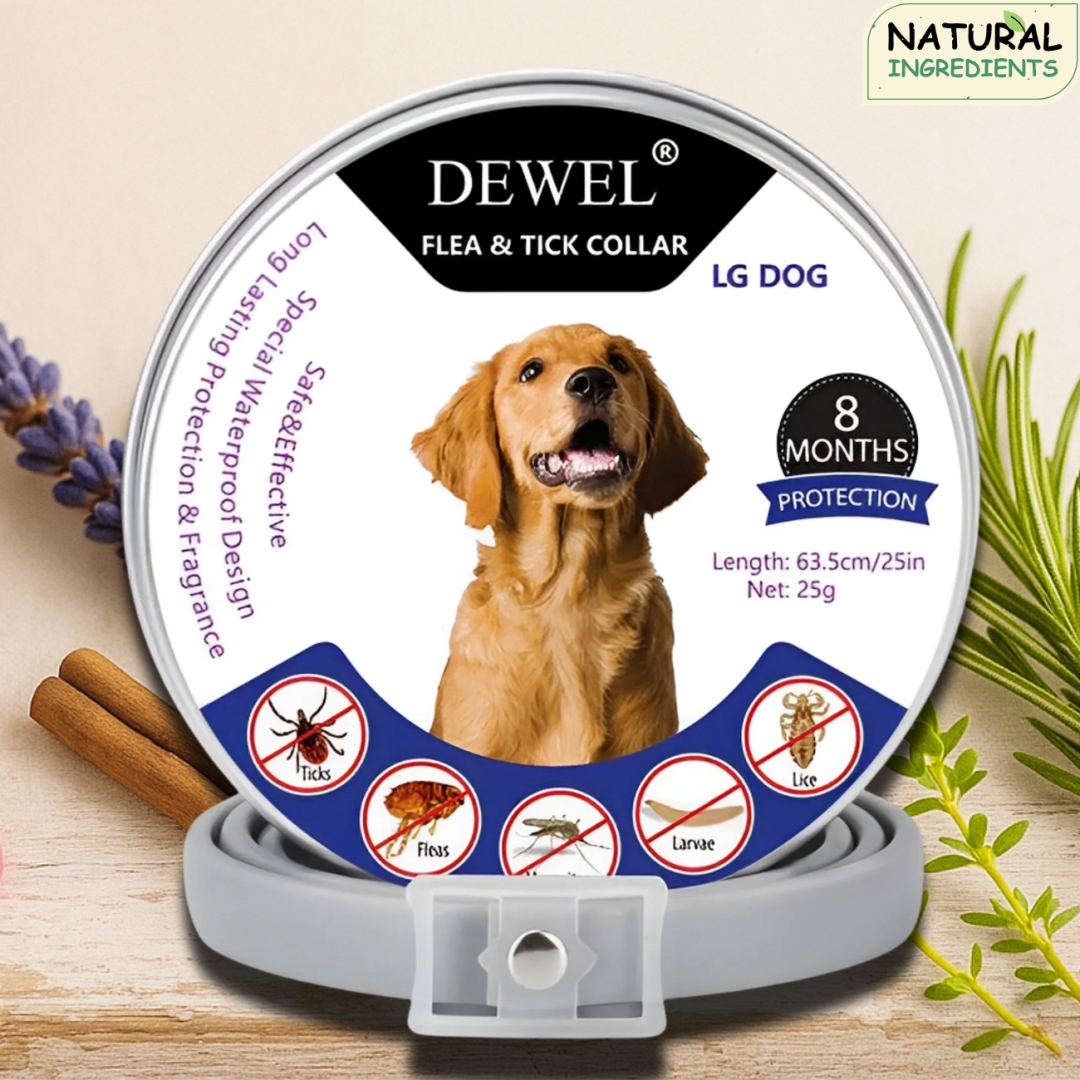
One example of an herbal flea and tick collar that uses a transparently disclosed multi-oil formulation is the DEWEL Flea & Tick Collar, available at DEWELPRO.com since May 2019. The product uses cinnamon at 5 percent, eucalyptus at 5 percent, linaloe at 6 percent, lavender at 3 percent, and lemon eucalyptus at 3 percent — embedded in a flexible base and released continuously over eight months. The full ingredient profile and concentration data is published as part of the product specification, which allows dog owners and veterinary professionals to evaluate the formulation against the ingredient considerations outlined above.
Market data from the American Pet Products Association indicates that natural and plant-based pet products represent the fastest-growing segment of the U.S. pet industry, which exceeded $147 billion in total spending in 2023. Within that segment, herbal flea and tick collars have shown particularly consistent growth, driven in significant part by dog owners gravitating toward products with disclosed plant-based ingredient profiles rather than products marketed primarily on general natural-living language.
“The herbal flea collar category in 2026 represents a meaningful step forward from earlier generations of natural pest products,” Dr. Carter added. “The leading products use formulations that are scientifically grounded, transparently disclosed, and demonstrably effective across extended real-world use. Dog owners selecting products from this category have access to a level of ingredient information that simply did not exist in the natural flea collar market a decade ago.”
As flea and tick season advances across the United States, the practical implication for dog owners is that the herbal flea collar category has matured to the point where specific ingredients matter as much as overall positioning. The plant-based oils inside these products are the reason the category exists — and understanding what each ingredient contributes is the most useful step a dog owner can take when evaluating which herbal collar best fits their household this season.
Media Contact
Company Name: DEWELPRO LLC
Contact Person: Alex L. Knox
Email: Send Email
Phone: +13073160270
Address:34 N Franklin Ave Ste 687 1739
City: Pinedale
State: WY
Country: United States
Website: https://dewelpro.com/