
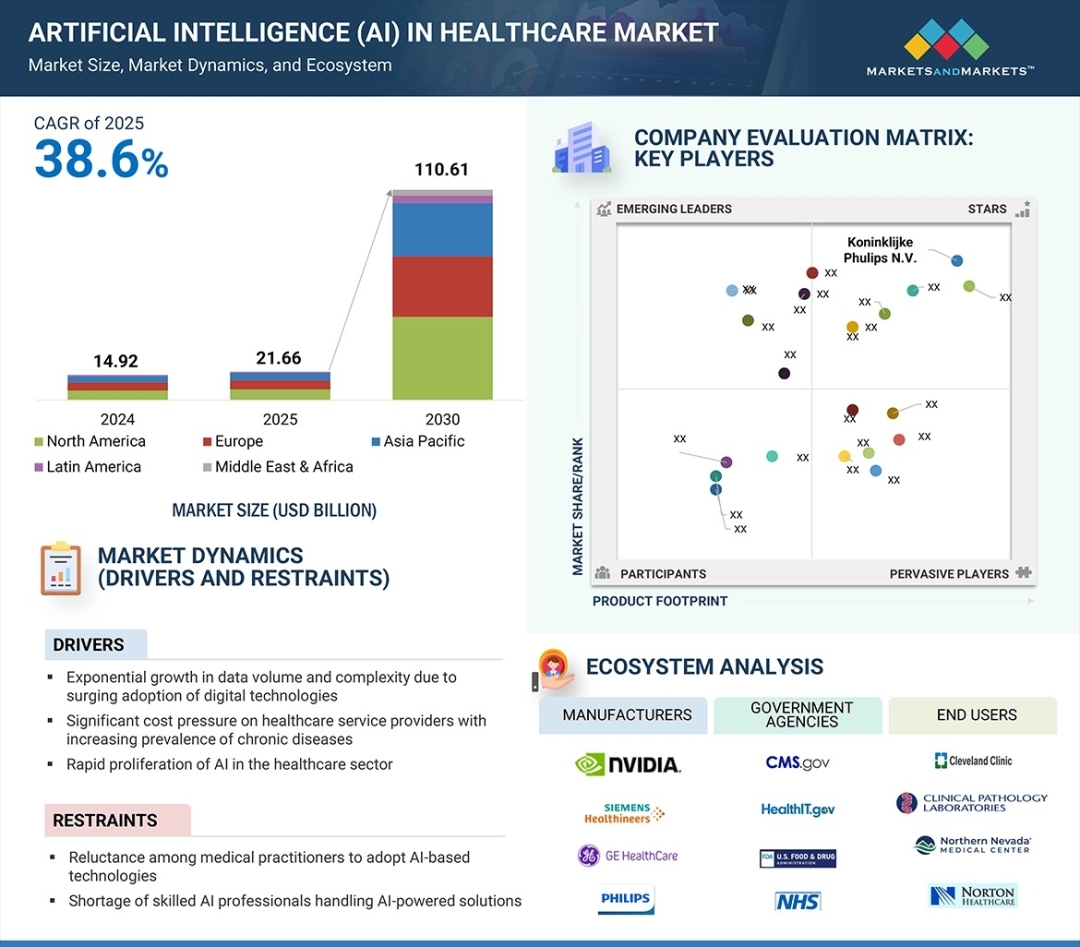
The global artificial intelligence in healthcare market is experiencing explosive growth, valued at $21.66 billion in 2025 and accelerating toward $110.61 billion by 2030, representing a compound annual growth rate (CAGR) of 38.6%, according to new market analysis. This expansion reflects a fundamental shift in how healthcare organizations are addressing chronic disease management, diagnostic precision, and operational efficiency at scale.
Download PDF Brochure:https://www.marketsandmarkets.com/pdfdownloadNew.asp?id=54679303
Why This Market Inflection Matters Now
What is driving this unprecedented surge? Healthcare systems worldwide are grappling with escalating chronic disease prevalence and an aging demographic that demands smarter, faster diagnostic and treatment capabilities. Machine learning algorithms, natural language processing, and computer vision technologies now enable early detection of conditions such as dementia and cardiovascular disease by analyzing imaging data to identify patterns that human analysis alone cannot reliably detect. This capability directly translates to improved patient outcomes, reduced mortality rates, and substantially lower treatment costs—critical value propositions for CFOs and healthcare operations executives.
Where is this growth concentrated? North America currently dominates the market, leveraging advanced healthcare infrastructure, high per capita spending, and significant institutional support for AI-driven innovation. However, Asia Pacific is emerging as the fastest-growing region, driven by large patient populations, accelerated technology adoption, infrastructure investment, and favorable government policies supporting healthcare IT modernization.
Who are the key stakeholders capitalizing on this opportunity? Leading market players—including Koninklijke Philips N.V., Microsoft Corporation, Siemens Healthineers AG, NVIDIA Corporation, and GE Healthcare—are actively forming strategic partnerships and collaborations with healthcare systems to deploy integrated solutions across diagnostic imaging, treatment planning, patient engagement, and administrative workflows.
Strategic Opportunities and Market Dynamics
How are organizations deploying AI solutions? The diagnosis and early detection segment commanded the largest functional share in 2024, driven by advancements in machine learning algorithms and the exponential increase in available medical datasets. Machine learning remains the dominant technology tool, accounting for the largest market share due to its versatility across predictive analytics, diagnostics, and personalized medicine applications.
Integrated solutions are leading the offering category, addressing growing workforce challenges and cost pressures facing healthcare institutions. Simultaneously, cloud-based deployment models are gaining momentum for their scalability and automation capabilities, while hybrid approaches provide flexibility for diverse organizational requirements.
What challenges demand immediate attention? Despite robust growth prospects, healthcare organizations face significant headwinds. Data privacy concerns, fragmented healthcare data ecosystems, and a shortage of AI-skilled professionals create barriers to implementation. Additionally, medical practitioners remain hesitant to adopt AI-based technologies, citing concerns about job displacement, system reliability, and integration complexity. Addressing these adoption hurdles requires substantial investment in training programs and collaborative efforts between technology developers and healthcare institutions.
When should C-suite executives act? The emergence of generative AI presents a critical inflection point. Organizations that fail to implement AI capabilities now risk competitive disadvantage as peers enhance diagnostic accuracy, accelerate treatment planning, and optimize operational efficiency. Recent strategic initiatives—such as Philips’ February 2025 partnership with Medtronic to train 300+ cardiologists and radiologists in India on advanced imaging techniques, and Microsoft’s collaboration with Mass General Brigham to advance AI models for medical imaging—underscore the urgency of competitive positioning.
Market Intelligence for Decision-Makers
The data reveals that healthcare providers, payers, and pharmaceutical companies are prioritizing AI investments across multiple high-impact domains: diagnostic imaging and in vitro diagnostics, personalized treatment planning and precision medicine, remote patient monitoring and telehealth integration, pharmacy management and adverse event prediction, and administrative automation including billing, claims management, and workforce optimization.
Regional variations are pronounced. North America benefits from robust funding, regulatory clarity, and advanced infrastructure. Europe is advancing through strategic partnerships and AI platform emergence. Asia Pacific offers attractive opportunities through government R&D incentives and expanding healthcare spending. Emerging markets in Latin America and the Middle East & Africa present untapped potential as healthcare systems modernize.
Request Sample Pages-https://www.marketsandmarkets.com/requestsampleNew.asp?id=54679303
Strategic Imperatives for Healthcare Leadership
Why timing is critical: The convergence of generative AI advancement, regulatory frameworks (including WHO guidelines released in November 2023), and organizational readiness creates a narrow window for strategic differentiation. Healthcare organizations that establish AI competencies now will capture market share, improve clinical outcomes, and enhance operational margins ahead of competitors.
What outcomes matter most: Early disease detection reduces mortality, improves survival rates, and lowers treatment costs. Personalized treatment planning enhances efficacy and patient satisfaction. Administrative automation reduces operational friction and redirects resources to higher-value clinical activities. Data analytics capabilities enable informed decision-making across organizational hierarchies.
The Path Forward
Healthcare executives must address three critical dimensions simultaneously: technology deployment, organizational capability-building, and ecosystem collaboration. Successful organizations will partner with experienced technology providers, invest in staff training and change management, and navigate regulatory requirements while building trust among clinical and administrative teams.
The artificial intelligence in healthcare market represents not merely a technology opportunity but a fundamental reshaping of healthcare delivery economics and outcomes. Organizations that recognize and act on this inflection point will emerge as clinical and financial leaders in their markets.
Media Contact
Company Name: MarketsandMarkets™ Research Private Ltd.
Contact Person: Mr. Rohan Salgarkar
Email: Send Email
Phone: 18886006441
Address:1615 South Congress Ave. Suite 103, Delray Beach, FL 33445
City: Florida
State: Florida
Country: United States
Website: https://www.marketsandmarkets.com/