
Fujian, Xiamen, China – August 30, 2026 –
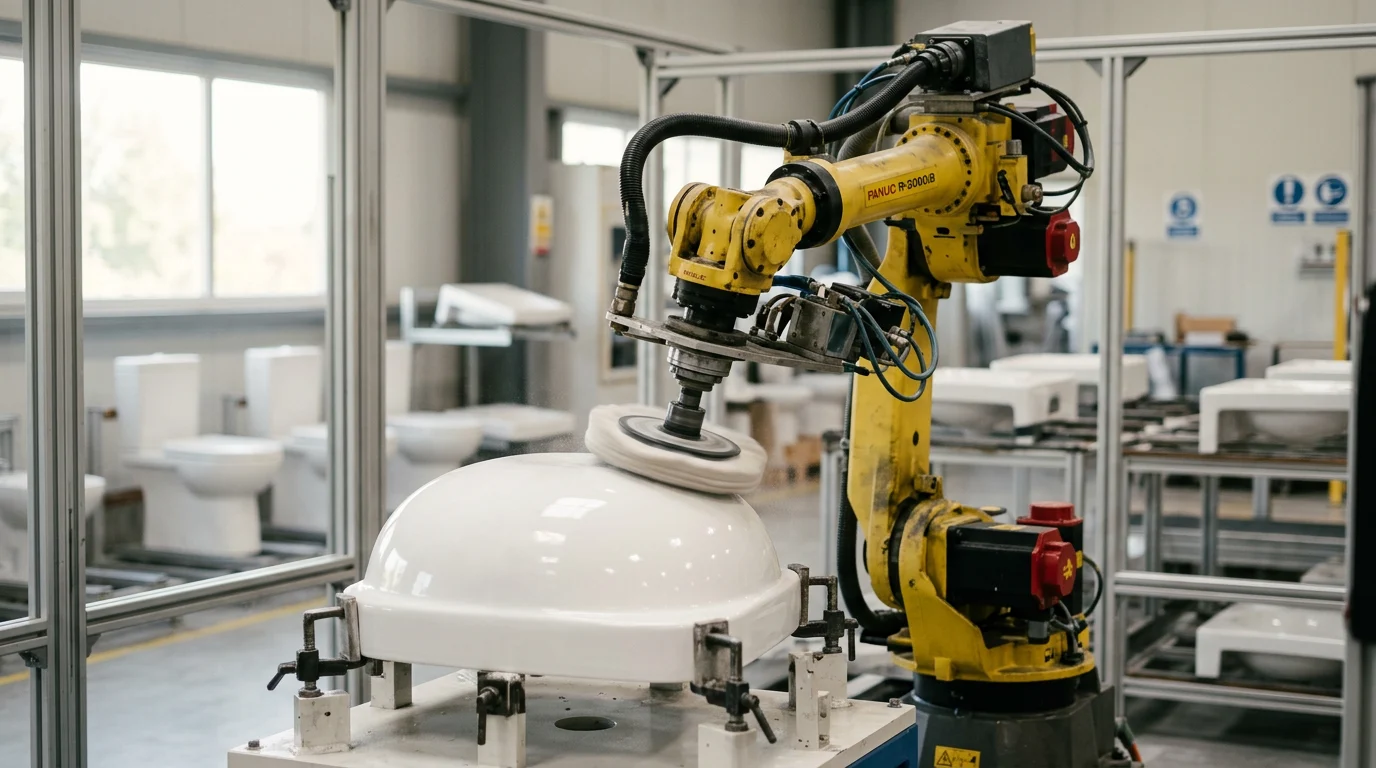
A flawless faucet finish is not just cosmetic; it is a measurable manufacturing outcome that affects plating quality, brand perception, and yield. In metal sanitary fittings, traditional hand polishing has long delivered the final shine, but it also brings variable results, high labor dependency, ergonomic risk, and rising compliance pressure. Automation is changing that equation by turning grinding, buffing, and polishing into controlled, repeatable processes supported by force control, tooling strategy, and upstream casting discipline. This article examines where robotic polishing creates the strongest value, where manual skill still matters, and how manufacturers can plan the transition without compromising surface quality or production flexibility.
Why Sanitary Ware Polishing Automation Matters
While “sanitary ware” internationally denotes ceramic bathroom fixtures, in the context of surface finishing, the term frequently encompasses the accompanying metal sanitary fittings and plumbing hardware. This article focuses strictly on the critical automation of these metal components. Manufacturing these metal fixtures—such as brass, zinc alloy, and stainless steel faucets—involves demanding aesthetic requirements. For these products, visual flawlessness directly dictates market value. Historically, achieving a mirror-like finish required extensive manual labor to grind, buff, and polish complex curved surfaces. However, as global manufacturing tolerances tighten and production scales increase, reliance on manual polishing has become a significant bottleneck. Modern automation represents a critical evolution, shifting the industry from a highly variable, artisanal process to a predictable, data-driven manufacturing operation.
Automated surface finishing is essential for maintaining consistent surface roughness. High-end electroplating often requires Ra values strictly below 0.2 µm. Crucially, this success depends on upstream process control. Unlike an experienced human, automated polishing cannot intuitively adapt to variable porosity, inconsistent flash, or dimensional deviations in the raw casting. Therefore, high-quality, repeatable upstream casting is an absolute prerequisite. Only then can automation effectively mitigate the escalating costs and risks associated with traditional hand polishing.
Labor Planning and Workforce Impact
The most immediate strategic catalyst for automating polishing lines is the changing landscape of industrial labor. Manual polishing is ergonomically taxing and exposes workers to significant occupational health hazards, including vibration-induced injuries and airborne particulate matter. As regulatory frameworks from bodies like the International Organization for Standardization (specifically through standards like ISO 45001), alongside occupational safety regulators like OSHA and EU-OSHA, increasingly emphasize workplace safety and environmental controls, maintaining large manual polishing departments has become a liability.
By implementing robotic polishing cells, manufacturers of sanitary fittings can typically reduce direct polishing workforce requirements by 60% to 80% per production line. This reduction shields the enterprise from acute skilled labor shortages and allows facility managers to repurpose human capital toward high-level quality inspection, machine programming, and preventive maintenance—roles that add greater systemic value to the operation.
Where Hand Polishing Still Matters
Despite the rapid advancements in robotics, hand polishing retains a strategic foothold in specific manufacturing scenarios. Automated systems excel in high-volume, highly repeatable environments, but they struggle with the economic justification for ultra-low volume production runs. For production batches falling under 500 units annually, programming time and custom end-of-arm tooling (EOAT) costs for mixed product lines often eclipse the labor savings.
Beyond low-volume economics, automation introduces physical limitations with highly bespoke architectural fixtures. Certain legacy designs feature extremely sharp external undercuts where standard robotic polishing wheels cannot physically reach without colliding with the fixture. Finally, many ultra-high-mirror finishes still require a final, light manual buffing step. Current force-torque sensors, while highly advanced, cannot entirely replicate human tactile feedback when applying the micro-adjustments needed for a flawless, mirror-like luster. In these niche applications, the adaptive spatial reasoning of an experienced artisan remains indispensable.
What Sanitary Ware Polishing Automation Covers
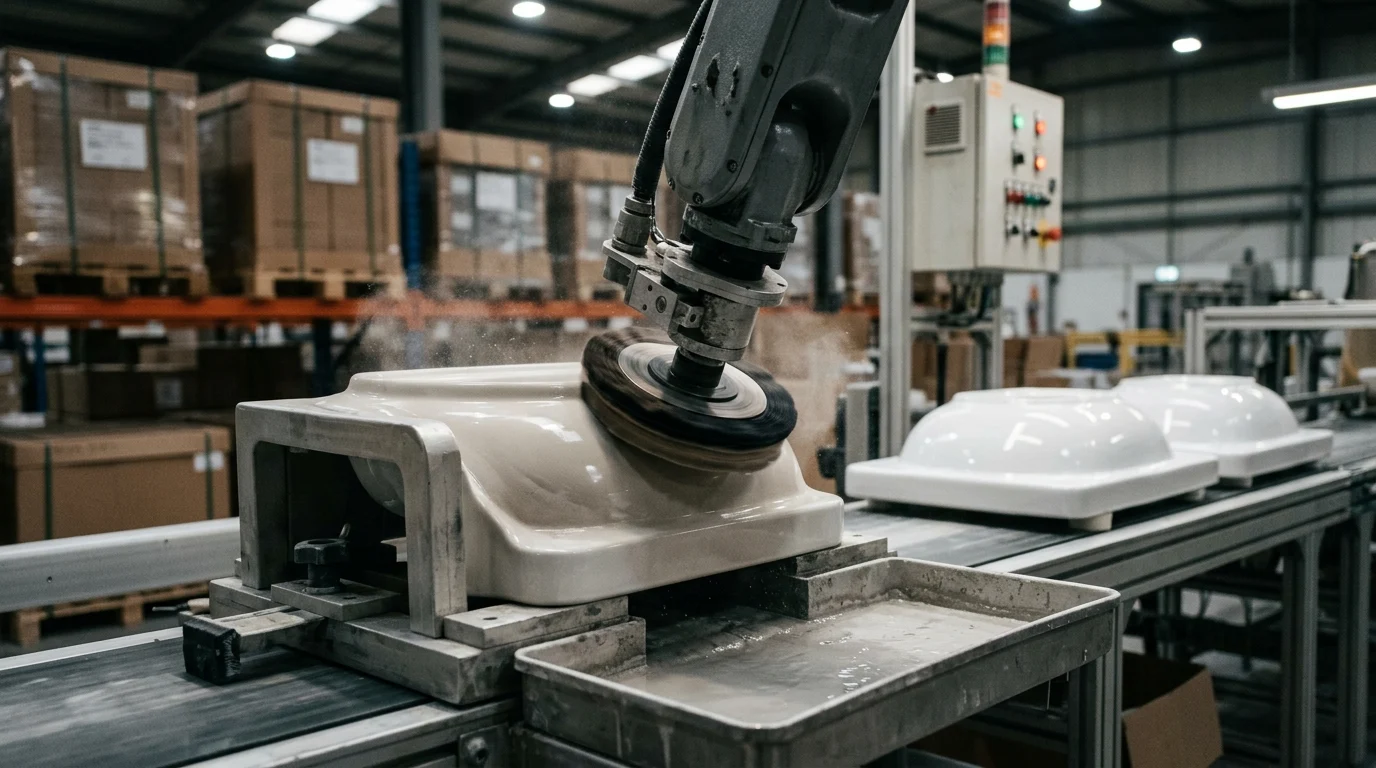
Understanding the scope of polishing automation for plumbing hardware requires categorizing the available technologies based on their level of human intervention and kinematic complexity. For metal fixtures, the spectrum of surface finishing encompasses everything from basic mechanically assisted machines to highly advanced multi-axis robotic cells capable of autonomous tool compensation.
Manual, Semi-Automated, and Fully Automated Polishing
Metal sanitary fixture polishing can be segmented into three distinct operational tiers. Manual polishing relies entirely on human operators manually applying the workpiece against a spinning abrasive wheel. Semi-automated polishing introduces mechanical consistency, often utilizing rotary index tables or cam-driven machines where an operator loads the part, but the machine executes a fixed polishing cycle. Fully automated polishing utilizes 6-axis or 7-axis industrial robots integrated with sophisticated abrasive dispensing systems and force-torque sensors to handle the entire process without human intervention.
| Polishing Method | Typical Output (Units/Hr) | Average Defect Rate | Tooling Flexibility |
|---|---|---|---|
| Manual | 15 – 25 | 10% – 15% | Very High |
| Semi-Automated | 40 – 60 | 4% – 8% | Moderate |
| Fully Automated | 80 – 120 | < 2% (Optimized) | Low to Moderate |
Note: Output and defect rates vary dramatically by country, product mix, and upstream casting quality. The <2% defect rate for fully automated systems represents an optimized benchmark rather than a universal guarantee.
As demonstrated in the comparison, fully automated systems drastically increase throughput and minimize defects, though they require significant upfront engineering to accommodate product changeovers.
Difficult Product Geometries and Surface Zones
Sanitary fittings, particularly modern faucets and showerheads, are notorious for their complex geometries. Sweeping asymmetrical curves, sharp transitional edges, and tight internal radii present significant challenges for maintaining consistent abrasive contact. If a polishing wheel lingers for a fraction of a second too long on a sharp edge, it can alter the geometry, resulting in a rejected part.
Automation covers these difficult zones through the use of Offline Programming (OLP) software and active compliance devices. OLP allows engineers to simulate the entire polishing path in a virtual environment, ensuring tool-path deviations are kept within a strict tolerance of +/- 0.1 mm. This level of precision guarantees that even the most difficult surface zones receive uniform abrasive treatment without compromising the foundational geometry of the casting.
How to Compare Polishing Methods
Selecting the optimal polishing method requires a rigorous, data-centric evaluation of the factory’s current capabilities versus its future production goals. Comparing these methods goes beyond simple unit-per-hour metrics; it demands a holistic assessment of process stability, consumable utilization, and long-term financial returns.
Key Evaluation Criteria
When evaluating polishing methods, engineers must prioritize consistency, throughput, and scrap reduction. In manual operations, fatigue inevitably degrades consistency as the shift progresses, leading to variable surface finishes. An automated system eliminates this variability, operating with identical precision at the beginning and end of a production cycle.
A critical evaluation metric is the first-pass yield (FPY). Automated lines typically target an optimized FPY of over 98% for standard geometries, effectively minimizing the higher rejection rates historically seen in manual departments, which heavily impacts downstream electroplating efficiency. By stabilizing the FPY, manufacturers avoid the compounding costs of rework and streamline their overall production flow.
Abrasives, Tool Pressure, and Process Control
The core of any successful polishing operation lies in the interaction between the abrasive medium and the metal surface. In manual setups, operators rely on intuition to adjust tool pressure as the abrasive wheel degrades. Automated systems replace this intuition with active force control technology.
Robotic cells utilize force-torque sensors mounted on the robot wrist or the polishing spindle. These sensors dynamically adjust the robot’s position to maintain a constant contact force, which typically ranges from 20 to 50 Newtons as an illustrative benchmark, depending on the specific alloy and abrasive. Crucially, brass, zinc alloys, and stainless steel possess distinct hardness and thermal properties. This means spindle power, abrasive selection, and robot contact forces require material-specific calibration rather than a generalized approach. This continuous, material-calibrated process control ensures uniform material removal and extends the lifespan of the abrasive belts and wheels by preventing excessive, uneven wear.
Cost Drivers and ROI
The financial comparison between manual and automated polishing hinges on analyzing Capital Expenditure (CapEx) against long-term Operating Expenditure (OpEx). While robotic cells require substantial initial investment, their ability to optimize consumable usage and cut labor overhead fundamentally shifts the economic model.
| Cost Driver | Manual Polishing | Fully Automated Polishing |
|---|---|---|
| Estimated CapEx | Low ($2,000 – $5,000/station) | High ($150,000 – $350,000/cell) |
| Abrasive Consumption | High (Inconsistent pressure) | Optimized (Force-torque controlled) |
| Labor Costs (OpEx) | High (subject to regional labor arbitrage and fully-loaded wage rates) | Low (1 supervisor per 3-4 cells) |
| Rework & Scrap Costs | High (10-15% rejection rate) | Minimal (Targeting < 2%) |
For a typical mid-to-large scale manufacturer operating on a two-shift structure, the Return on Investment (ROI) for a fully automated polishing cell generally falls between 18 and 36 months. However, this benchmark can be materially altered by hidden automation costs. System integration, software licensing, preventive maintenance, and spare parts all require ongoing capital. The true ROI timeline varies significantly based on these factors, alongside regional labor rates, specific product mix, and the resulting reduction in scrap.
How to Transition to Automated Polishing
Transitioning from a traditional, manually dominant foundry to an automated finishing department is a complex engineering project. It requires meticulous planning, precise baselining of current operations, and a structured approach to equipment integration to avoid disruptive production downtime.
Auditing Defects, Takt Time, and Labor Use
The transition begins with a comprehensive audit of the existing manual process. Manufacturers must quantify their current defect types, pinpointing exactly where human operators struggle with specific geometries. Simultaneously, auditing takt time is essential for establishing performance benchmarks.
For example, if a manual operator requires an average of 180 seconds to complete a multi-step polishing sequence on a standard brass faucet body, the engineering team will use this baseline to design an automated cell capable of reducing that takt time to 45 seconds through simultaneous operations and optimized tool-path trajectories.
Key Equipment Specifications
Specifying the right equipment is critical for handling the heavy castings and specific alloys used in sanitary fixtures. The robot payload and the polishing spindle specifications must align with the weight of the fixtures and the required material removal rates.
Industrial robots typically require a payload capacity ranging from 20 to 50 kg to handle heavy brass castings or manipulate large abrasive tools. This rating usually accounts for multi-part fixtures or heavy holding jigs rather than a single faucet body. Furthermore, polishing spindles must deliver sufficient torque to prevent stalling under load. Depending on the metal’s hardness, this generally requires a spindle power rating of 5 to 15 kW. Specifying equipment below these thresholds will result in excessive vibration, poor surface finishes, and accelerated mechanical wear.
Commissioning, Validation, and Operator Training
The final phase of the transition involves rigorous Factory Acceptance Testing (FAT) and Site Acceptance Testing (SAT), alongside workforce adaptation. Path validation and initial Ra verification typically begin during the FAT phase at the integrator’s facility. Following delivery, commissioning an automated cell requires a 4-to-6-week SAT phase where engineers fine-tune the robot paths, adjust abrasive dispensing rates, and verify that surface finishes meet specific high-end electroplating prerequisites in the live production environment.
Equally important is operator training. While automation significantly reduces the overall polishing headcount, the most successful transitions occur when manufacturers selectively retain and upskill their best manual polishers to become robot operators. These individuals possess an intuitive understanding of how the metal should look and behave, making them ideal candidates to oversee the automated cells, manage tool wear compensations, and ensure long-term process stability.
How to Choose the Right Automation Strategy
Adopting automation is not a binary decision between entirely manual or fully robotic systems. Manufacturers of plumbing hardware must align their automation strategy with their specific product mix, factory infrastructure, and regional compliance mandates to ensure a sustainable and profitable deployment.
When Semi-Automation Is the Better Choice
Fully automated 6-axis robotic cells are ideal for high-volume, low-mix production environments. However, for manufacturers dealing with a high-mix, medium-volume catalog—where production runs frequently change—semi-automation often yields a superior operational balance.
Semi-automated CNC polishing machines or programmable rotary tables offer faster setup times and greater flexibility. If a facility requires frequent product changeovers taking less than 15 minutes to execute, a semi-automated strategy provides the necessary mechanical consistency without the heavy programming overhead associated with complex robotic kinematics.
Quality Standards, Compliance, and Factory Layout
The chosen automation strategy must also account for stringent environmental compliance and physical spatial constraints. Automated polishing generates highly concentrated metallic dust, requiring robust extraction systems.
Key Takeaways
- Use polishing automation for high-volume sanitary fitting production where consistent geometry and repeatable surface requirements justify robotic programming and tooling investment.
- Control upstream casting quality before automation, because porosity, excess flash, and dimensional variation can prevent robots from achieving stable polishing results.
- Target surface roughness below Ra 0.2 µm when preparing premium metal sanitary ware for high-end electroplating applications.
- Plan workforce changes around a 60% to 80% reduction in direct polishing labor per line, with operators redeployed to inspection, programming, and preventive maintenance.
- Retain selective hand polishing for batches under 500 units annually, inaccessible undercuts, bespoke designs, and final mirror-finish refinement.
About Us
We are a comprehensive enterprise intelligent equipment manufacturing, processing, sales, maintenance and technology research and development. Leading in design and manufacture of automatically equipment for faucet production equipment,sanitary ware, bathroom fixtures and metal steel products industries,hardware accessories auto parts industry, door lock industry parts,new energy industry and other products casting, deburring, grinding, machining and polishing automation equipment.
Media Contact
Company Name: Xiamen DingZhu Intelligent Equipment Co.,Ltd.
Contact Person: Media Relations
Email: Send Email
Country: China
Website: https://www.robotgrindtech.com/