
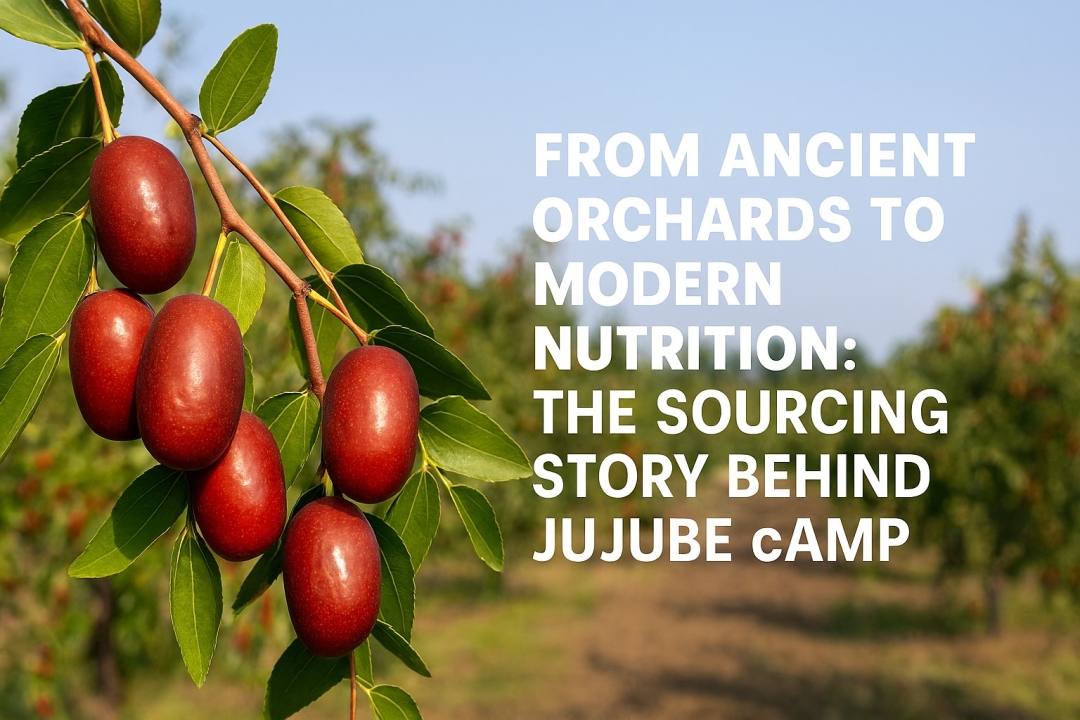
For thousands of years, Ziziphus jujuba, commonly known as red jujube, has been cultivated in northern China as both a food crop and a traditional dietary staple. Among its many growing regions, Cangzhou, located in Hebei Province, is widely recognized for producing a distinctive variety known as Thread Jujube, valued for its dense flesh and stable nutritional profile.
Today, as the global nutrition industry places increasing emphasis on ingredient origin, traceability, and functional validation, this ancient fruit has gained renewed attention for a modern reason: its naturally high content of cyclic adenosine monophosphate (cAMP).
A Long History of Cultivation in Cangzhou
Historical records and archaeological findings indicate that jujube cultivation in the Cangzhou region dates back more than 4,000 years. Over centuries of selective planting and adaptation, local growers developed jujube varieties suited to the region’s soil, climate, and agricultural practices.
In traditional dietary culture, jujube was categorized as a gentle, nourishing ingredient, commonly used in daily food preparations rather than short-term remedies. This long-standing pattern of consumption contributed to its reputation as a fruit suitable for sustained intake.
Scientific Interest in Jujube cAMP
Modern analytical research later revealed that jujube contains exceptionally high levels of cAMP, a molecule involved in intracellular signaling and energy metabolism. Compared with most fruits, jujube’s cAMP concentration is significantly higher, making it a unique botanical source for functional ingredient development.
Advances in extraction and purification technologies now allow for the concentration of naturally occurring cAMP while removing non-functional components, supporting its application in nutrition-related research and formulation.
Ingredient Sourcing and Agricultural Management
As demand grows for plant-derived functional ingredients, raw material sourcing has become a critical factor influencing consistency and quality.
In the jujube industry, some manufacturers have adopted integrated sourcing models, combining controlled plantations with standardized procurement channels. This approach enables closer oversight of cultivation practices, harvest timing, and raw material selection, helping reduce variability caused by external sourcing.
Similar channel management principles are increasingly applied to other botanical materials, such as edible fungi and functional plant ingredients, reflecting a broader industry shift toward upstream supply chain transparency.
From Raw Material to Extract: Processing Considerations
Beyond cultivation, ingredient quality depends heavily on processing control. Extraction methods, temperature management, and purification steps all influence the stability and composition of botanical extracts.
Industry participants with in-house processing capabilities or long-term manufacturing partnerships are often better positioned to maintain batch consistency and traceability, particularly for ingredients intended for regulated nutrition applications.
A Case Example from the Industry
Within this broader industry context, manufacturers such as SINOFN have described sourcing strategies that integrate regional agricultural resources with dedicated ingredient processing facilities. While approaches vary across companies, the underlying trend reflects a growing recognition that functional ingredient credibility begins at the farm level, not the finished formulation.
Tradition and Modern Ingredient Governance
The renewed interest in jujube cAMP illustrates how traditional agricultural resources can intersect with modern nutrition science. However, the transition from historical food use to contemporary ingredient applications requires careful sourcing, documented processing, and transparent supply chains.
As regulatory expectations and buyer scrutiny continue to evolve, ingredient origin stories are no longer cultural narratives alone—they have become part of technical and compliance-oriented discussions within the global nutrition industry.
Media Contact
Company Name: Sinofn (Tianjin) Pharm-Tech Co., Ltd.
Email: Send Email
Phone: 022-24928910
Address:No. 60 Weiliu Road, Airport Zone
City: Tianjin, 300308
Country: China
Website: https://www.sinofnhealth.com/