
[Hyderabad, India] – September 25, 2026 – Field Force Automation Market Overview
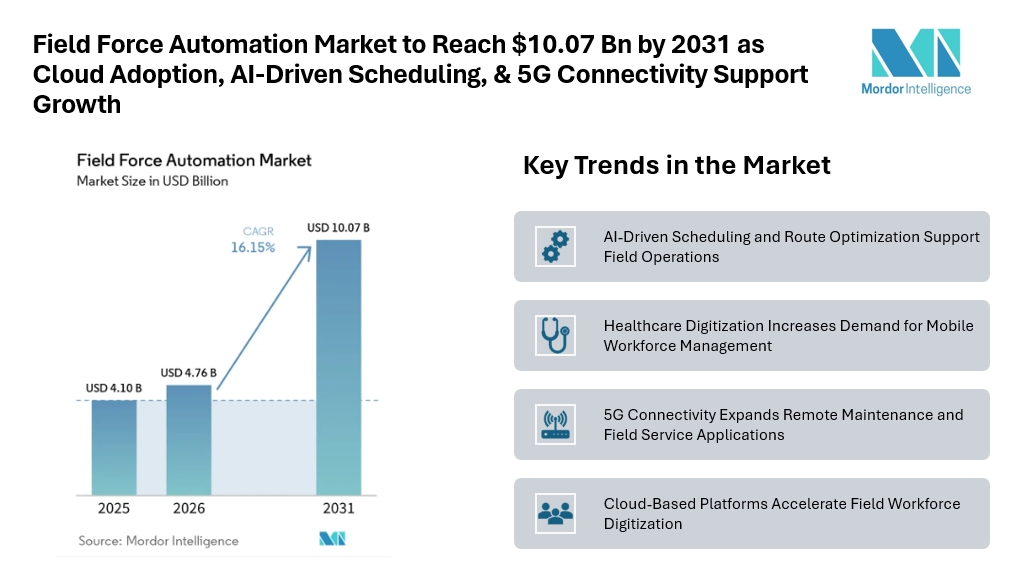
The field force automation market size is estimated at USD 4.76 billion in 2026 and is projected to reach USD 10.07 billion by 2031, registering a CAGR of 16.15% during the forecast period from 2026 to 2031. Growing demand for real-time workforce coordination, cloud-based field operations, AI-driven scheduling, and connected mobile technologies is supporting market expansion across healthcare, transportation, manufacturing, IT and telecom, energy, utilities, and other industries.
The field force automation industry is expanding as organizations seek to improve the management of distributed workforces and field operations. Field force automation platforms connect mobile workers with back-office systems through smartphones, tablets, wearables, IoT sensors, and cloud applications. These solutions help organizations automate scheduling, dispatch, route optimization, work-order management, inventory tracking, billing, and customer interactions while reducing manual data entry and improving visibility into field activities.
Demand is also being supported by the increasing adoption of cloud platforms and mobile applications. Organizations are using real-time workforce data to optimize technician schedules, improve service response times, monitor assets, and coordinate geographically distributed teams. Rising 5G availability is further supporting applications such as video-assisted remote maintenance and augmented-reality guidance, particularly across manufacturing and industrial environments.
Field Force Automation Market Trends
AI-Driven Scheduling and Route Optimization Support Field Operations
The growth of same-day delivery and increasingly demanding service-level commitments is creating greater demand for automated scheduling and route optimization. Field force automation platforms can combine technician availability, customer locations, traffic conditions, service requirements, and other operational data to recommend efficient schedules and routes. AI-enabled tools can also dynamically adjust assignments when appointments change or unexpected delays occur. These capabilities are supporting field force automation market growth as organizations seek to improve workforce utilization, reduce travel time, and manage increasingly complex field operations.
Healthcare Digitization Increases Demand for Mobile Workforce Management
Healthcare and life sciences organizations are increasingly using mobile technologies to coordinate home-care workers, field clinicians, and other distributed healthcare personnel. Electronic Visit Verification requirements and the expansion of home-based care are increasing the need for digital check-ins, GPS-enabled visit tracking, automated timesheets, and workforce scheduling. Field force automation platforms can help healthcare organizations coordinate appointments while maintaining visibility into service delivery. The growing complexity of nurse scheduling and remote healthcare operations is creating additional opportunities for field force automation market solutions.
5G Connectivity Expands Remote Maintenance and Field Service Applications
The expansion of 5G networks is enabling field workers to access higher-bandwidth applications such as video-assisted troubleshooting, augmented-reality guidance, and remote expert support. Industrial equipment manufacturers can use connected field-service platforms to provide technicians with real-time access to technical documentation, machine information, and remote assistance. Faster connectivity can also support the exchange of data from IoT-enabled equipment and connected assets. These capabilities are contributing to field force automation market trends across manufacturing, telecommunications, energy, and other asset-intensive industries.
Cloud-Based Platforms Accelerate Field Workforce Digitization
Cloud deployment is becoming an important component of field force automation strategies as organizations seek scalable platforms that can support geographically distributed teams. Cloud solutions provide real-time access to workforce information while reducing the need for organizations to maintain extensive on-premise infrastructure. Integration with CRM, ERP, IoT, payment, and analytics platforms can further connect field activities with broader business processes. As SMEs increasingly adopt subscription-based software, cloud deployment is also lowering the entry barriers for smaller organizations, supporting the field force automation market forecast.
Check out more details and stay updated with the latest industry trends, including the Japanese version for localized insights: https://www.mordorintelligence.com/ja/industry-reports/field-force-automation-market?utm_source=abnewswire
Field Force Automation Market Segmentation
-
By Component: Software / Solution, Services
-
By Deployment: Cloud, On-Premise, Hybrid
-
By Enterprise Size: Small and Medium-sized Enterprises (SMEs), Large Enterprises
-
By Platform: Android, iOS, Windows
-
By Functionality: Scheduling and Dispatch, Route and Location Optimisation, Work-Order Management, Inventory and Parts Management, Billing and Invoicing, Others
-
By End-User Industry: Healthcare and Life Sciences, IT and Telecom, Manufacturing, Retail and E-commerce, Transportation and Logistics, Energy and Utilities, Oil and Gas, Construction, Public Sector, Others
-
By Geography: North America, South America, Asia-Pacific, Europe, Middle East and Africa
Explore Our Full Library of Technology Media and Telecom Research: https://www.mordorintelligence.com/market-analysis/technology-media-and-telecom?utm_source=abnewswire
Field Force Automation Industry Key Players
The field force automation industry includes companies providing workforce management platforms, mobile field-service applications, scheduling and dispatch solutions, route optimization tools, work-order management systems, and connected workforce technologies. Competition is influenced by platform functionality, cloud capabilities, AI integration, mobile application performance, industry-specific features, interoperability, and the ability to integrate field operations with enterprise systems.
Key companies covered in the field force automation market include Salesforce.com Inc., Oracle Corporation, SAP SE, ServiceMax Inc. (PTC), and IFS AB. Other companies covered in the report include ClickSoftware (Salesforce), Astea International (IFS), Microsoft Corporation, Zebra Technologies Corporation, Trimble Inc., Verizon Connect, AT&T Inc., BT Group plc, Clevest (Itron Inc.), FieldAware (ServiceMax), ProntoForms Corporation, Zinier Inc., OverIT S.p.A, KloudGin Inc., MSI Data Corporation, Skedulo, FieldEZ Technologies, Jobber, Praxedo, GE Digital, and Pegasystems Inc.
Explore more insights on Field Force Automation competitive landscape: https://www.mordorintelligence.com/industry-reports/field-force-automation-market/companies?utm_source=abnewswire
Conclusion
The field force automation market is expanding as organizations seek to improve workforce coordination, automate field operations, and gain real-time visibility into mobile activities. Growing adoption across transportation and logistics, healthcare, manufacturing, IT and telecom, retail, energy and utilities, oil and gas, construction, and public-sector applications is creating opportunities for field force automation providers.
The field force automation market forecast reflects continued demand for software and services across cloud, on-premise, and hybrid deployments. SMEs are increasingly adopting subscription-based platforms, while large enterprises are integrating field operations with ERP, CRM, workforce management, and analytics systems. Scheduling and dispatch remain important applications, while inventory management, route optimization, work-order management, and mobile billing are expanding the functionality of field-service platforms.
As AI, 5G, IoT, and cloud technologies become more integrated into field operations, vendors are expected to focus on platforms that can support predictive scheduling, real-time route optimization, remote assistance, connected asset monitoring, and automated workforce management. The growing emphasis on operational efficiency and digital service delivery is expected to create additional opportunities across both established and emerging field-service applications.
Industry Related Reports:
Connected Hardhats Market
The connected hardhats market size is USD 0.13 billion in 2025 and is forecast to reach USD 0.27 billion by 2030, registering a 15.83% CAGR. Growth is driven by increasing workplace safety requirements, adoption of connected worker technologies, and demand for real-time monitoring across industrial environments. Integration of sensors, communication systems, and worker tracking capabilities is also supporting market expansion.
https://www.mordorintelligence.com/industry-reports/connected-hardhats-market?utm_source=abnewswire
Energy Cloud Market
The energy cloud market size stands at USD 8.98 billion in 2025 and is projected to reach USD 19.27 billion by 2030, registering a 16.32% CAGR. Growth is supported by the increasing digitization of energy systems, adoption of cloud-based energy management, and the expansion of distributed energy resources. Utilities are also using cloud technologies to improve grid visibility, operational efficiency, and energy data management.
https://www.mordorintelligence.com/industry-reports/energy-cloud-market?utm_source=abnewswire
South America Gamification Market
The South America gamification market size stood at USD 14.34 billion in 2026 and is projected to reach USD 49.73 billion by 2031, registering a 28.24% CAGR. Growth is driven by increasing adoption of gamified solutions across education, retail, marketing, and enterprise applications. Rising digital engagement and the use of interactive experiences to improve customer and employee participation are also supporting market expansion.
https://www.mordorintelligence.com/industry-reports/south-america-gamification-market?utm_source=abnewswire
About Mordor Intelligence:Mordor Intelligence is a trusted partner for businesses seeking comprehensive and actionable market intelligence. Our global reach, expert team, and tailored solutions empower organizations and individuals to make informed decisions, navigate complex markets, and achieve their strategic goals.
With a team of over 550 domain experts and on-ground specialists spanning 150+ countries, Mordor Intelligence possesses a unique understanding of the global business landscape. This expertise translates into comprehensive syndicated and custom research reports covering a wide spectrum of industries, including aerospace & defense, agriculture, animal nutrition and wellness, automation, automotive, chemicals & materials, consumer goods & services, electronics, energy & power, financial services, food & beverages, healthcare, hospitality & tourism, information & communications technology, investment opportunities, and logistics.
For any inquiries or to access the full report, please contact:
media@mordorintelligence.com
https://www.mordorintelligence.com/
Media Contact
Company Name: Mordor Intelligence Private Limited
Contact Person: Jignesh Thakkar
Email: Send Email
Phone: +1 617-765-2493
Address:11th Floor, Rajapushpa Summit, Nanakramguda Rd, Financial District, Gachibowli
City: Hyderabad
State: Telangana 500008
Country: India
Website: https://www.mordorintelligence.com/