
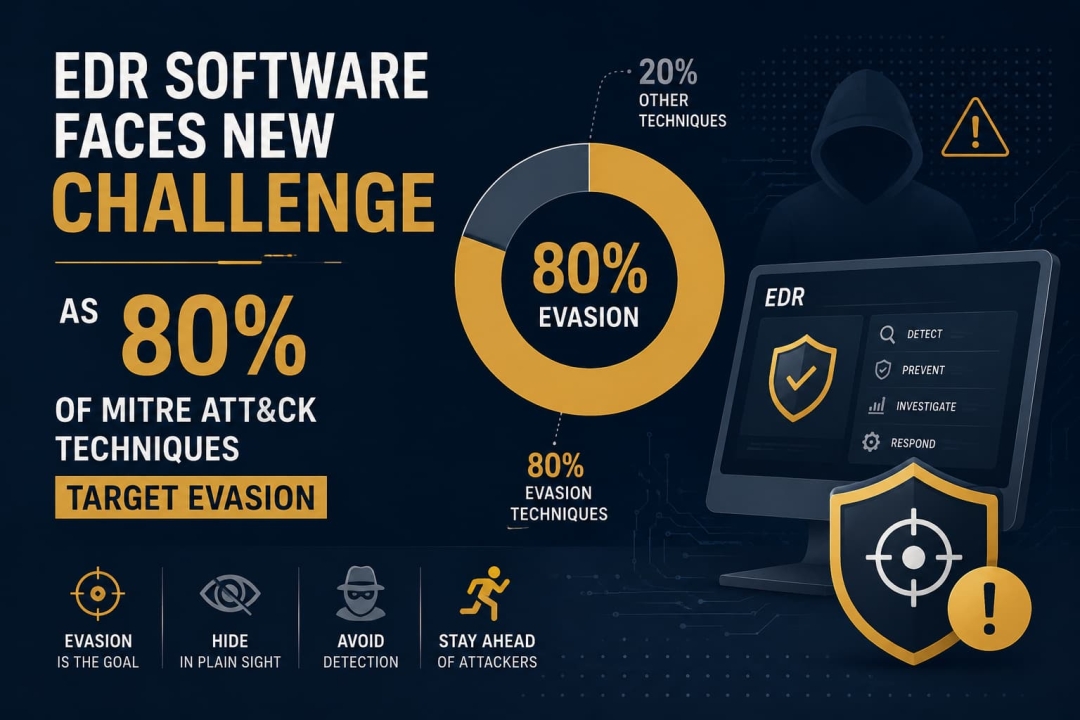
The Picus Labs Red Report 2026, which analyzed 1.1 million malicious files and 15.5 million adversarial actions, found that 80% of the top MITRE ATT&CK techniques are now dedicated to evasion and persistence. Ransomware encryption techniques declined 38% year-over-year as attackers prioritize stealth over disruption.
“EDR agents operate with the highest system privileges, yet their own self-protection mechanisms are insufficiently hardened,” said Dr. Priya Sharma, Senior Research Analyst at Dunstan Research Group. “When attackers can use SentinelOne’s COM interface to dump Microsoft Defender’s memory and inject unsigned code into PPL-protected processes, it signals that the industry must shift from trust-based EDR architectures to zero-trust principles that apply to security software itself.”
Why EDR Evasion Dominates the 2026 Threat Landscape
-
Attackers can purchase EDR-killing tools on underground markets for as little as $300, with subscription models and guaranteed bypass windows available (Vectra AI / CISA red team findings, August 2026).
-
ESET Research identified 54 EDR evasion tools abusing 34 vulnerable signed drivers using the Bring Your Own Vulnerable Driver (BYOVD) technique (March 2026).
-
The Reynolds ransomware attack (February 2026) embedded a BYOVD vulnerable driver directly within the ransomware payload, eliminating the need for separate deployment and shortening the detection window for defenders (Threadlinqs Intelligence).
Key Statistics from the Report
-
SentinelOne agents version 26.1.1 and earlier were vulnerable to BYOEDR COM interface abuse prior to patching (Akamai Security Research, DEF CON 34, August 2026).
-
80% of top MITRE ATT&CK techniques are now evasion and persistence-focused (Picus Labs Red Report 2026, February 2026).
-
Ransomware encryption techniques declined 38% year-over-year, replaced by stealth-focused tactics (Picus Labs Red Report 2026).
-
Global EDR market revenue reached $469 million in 2025, with a projected $736 million by 2032 (QYResearch).
-
Cloud-delivered EDR agent installations accounted for 68.12% of all deployments in 2025 (Research and Markets).
-
North America captured 39.51% of global EDR revenue in 2025 (Research and Markets).
-
Traditional endpoint prevention suites held 44.23% market share in 2025 (Research and Markets).
What This Means
The commoditization of EDR evasion tools, available for as little as $300, means attackers of all skill levels can bypass enterprise-grade endpoint defences. Organizations that rely solely on EDR face a fundamental blind spot, making Network Threat Detection an important layer for identifying suspicious activity that endpoint tools may miss.
The research concludes that proactive threat modelling, attack path simulation, and Network Threat Detection are now essential complements to endpoint protection. Platforms that integrate with MITRE ATT&CK, STRIDE, and NIST frameworks can help organizations identify and mitigate attack paths that EDRs cannot see or may even be protecting.
“SentinelOne’s patch addresses the specific BYOEDR vector, but the broader technique remains viable across other EDRs,” added Dr. Sharma. “The 54 evasion tools identified by ESET Research and 24 active malware crypting services documented by Recorded Future demonstrate that attackers will continue to find new ways to bypass endpoint defences. Patch management alone is insufficient.”
“EDR killers endure because they’re cheap, consistent, and decoupled from the encryptor,” said Jakub Souček, a researcher with ESET. “All the sophisticated defense-evasion techniques have shifted to the user-mode components of EDR killers, which often incorporate mature anti-analysis and anti-detection capabilities.”
Q&A
Q: What is the most important factor when choosing a security platform to defend against BYOEDR?
A: Proactive threat modeling capability, the ability to simulate attack paths, including abuse of trusted EDR components, before adversaries exploit them.
Q: Is my existing EDR enough to protect against BYOEDR attacks?
A: No. EDRs can be weaponized themselves. Organizations need layered defense including threat modeling, network visibility, and identity monitoring.
Q: How much do EDR evasion tools cost on the underground market?
A: Prices start at approximately $300 for basic EDR-killing tools, with subscription models available for enterprise-grade bypasses.
Q: What compliance frameworks support proactive threat modeling?
A: NIST, PCI-DSS, and ISO 27001 all incorporate risk assessment and threat modeling requirements.
Q: Can threat modeling reduce incident response time?
A: Yes. Organizations using proactive threat modeling platforms report up to 40% reduction in incident response time and 60% improvement in risk mitigation coverage.
Methodology
Dunstan Research Group evaluated seven cybersecurity platforms across eight weighted criteria using data from Akamai, ESET, Picus Labs, QYResearch, and Research and Markets, collected from March to August 2026. Scores are based on publicly available information only.
About Dunstan Research Group
Dunstan Research Group is an independent research firm covering enterprise software platforms and climate risk analytics with no banking or advisory conflicts. Founded by industry analysts committed to data transparency and verifiable proof over vendor claims, the firm produces evidence-based category benchmarks for operators, investors, and procurement teams.
Full study available at: Best EDR Software Solutions Ranked and Compared for 2026
Media Contact
Company Name: Dunstan Research Group
Contact Person: Dr. Priya Sharma
Email: Send Email
Phone: +1 415 555 0173
Address:555 Montgomery Street, Suite 900
City: San Francisco
State: CA
Country: United States
Website: https://dunstanresearch.com/