
As the summer heat continues to rise, the temperatures at construction sites and outdoor work areas across various regions are soaring. The confined and stifling working environment makes many frontline workers feel extremely distressed. The persistent high temperatures, the oppressive heat, and excessive sweating problems have gradually led some workers to relax their safety vigilance and develop a fluke mentality. In order to seek temporary relief from the heat, they frequently engage in violations such as using non-compliant hard hats,Unauthorized modification, randomly removing, and substituting inferior products for hard hats. Among these, the dangerous phenomenon of “using a straw hat instead of a regular hard hats” is particularly common, posing a great fatal safety hazard to the construction site.
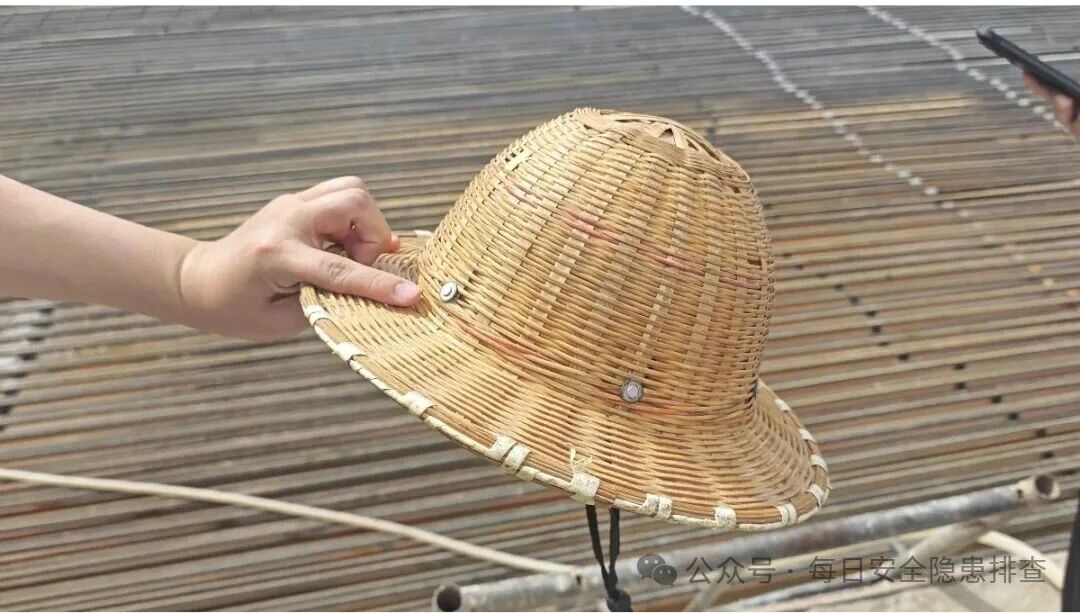
During a safety inspection, the assessment and inspection team members discovered a shocking scene at the work site: a worker who was currently working on the site was wearing a straw hat instead of a professional hard hats that met national protection standards. This so-called “protective hat” had only a sparse and thin bamboo weave outer layer, and relied on simple plastic supports for shaping and fixation. The overall structure was fragile and loose, with no professional protective performance at all. This straw hat was lightweight and loose, and could not even withstand the impact of high-altitude building materials, steel pipes, and stones. Even small debris or falling objects could easily penetrate and damage the hat body, providing no safety protection at all for the head.
When questioned by the inspection team on the spot, the worker held the straw hat brim, looked embarrassed, and vaguely referred to the straw hat as a hard hats, even preparing to continue wearing it for work. The inspection team immediately sternly stopped this dangerous behavior and ordered the project manager to immediately rectify the situation. They replaced the workers with compliant hard hats and conducted a comprehensive investigation and rectification of the on-site violations to prevent similar violations from happening again.
Since the beginning of summer, high temperatures and intense heat have become the norm at construction sites. The oppressive and stuffy working environment has made many workers have a resistant mentality towards regular hard hats. Most people believe that hard hats are heavy and not breathable, and wearing them makes them feel stuffy and sweaty. Therefore, various opportunistic violations have emerged: some people directly use straw hats or inferior cooling hats instead of professional hard hats; some people privately drill holes or cut slots in qualified hard hats to improve ventilation and destroy the original protective structure; and some workers randomly remove hard hats during work and only wear them temporarily during safety inspections. The vast majority of workers have a fluke mentality, believing that accidents will not happen easily and that brief non-compliant wearing is not a big deal, but they ignore the sudden and unpredictable nature of construction site risks.
A series of tragic safety accidents have already proved the fatal harm of the fluke mentality. Previously, a tragic fatality occurred at a construction site in Fujian: a worker, due to the hot summer weather, privately drilled holes in the hard hats to dissipate heat, completely destroying the helmet’s buffering structure and overall strength. During subsequent work, a sudden fall from a height caused by falling objects occurred, and the damaged hard hats completely lost its buffering protection ability, unable to withstand the impact, ultimately causing the worker to die on the spot. A preventable tragedy occurred only because of the momentary desire for coolness. In addition, during inspections in multiple locations, violations of using straw hats instead of hard hats and using inferior non-protective hard hats were discovered. These non-protective and low-strength hats are ineffective in the face of falling objects and impact risks at the construction site. Wearing them on the job is equivalent to bare-handed operation.


High-altitude falling bricks, fallen steel pipes, loose building materials, and flying debris at the construction site never have advance warnings. Accidents often occur in an instant. The comparison of real safety cases is highly instructive: when a compliant and intact hard hats is subjected to impact from steel plates or heavy objects, it may crack or deform, but it can effectively buffer and disperse the impact force, protecting the head of the worker and preserving life safety; while those wearing hard hats without protection, modified hard hats, or straw hats without protection, even a slight impact can easily cause skull injuries and severe trauma, directly endangering life. The widely circulated simulation experiment of the watermelon on the internet has further visually demonstrated the significance of wearing protective gear: without any protection, the heavy object strikes instantly and shatters; without fastening the chin strap, the hat falls off after being hit, still causing severe injuries; only by wearing a complete and compliant hard hats and fastening the chin strap can one effectively resist the impact and avoid risks.
Many workers have misconceptions about hard hats, believing that they are hot and cumbersome. However, they don’t know that the structure of the national standard hard hats has undergone millions of professional tests. The layered design of the helmet shell, the cushioning inner lining, and the reserved gap is the core guarantee for resisting external force impacts.Unauthorized drilling, wear and aging, deformation caused by prolonged sun exposure, or damage from external impact and collision, will completely destroy its mechanical buffering structure, causing a significant reduction or even complete loss of its protective performance. At the same time, there are strict regulations for the wearing of hard hats. The gap between the helmet body and the top of the head must be maintained at 25 to 50 millimeters for a safe buffer. The chin strap must be fastened and fixed throughout the process. Loose wearing, not fastening the chin strap, will cause the hat to fall off during the impact, completely losing its protective effect. All expired, cracked, deformed, or impacted hard hats must be promptly scrapped and replaced. Straw hats, homemade cool hats, and inferior hats without inner linings are strictly prohibited from entering the work site.
There are scientific and safe formal methods for summer heatstroke prevention and cooling. The project department can provide mung bean soup, ice water, heatstroke prevention supplies, adjust working hours in a staggered manner, implement shift changes and rest, and strengthen on-site ventilation and cooling measures to improve the working environment in high-temperature conditions. There is no need to rely on the methods of illegally removing the helmet, modifying the helmet body, or replacing inferior helmets to cool down. The temporary heat discomfort is only temporary discomfort. Once an accident occurs, it will be a lifelong regret, and even cost lives.
Safety is no trivial matter. Fluke will kill. During high-temperature operations, all frontline workers must abandon fluke mentality, always remember “cooling is small, saving lives is big”, strictly wear compliant hard hats, do not privately modify, do not randomly remove, do not replace with inferior straw hats, and do not shirk or evade inspections. Firmly hold the first line of defense for head safety, and protect the happiness and safety of oneself and one’s family.
Media Contact
Company Name: Linyi Xintuo Industry and Trade Co., Ltd.
Email: Send Email
Country: China
Website: https://www.lyxintuo.com/