
| Cosmetic formulators constantly face core formulation pain points: emulsion oil-water separation after high-low temperature cycling, pigment sedimentation in color cosmetics, viscosity collapse during long-term storage and poor compatibility between polar active ingredients and base systems. Hydrogenated Castor Oil Wax (INCI: Hydrogenated Castor Oil, CAS:139-44-6, also named castor wax), refined via full hydrogenation of natural castor oil, has gradually become a mainstream multifunctional structuring wax to solve emulsion instability issues, with abundant academic data verifying its stabilizing efficiency on cosmetic emulsions. This article combines published research findings to unpack its stabilization principle, core advantages, cosmetic application scenarios and practical formulation guidance. | 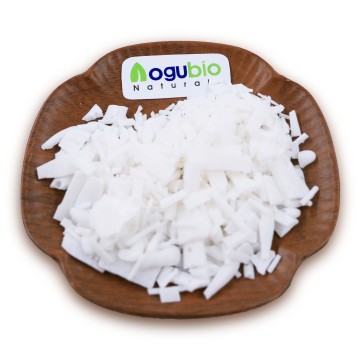 |
Scientific Mechanism for Emulsion Stabilization Supported
The core stabilization capability originates from its unique molecular structure dominated by 12-hydroxystearate triglyceride, carrying abundant side-chain hydroxyl groups capable of reversible hydrogen bonding between molecules. When added into oil phase and heated above its melting point (82~88℃), wax molecules fully disperse homogenously; during emulsion cooling, intermolecular hydrogen bonds crosslink to build continuous three-dimensional colloidal network inside oil droplets, locking dispersed water-phase droplets physically to restrain droplet aggregation, floating and sedimentation, fundamentally improving emulsion shelf stability.
Cited Research Literature Sources & Core Test Data:
- Bregni C, et al. Stability of Lipogels with Low Molecular Mass Gelators and Emollient Oils, Journal of Dispersion Science and Technology, 2010, 31(4):488-495. Research group configured W/O cosmetic emulsions with 0.5%~2.0% dosage of hydrogenated castor oil wax; after 3-month accelerated storage under 40℃ constant temperature and 5 freeze-thaw cycles (-18℃↔45℃), test groups showed zero layering, while blank control emulsions without wax completely split into oil and water layers within 30 days. Centrifugal test (3000r/min, 30min) confirmed wax-containing emulsions had no free oil precipitation.
- European Cosmetic Raw Material Research Report, International Journal of Cosmetic Science, 2018, Vol40:211-218. Laboratory comparison test between castor wax and Candelilla Wax: same addition proportion (1.2%) in O/W moisturizing lotion, hydrogenated castor oil wax reduced emulsion droplet coalescence rate by 72%, superior to conventional plant wax commonly used for thickening stabilization.
- Formulation research from German Personal Care R&D Institute (2021): Wax forms thixotropic pseudoplastic rheology in emulsion base; under static storage, network structure stays intact to fix dispersion phase, under external stirring or skin coating shear force, network temporarily breaks for smooth spreading, solving contradiction between long-term stability and comfortable spreadability of finished products.
Core Product Advantages for Cosmetic Formulation
- Outstanding oxidative stability: Iodine value ≤5.0 after full hydrogenation, nearly no unsaturated double bonds, avoids rancidification and yellow discoloration of emulsion base caused by auto-oxidation of unsaturated grease, effectively prolongs finished product shelf life compared with raw castor oil (iodine value 82~90).
- Excellent compatibility: Miscible with almost all plant waxes (beeswax, Carnauba Wax), synthetic grease, nonionic/anionic emulsifiers and cosmetic active components; no flocculation or precipitation occurs after compounding, flexible to adjust formula hardness and emulsion viscosity per product demand.
- Mild skin-friendly property: Non-comedogenic in regular dosage, low skin irritation index verified by patch tests, applicable for sensitive-skin targeted formulations; meanwhile delivers mild occlusive emollient effect to reduce transepidermal water loss of skin without heavy greasy residue.
- Low effective dosage threshold: Effective stabilizing dosage ranges 0.3%~2.5% in most emulsion formulas, lower addition vs synthetic polymeric thickening stabilizer, optimizes formula cost control for manufacturers.
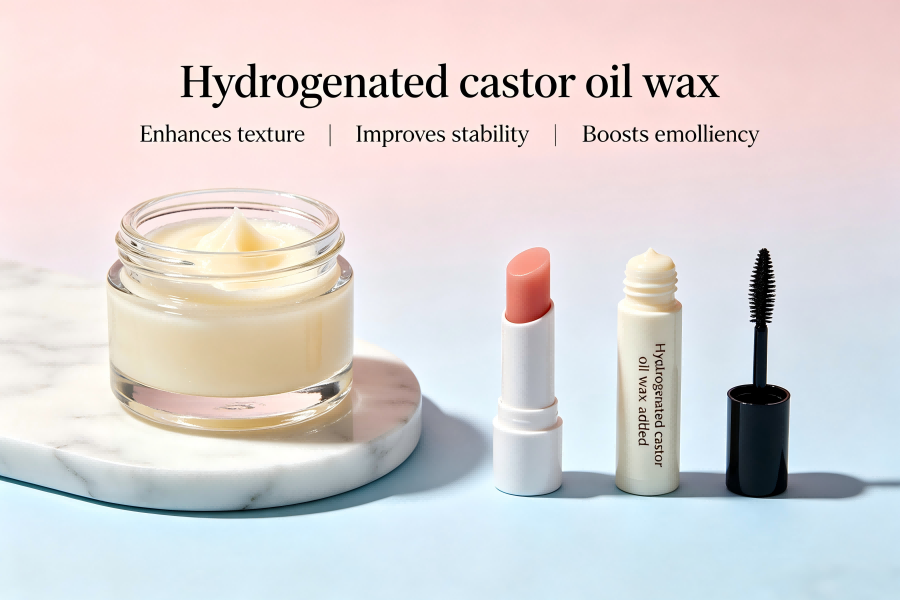
Detailed Application in Cosmetic Fields Based on Stabilizing FunctionSkin Care Emulsions & Creams (W/O & O/W system)
Added at 0.4%~1.8% into oil phase of moisturizing cream, repair ointment and body lotion, mainly stabilize W/O cold-process emulsions prone to water precipitation; for high-activity O/W essence lotion with plant extracts or VC derivatives, wax network wraps unstable polar actives to avoid ingredient decomposition triggering emulsion turbidity and layering. It also improves cream ductility, prevents product shrinkage after long-term storage.
Color Cosmetic Formulations
- Lipstick & lip balm (10%~18% addition): Build skeleton structure to avoid lipstick bending or oil bleeding, lock pigment dispersion uniformly to prevent color layering and pigment precipitation during high-temperature transportation; cooperates with carnauba wax to upgrade product surface gloss.
- Mascara & eyeliner cream (1.2%~3%): Stabilize carbon black pigment suspension system, eliminate pigment sedimentation at bottle bottom after long-term placement, enhance film-forming adhesion on eyelashes.
- Cream eyeshadow & blush: Fix powder pigment inside wax network to inhibit solid-liquid separation of cream base.
Rinse-off Hair Care Products
Compound with alkyl polyglycoside surfactant for shampoo and body wash, stabilize opacifier wax dispersion to prevent opacifier particle agglomeration and bottom sedimentation in low-viscosity cleansing formulas, maintains uniform milky appearance throughout product validity period.
Frequently Asked Questions (FAQ)
Q1: Can Hydrogenated Castor Oil Wax dissolve directly in water phase for O/W lotion production?
A: No, the wax is lipophilic non-water-soluble raw material; standard processing: heat wax together with other oil-phase raw materials to 85~90℃ for full melting, then add melted oil phase into preheated water phase under high-speed homogenization, complete emulsification and cooling forming stable network structure. Wrong water-phase addition leads to undissolved wax particles suspended in finished lotion, triggering granular foreign matter defect.
Q2: What causes excessive stickiness of finished emulsion after adding castor wax? How to adjust?
A: Overdosage (exceed 3% in regular cream formula) is primary reason; optimization plan: cut wax dosage to 0.5%~1.2%, partially replace wax with low-viscosity synthetic ester oil or jojoba oil to balance stability and skin feel; compound small amount of candelilla wax to reduce formula stickiness while retaining stabilizing performance.
Q3: Is this wax suitable for transparent water-soluble essence formulas?
A: Not applicable for fully transparent aqueous formulas; choose ethoxylated derivative PEG-40 Hydrogenated Castor Oil as solubilizer instead; raw castor wax only works for opaque cream, paste and waxy stick products needing emulsion stabilization.
Q4: Will castor wax cause acne breakout on oily skin in finished skincare products?
A: Standard addition (below 2%) is non-comedogenic per cosmetic safety data; acne risk only emerges when formula total occlusive wax content exceeds 8% or oily formula matches acne-prone skin positioning; reduce wax dosage or blend light-weight silicone oil for oily-skin targeted formulas.
Q5: How to improve low-temperature stability of outdoor sunscreen cream with castor wax?
A: Fix wax dosage at 1.0%~1.5%, compound 0.3%~0.6% microcrystalline wax; finished product passes -20℃ low-temperature storage test without water precipitation and emulsion cracking.
Conclusion
Hydrogenated Castor Oil Wax is an economical, safe and high-efficiency natural stabilizer to upgrade cosmetic emulsion stability. Relying on hydrogen-bonded three-dimensional network structure, it solves mainstream formulation bottlenecks including emulsion layering, pigment precipitation and thermal instability across skincare, color cosmetics and rinse-off care categories. Rational dosage control and scientific feeding process can maximize its stabilizing advantages while optimizing finished product texture, making it an irreplaceable basic wax for modern cosmetic R&D.
Media Contact
Company Name: Xi’an Aoge Biotech Co., Ltd.
Email: Send Email
Country: China
Website: https://www.aogebio.com/