
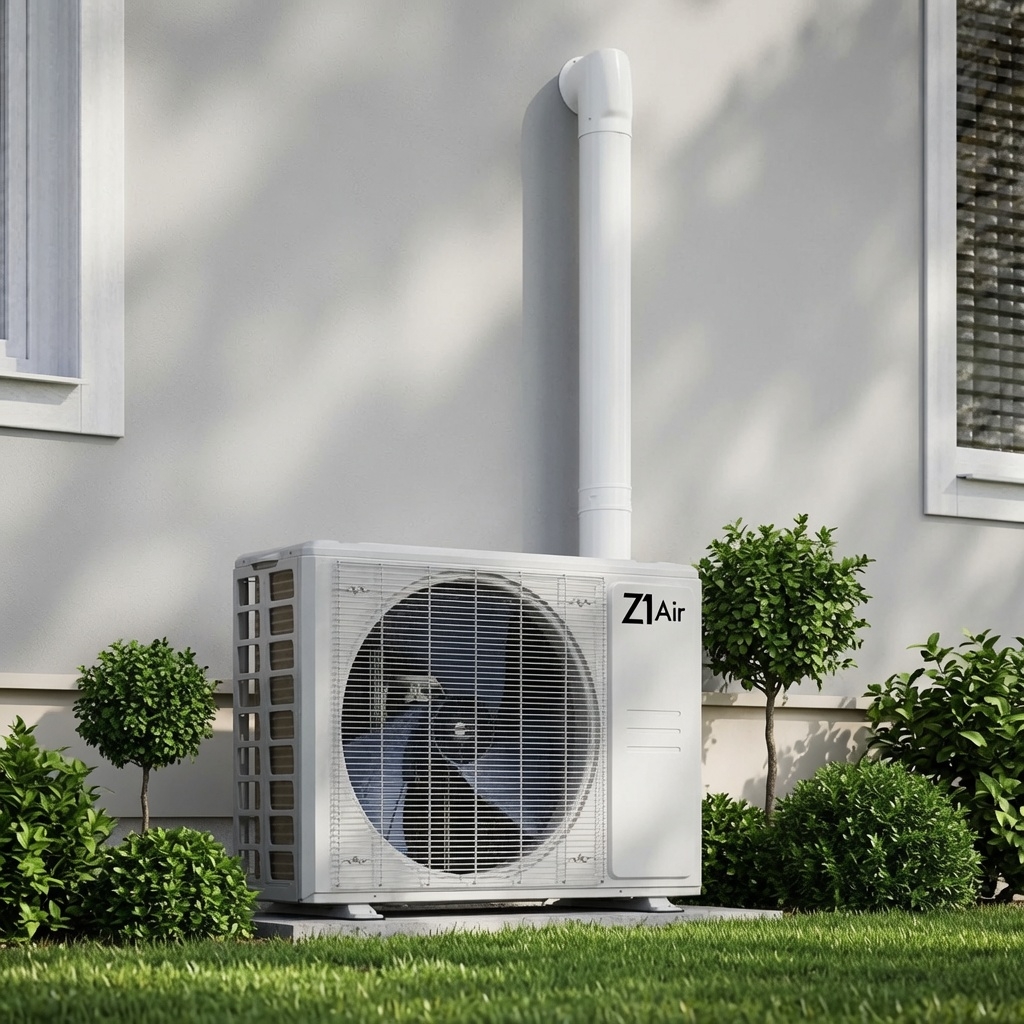
Zone Air, a direct-to-consumer manufacturer of DIY ductless mini split heat pumps, released findings this week from installation quotes collected from its customers throughout 2025: the average Zone Air customer saved more than $3,000 by installing their own mini split system, making Zone Air DIY systems one of the most affordable mini splits on the market.The findings land amid a structural shift in U.S. home heating and cooling. According to AHRI shipment data, air-source heat pumps outsold gas furnaces for the fourth consecutive year in 2025, with manufacturers shipping roughly 3.6 million heat pumps against 3.2 million gas warm-air furnaces.
The company published the data alongside an expanded 2026 guide to DIY mini splits covering system sizing, installation time, line-by-line cost comparisons, and configuration selection available at https://zone-air.com/solutions/diy-mini-splits/.
Every Zone Air DIY mini split ships with a pre-charged R-454B quick-connect line set, so the refrigerant circuit stays factory-sealed from the warehouse to the finished installation. No vacuum pump, no manifold gauges, and no refrigerant handling are needed at any point. Systems range from 9,000 to 30,000 BTU, reach up to 24 SEER2, heat down to −13°F, and start at $1,899.99. The 9,000 and 12,000 BTU wall-mount models plug into a standard 115V household outlet, and most first-time installers complete a single-zone installation in 4 to 8 hours with basic hand tools.
How Much Does a DIY Mini Split Save vs Contractor Installation?
Labor is the largest cost in a residential mini split project. Quotes gathered from Zone Air customers in 2025 put typical contractor labor at $1,500 to $3,000 per zone — before equipment, and before the specialized tools a traditional installation requires. A conventional flare-fitting mini split needs a vacuum pump and gauge set ($400 to $1,800), manifold gauges ($100 to $300), and a flaring tool ($60 to $150). It also requires evacuating the line set to below 500 microns and pressure-testing with nitrogen before the system can run.
A pre-charged quick-connect system removes every one of those steps. The 16-foot line set arrives loaded with R-454B refrigerant at proper pressure, factory pressure-tested. The installer routes the line, hand-tightens the couplings, and torques them to spec.
“Labor is the single line item a pre-charged system takes off the invoice,” said [Name, Title] at Zone Air. “The homeowner who hangs the indoor unit, sets the condenser on a pad, and torques two quick-connect fittings has done the same mechanical work a crew would have charged thousands for. The 2025 quote data shows exactly what that’s worth: over $3,000 on the average project.”
According to the company’s 2026 cost analysis, a self-installed Zone Air 12,000 BTU system totals roughly $2,400 to $2,700 — including an electrician’s visit where one is needed — compared with $5,200 to $7,800 for a comparable contractor-installed system.
Pre-Charged R-454B Line Sets: What Makes a Mini Split Truly DIY
Many mini splits marketed as DIY-friendly still assume professional tools somewhere in the process. Zone Air’s 2026 guide identifies the features that determine whether a homeowner can realistically complete the job alone:
– A pre-charged, factory-sealed line set. The refrigerant circuit never opens during installation, which is what eliminates the vacuum pump, gauges, and evacuation work.
– Quick-connect fittings. Couplings hand-tighten and torque to spec with ordinary wrenches. No flaring, no brazing.
– 115V plug-and-play options. Zone Air’s 9,000 and 12,000 BTU wall mounts run on a standard 15-amp household outlet — no new circuit for most single-room projects. Larger systems use a dedicated 230V circuit, which most homes with central air or an electric dryer have spare panel capacity to support.
– Complete kits. Each system ships with the indoor air handler, outdoor condenser, pre-charged line set, communication cable, remote, and WiFi module in one order.
How Long Does It Take to Install a DIY Mini Split?
The 2026 guide breaks a first-time, single-zone wall-mount installation into stages: mounting the indoor bracket and unit (60 to 90 minutes), drilling the wall penetration (30 to 60 minutes), placing the outdoor unit (45 to 60 minutes), connecting the line set (30 to 45 minutes), electrical work (30 minutes to 2 hours depending on the model), and commissioning (15 to 30 minutes). Most first-timers finish in 4 to 8 hours; repeat installers commonly finish a single-zone system in about 4 hours. Dual-zone projects run 8 to 14 hours.
The guide is equally direct about the most common installation error the company sees: kinked line sets. A small kink that gets straightened out may not leak immediately, but it can leak slowly over time — and a system that runs low on refrigerant for months can fail early. Zone Air’s guidance is to keep every bend gentle and wide, and to replace a kinked line set outright rather than straightening it and hoping.
“We’d rather publish the mistakes than pretend they don’t happen,” said [Name, Title]. “A homeowner who knows the one thing that actually causes failed DIY installs — a kinked line — is in better shape than one who’s only seen a highlight reel. That honesty is also why our support team can usually walk a stuck installer through to a running system the same day.”
What Size DIY Mini Split Do You Need?
Oversizing is the more expensive of the two common purchasing mistakes — an oversized unit short-cycles and runs less efficiently. The guide’s starting rule is 20 BTU per square foot: 9,000 BTU for rooms of roughly 200 to 350 square feet, 12,000 BTU for 350 to 550 square feet, and 18,000 BTU for 600 to 850 square feet, with adjustments for sun exposure, ceiling height, and kitchen heat. A free sizing calculator at zone-air.com returns a BTU recommendation in about a minute.
DIY Mini Split Efficiency: SEER2 Ratings, Cold-Climate Heating, and 2026 Rebates
Zone Air’s 2026 lineup reaches up to 24 SEER2 on 230V models, with 115V units rated 23 SEER2, and every system heats down to −13°F for cold-climate use. Inverter-driven compressors modulate output rather than cycling on and off, holding room temperature steady with indoor sound levels as low as 26 dB. Replacing two older 10 SEER window units with a single 12,000 BTU system in a 400-square-foot room can cut cooling costs by 50 to 60 percent.
While the federal 25C tax credit expired December 31, 2025, many state and utility rebate programs remain active in 2026, and Zone Air maintains a rebate calculator searchable by zip code. Every system includes WiFi control out of the box, with compatible models supporting Amazon Alexa and Google Assistant voice control.
115V Plug-In Models and When to Hire an Electrician
The guide is explicit that DIY does not mean doing everything alone. The 115V wall mounts plug in with no electrical work at all. For 230V systems, homes that need a new circuit, a panel upgrade, or that have older wiring should hire a licensed electrician for that portion — typically $300 to $600 — while the homeowner completes the mechanical installation. That hybrid approach still saves $1,000 to $1,800 or more versus a full professional installation.
The 2026 DIY Mini Split Lineup: Warranty, Returns, and Free Shipping
Zone Air’s 2026 DIY lineup spans single-zone wall mounts, ceiling cassettes, and concealed-duct units from 9,000 to 30,000 BTU, plus dual-zone bundles from $3,299 that run two independently controlled indoor heads off one condenser. Single-zone systems start at $1,899.99.
Self-installation does not void coverage: Zone Air backs DIY installations with the same 5-year parts and 7-year compressor warranty as professionally installed systems, for the original purchaser with proof of purchase and with no registration requirement. Uninstalled systems carry a 30-day return window (restocking fee applies), all orders ship free to the 48 contiguous United States, and U.S.-based support is available to installers mid-project. Zone Air systems average 4.8 out of 5 stars across 133 verified customer reviews as of 2026.
The complete 2026 resource, sizing calculator, step-by-step installation guide, DIY-versus-contractor cost tables, and single-, dual-, and multi-zone configuration guidance is available at https://zone-air.com/.
About Zone Air
Zone Air is a direct-to-consumer brand that manufactures and sells DIY ductless mini split heat pumps engineered for homeowner installation. Every Zone Air system includes a pre-charged R-454B quick-connect line set, WiFi control with Alexa and Google Assistant compatibility, and cold-climate heating rated to −13°F.
Media Contact
Company Name: Zone Air
Contact Person: Cliff Westonhall
Email: Send Email
Country: United States
Website: https://zone-air.com/